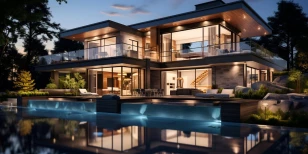

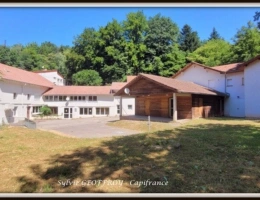
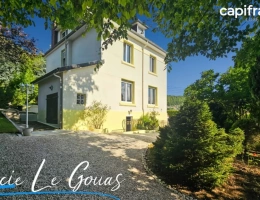
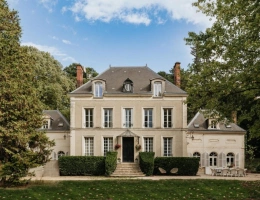
A maison de maître for sale in Moselle often stands in golden Jaumont stone, with tall windows, front steps and a hipped roof: it is the home of the notables of Metz, of glass and crystal masters, of the industrialists of Sarreguemines and of the ironmasters of the Fensch valley. This section readily goes beyond that frame: it gathers all the fine residences of Moselle, Wilhelmine villas, bourgeois houses, country houses and architect-designed properties, that exceed 300 m² or approach a million euros without being chateaux, manor houses or historic monuments. Here you can consult the maisons de maître and fine residences for sale posted by private owners, agencies and notaries in Moselle.
This page describes the profile of the large residences on sale, the buildings of German-speaking Lorraine and the Lorraine plateau, the areas from Metz to the Bitche country and the checks to know about, including local law. Our guide to buying prestige property in France completes the process step by step. Every section is drawn from local conditions.
Maisons de maître form the core of the segment tracked by our observatory: houses with more than 300 m² of living space on 0.05 to 10 ha, sold above €1,000 per m², recorded in the DVF database of the French tax administration. These benchmarks frame the market for large residences without describing it entirely: a small village bourgeois house or a chateau sold with 30 ha of parkland fall outside this scope.
DVF statistics do not cover this department, which is governed by the Livre foncier land register: only figures for the Grand Est region are given. Across the Grand Est region, the 2021-2025 median stands at €550,000 (149 sales), against €822,000 in France in 2025 (981 sales).
| Scope | Sales | Median price | Floor – ceiling (P10–P90) | €/m² living space (median) |
|---|---|---|---|---|
| Grand Est (2021-2025) | 149 | €550,000 | €371,900 – €892,000 | 1,475 |
| France (2025) | 981 | €822,000 | €428,000 – €3,100,000 | 2,308 |
The breakdown by stratum (coastal, rural tourist, ordinary rural) and the five-year trend are in our observatory of prestige property prices in France (in French). Before making an offer, work out purchase costs and borrowing capacity with our financial tools and calculators.
Source: DVF (DGFiP), transactions from 1 January 2021 to 31 December 2025, processed by ma-propriete.fr; prices rounded to the nearest €100.
As of 28 September 2026, the section lists 267 properties in France (the section does not yet have enough listings in Moselle for a reliable calculation) at a median asking price of €978,000 (average €1,520,334); 80% of properties are offered between €485,000 and €2,750,000, for a median living space of 372 m² on 1.0 hectare of land, or €2,864 per m² of living space. These are asking prices, before negotiation; they compare with the actual sale prices in the previous section, which are generally lower.
| Asking price | Listings | Share |
|---|---|---|
| under €500,000 | 33 | 12 % |
| €500,000 to €800,000 | 58 | 22 % |
| €800,000 to €1.2M | 70 | 26 % |
| €1.2M to €2M | 67 | 25 % |
| €2M to €5M | 31 | 12 % |
| over €5M | 8 | 3 % |
Statistics calculated on the listings published in the section on 28 September 2026; they change daily with new listings and withdrawals.
Jaumont stone, a golden-yellow limestone quarried near Metz, clads the façades of the large houses of the Metz country, with regular bays and moulded cornices. Between 1871 and 1918, the German annexation left Metz, Thionville and Sarreguemines with neo-Romanesque and neo-Renaissance villas, with carved gables, turrets and stained glass, whose build quality remains remarkable. In the Bitche country and around Sarreguemines, pink sandstone and coloured brick mark the homes of faience and glass industrialists. Contemporary villas in parkland are found mostly near Metz and Luxembourg. The masonry of the Wilhelmine period stands apart from buildings of the same date elsewhere in France.
Outbuildings include stables, coach houses, a brewery vat house, a caretaker's cottage, a greenhouse, an orangery and a summer pavilion, sometimes a dovecote in converted manorial farms. Inside, you find mosaic tiles, faience stoves, dark panelling and Jugendstil-style stained glass. Ceiling heights often exceed three metres. Some attics still hold their original roof timbers, which deserve careful examination. Cellars are often deep and dry, a legacy of careful German-era construction.
Around Metz, the Seille valley, the Val de Metz and the slopes of Lorry-lès-Metz, Plappeville and Ars-sur-Moselle gather maisons de maître and villas with views of the cathedral. Thionville and the Pays-Haut, from Yutz to Hettange-Grande, attract a clientele tied to Luxembourg. Towards the east, Sarreguemines, Forbach and Saint-Avold offer industrialists' homes, while the Saulnois, around Vic-sur-Seille, and the pond country towards Sarrebourg provide village houses and large farm complexes. The Bitche country remains the most wooded and the calmest. Villages along the Nied and the Saar offer discreet estates that seldom reach the public market.
Metz is served by the TGV to Paris, and Lorraine TGV station adds to the offer; Thionville and Forbach have regional links towards Luxembourg and Germany. The A4, A31 and A320 structure the road network. Luxembourg, the Saarland and Germany, all close by, explain the presence of many cross-border buyers in the north of the department.
Moselle falls under the local law of Alsace-Moselle: ownership is recorded in the Land Register, kept by the judicial court, and the notarial deed follows its own rules, notably for mortgages, publicity and the clearing of certain charges. Ask for a recent Land Register extract and check with the notary the exact nature of the rights of way, easements and old charges attached to the plot. The religious regime, building-damage insurance and the extra public holiday do not affect the sale, but local taxation deserves an explanation. Sellers can usually provide the previous surveys, and these are worth reading in full.
In the coalfield and the Pays-Haut, former mines require consulting the mining-risk prevention plans; radon and the clays of the plateaux call for surveys. The large stained-glass windows, roof timbers and slate roofs of Wilhelmine villas need an expert inspection, and the protected districts of Metz subject façades and joinery to authorisation. On a recent villa, check the permit, the pool and the drainage. A building surveyor knows how to spot such defects.
Private owners, agencies and notaries in Moselle offer their residences on ma-propriete.fr; refine the search by living space, outbuildings and land, then create an alert to follow every new listing. To open the search to the rest of the territory, explore the maisons de maître and fine residences for sale in Grand Est.