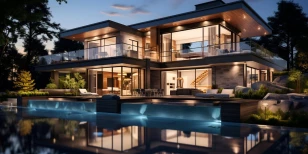

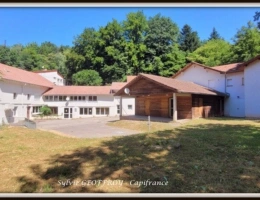
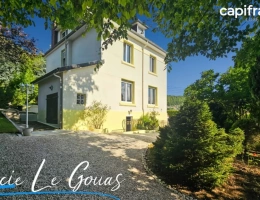
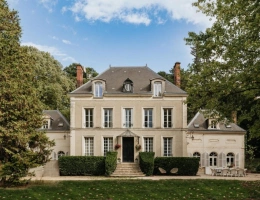
The maison de maître for sale in Meuse is recognised by its pale yellow stone, its orderly façade and its tall casement windows: it housed the notables of Bar-le-Duc, Verdun, Commercy and Saint-Mihiel, magistrates, merchants, brewers and the ironmasters of the Ornain and Meuse valleys. Here the section reaches beyond that single type: it welcomes every fine residence of the department that exceeds 300 m² or whose price comes close to a million euros, whether a bourgeois house, an untitled country seat, a villa or an architect-designed home, provided it falls outside the categories of chateaux, manor houses and historic monuments. Here are the maisons de maître and fine residences for sale placed by private owners, agencies and notaries in Meuse.
On this page you will find real price benchmarks, the kind of properties on sale today, the character of Meuse buildings between the Woëvre, the Argonne and the Meuse hills, the areas to explore and the checks specific to the department. Our guide to buying prestige property in France then accompanies you, step by step, as far as the preliminary sale agreement. Each section is written from the local market, not from a national template.
Maisons de maître form the core of the segment tracked by our observatory: houses with more than 300 m² of living space on 0.05 to 10 ha, sold above €1,000 per m², recorded in the DVF database of the French tax administration. These benchmarks frame the market for large residences without describing it entirely: a small village bourgeois house or a chateau sold with 30 ha of parkland fall outside this scope.
The local market is too thin to publish a reliable department-level benchmark (7 sales in five years): we give the figures for the Grand Est region. Across the Grand Est region, the 2021-2025 median stands at €550,000 (149 sales), against €822,000 in France in 2025 (981 sales).
| Scope | Sales | Median price | Floor – ceiling (P10–P90) | €/m² living space (median) |
|---|---|---|---|---|
| Grand Est (2021-2025) | 149 | €550,000 | €371,900 – €892,000 | 1,475 |
| France (2025) | 981 | €822,000 | €428,000 – €3,100,000 | 2,308 |
The breakdown by stratum (coastal, rural tourist, ordinary rural) and the five-year trend are in our observatory of prestige property prices in France (in French). Before making an offer, work out purchase costs and borrowing capacity with our financial tools and calculators.
Source: DVF (DGFiP), transactions from 1 January 2021 to 31 December 2025, processed by ma-propriete.fr; prices rounded to the nearest €100.
As of 28 September 2026, the section lists 267 properties in France (the section does not yet have enough listings in Meuse for a reliable calculation) at a median asking price of €978,000 (average €1,520,334); 80% of properties are offered between €485,000 and €2,750,000, for a median living space of 372 m² on 1.0 hectare of land, or €2,864 per m² of living space. These are asking prices, before negotiation; they compare with the actual sale prices in the previous section, which are generally lower.
| Asking price | Listings | Share |
|---|---|---|
| under €500,000 | 33 | 12 % |
| €500,000 to €800,000 | 58 | 22 % |
| €800,000 to €1.2M | 70 | 26 % |
| €1.2M to €2M | 67 | 25 % |
| €2M to €5M | 31 | 12 % |
| over €5M | 8 | 3 % |
Statistics calculated on the listings published in the section on 28 September 2026; they change daily with new listings and withdrawals.
Meuse limestone, including the famous stone of Euville and Sorcy, produces pale yellow façades with moulded string courses, quoins and carefully cut window surrounds. In Bar-le-Duc, the Upper Town preserves Renaissance and eighteenth-century mansions; in the Lower Town, the nineteenth century left large bourgeois houses under slate roofs. After the First World War, Verdun and the villages of the Woëvre and the Argonne were rebuilt in brick and stone, with notables' houses in a neo-regional style with decorated gables. Around the lakes and on the edge of Bar-le-Duc, finally, there are recent villas on large plots.
Annexes accompany the house: service buildings, stables, a barn, a vaulted cellar, a caretaker's cottage, a dovecote, a greenhouse. The park, often walled with dry stone, shelters lime and beech trees and sometimes an old kitchen garden. Inside, wrought-iron banisters, cement floor tiles, parquet and marble fireplaces testify to a bourgeois comfort that often survived the bombardments. Many owners have kept the original iron gates and the boundary walls, which contribute to the character of the street front and should be maintained.
The Barrois, around Bar-le-Duc and Ligny-en-Barrois, concentrates the town mansions and maisons de maître of the Ornain and Saulx valleys. The Verdun area and the Meuse hills, from Verdun to Dieue and Saint-Mihiel, offer large homes with views over the valley; further south, Commercy, Void-Vacon and Vaucouleurs provide notables' houses on more accessible terms. The north of the department, around Stenay, Montmédy and Dun-sur-Meuse, remains the most rural, with broad properties to renovate beside the river.
The Meuse TGV station, on the plateau between Bar-le-Duc and Verdun, reaches Paris in about an hour, which draws Paris-region buyers looking for second homes. The A4 crosses the department and the A31 passes further east, near Toul, towards Nancy and Metz. For a second home, the calm of the Woëvre villages and the light traffic on the roads weigh as much as the journey time from the capital.
Around Verdun, part of the communes lie in the red zone or in areas exposed to war remnants: the presence of unexploded shells, soil pollution and building restrictions should be checked with the town hall and the prefecture before any purchase. The notables' houses rebuilt between the wars deserve an inspection of roof timbers, renders and roof waterproofing, sometimes done with emergency materials. Vaulted cellars, frequent in the Barrois, are prone to damp and occasionally to seepage.
The Lorraine regional nature park and the protected sites of the Meuse valley require the opinion of the architect of the Bâtiments de France on visible façades, fences and outbuildings. On a contemporary villa, verify that the extension, the pool and the private drainage comply with the permit issued. The clays of the Woëvre, which swell in winter, justify a soil study before any enlargement. Ask the seller for the survey history of the roof and of any water ingress, and keep the reports with the deed.
On ma-propriete.fr, private owners, agencies and notaries in Meuse publish their residences; filter by living space, outbuildings and plot size, and switch on an alert to receive each new listing. Do you want to compare with neighbouring Lorraine or Alsace? Browse the maisons de maître and fine residences for sale in Grand Est.