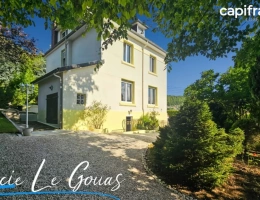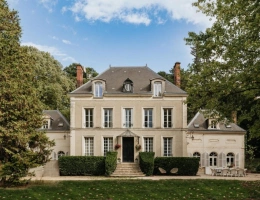
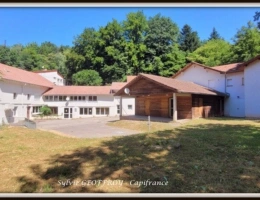
A luxury property for sale in Grand Est crosses several distinct building identities: a Champagne chateau surrounded by vines near Reims and Épernay, a Lorraine master house in ochre Jaumont stone around Metz and Nancy, a fortified farmhouse in the Ardennes, a gentleman's residence in the Vosges at the foot of the fir forests. The region thus brings together farming plains, vineyards and forest ranges within a single set of large residences. Browse every luxury property for sale listed by private owners, specialist agencies and notaries across the region.
This page sets out real price benchmarks for the region, a tour of the Champagne, Lorraine and Vosges areas where large residences cluster, the traits of local buildings and the checks worth making before buying in wine country, forest land or a border area. To prepare your project, read our guide to buying prestige property in France.
Our observatory tracks, in the DVF land registry data published by the French tax administration, sales of houses over 300 m² of living space on 0.05 to 10 ha of land, above €1,000/m²: chateaux, manor houses, master houses, villas and large rural residences. The benchmarks below are based on these actual sales, after removal of outliers; an estate of more than 10 ha or a listed monument sold with its farmland is excluded.
In Grand Est, 149 sales of luxury properties were recorded in 2021-2025. The median price stands at €550,000, with an average of €600,800; the floor/ceiling range (P10–P90) runs from €371,900 to €892,000 and the median price per square metre of living space reaches €1,475/m² (average 355 m² of living space on 8,007 m² of land). The region sits 33% below the 2025 national median (€822,000 across 981 sales).
| Department | Sales | Median price | Floor – ceiling (P10–P90) | €/m² living space |
|---|---|---|---|---|
| Ardennes (08) | 13 | fewer than 30 sales: not published | — | — |
| Aube (10) | 10 | fewer than 30 sales: not published | — | — |
| Bas-Rhin (67) | — | Livre foncier (no DVF) | — | — |
| Haut-Rhin (68) | — | Livre foncier (no DVF) | — | — |
| Haute-Marne (52) | 6 | fewer than 30 sales: not published | — | — |
| Marne (51) | 36 | €636,000* | €384,800 – €1,123,500 | 1,848 |
| Meurthe-et-Moselle (54) | 57 | €615,000* | €401,000 – €960,700 | 1,700 |
| Meuse (55) | 7 | fewer than 30 sales: not published | — | — |
| Moselle (57) | — | Livre foncier (no DVF) | — | — |
| Vosges (88) | 20 | fewer than 30 sales: not published | — | — |
| Year | Sales | Median price | €/m² living space |
|---|---|---|---|
| 2021 | 35 | €520,000* | 1,532 |
| 2022 | 39 | €476,000* | 1,404 |
| 2023 | 26 | n.p. | — |
| 2024 | 29 | n.p. | — |
| 2025 | 20 | n.p. | — |
These benchmarks place an asking price within its market; they do not replace a valuation of the property itself, whose worth depends on condition, architecture, outbuildings and setting. The breakdown by stratum (coastal, rural tourist, ordinary rural) and the full methodology are in our observatory of luxury property prices in France (in French). Then work out purchase costs and borrowing capacity with our financial tools and calculators, and prepare your project with our guide to buying luxury property in France.
Source: DVF (DGFiP), transactions from 1 January 2021 to 31 December 2025, processed by ma-propriete.fr; prices rounded to the nearest €100. * Fewer than 100 sales: read as an indication only. n.p.: fewer than 30 sales, not published.
In the Marne and the Aube, the Champagne chateau, often built in the nineteenth century by the large wine-trading houses, is recognisable by its vaulted chalk cellars and its attached vine parcels. In the Meurthe-et-Moselle and the Moselle, the master house in ochre-toned Jaumont stone dominates the outskirts of Metz and Nancy, while the Ardennes keeps fortified farmhouses in blue stone, inherited from a turbulent border past. In the Vosges and the Haute-Marne, the grey-stone gentleman's residence, surrounded by conifer forests, remains more discreet.
Traditional outbuildings include chalk quarries and storerooms in Champagne, service wings and orangeries around Lorraine residences, massive barns in the Vosges and the Meuse. In Alsace, in the Bas-Rhin and the Haut-Rhin, large rural residences often combine half-timbering and stone, with farm outbuildings converted into living or reception space.
The Marne holds the most sought-after properties between Reims, Épernay and the Montagne de Reims, at the heart of the Champagne vineyard. The Aube extends this market around Troyes and the Côte des Bar, while the Ardennes, between Charleville-Mézières and Sedan, and the Haute-Marne, around Chaumont and Lac du Der, remain more rural. The Meuse offers forest estates around Verdun and Bar-le-Duc, and the Meurthe-et-Moselle and the Moselle hold most of the large residences around Nancy and Metz. The Vosges, between Épinal and Gérardmer, offer mid-mountain forest properties, and the Bas-Rhin and the Haut-Rhin complete the picture around Strasbourg, Colmar and the Alsace wine route. The Sundgau, in the southern Haut-Rhin, adds a quieter farming pocket close to the Swiss border.
The stations at Reims and Champagne-Ardenne TGV, at Metz and Nancy, at Strasbourg and Colmar, and at Meuse TGV, bring most of the region close to Paris; the Aube and the Haute-Marne, without a TGV station, remain served by Intercités and TER services. The most expensive areas lie in the Champagne vineyard and around Strasbourg; the Ardennes, the Haute-Marne and inland Vosges offer comparable properties at markedly more accessible levels. The A4 and A31 motorways link the region's main cities and ease access to Germany, Belgium and Switzerland.
In Champagne, check the precise appellation classification of the parcels, the SAFER's pre-emption right and any current leases before making an offer on a wine property; on the best slopes, the value of the vines can exceed that of the buildings. In the Vosges and the Meuse, the health of the forest stands, weakened in places, and the sustainable management documents deserve close review. For a listed character residence, sign-off from the Architecte des Bâtiments de France is required before any change to a facade. Where a property lies near the German or Luxembourg border, cross-border tax and inheritance rules can also warrant specific advice.
On the technical side, Champagne's chalk cellars need a specific stability survey, and Jaumont-stone facades, sensitive to frost, call for regular monitoring. In the Bas-Rhin and the Haut-Rhin, old half-timbered frames need checking by a professional before works, given their sensitivity to moisture.
Luxury property listings in Grand Est come from private owners, specialist agencies and notaries; filter them by area, outbuildings, land and property type, then set an e-mail alert to follow new listings. Also browse the chateaux for sale in Grand Est to discover the region's largest residences.