
Before you look for hunting property for sale in Haut-Rhin, bear in mind a rule that sets Alsace apart from the rest of France: buying a wood here does not, as a rule, give you the right to hunt it. Under the local law of Alsace-Moselle, each commune leases out the hunting on the land within its boundaries, in lots and for nine years; there are no ACCA associations, the Verdeille Act does not apply, and only an owner with enough land in one block can reserve the hunting on it. Properties that truly deserve the name hunting estate are therefore few: large forest holdings in the High Vosges, Sundgau properties built around a pond, mountain farms and chalets with their own plots. We list them alongside the hunting estates and grounds for sale across France.
The data section below gives the price benchmarks available, as Alsatian sales, recorded in the livre foncier (the local land register), do not appear in the national DVF database, then the OFB game bag records, fallow deer and chamois included. We then describe the department’s hunting ground, followed by local law, the main point of caution for any buyer.
A hunting estate is rarely valued with a single figure: its price adds up the value of the woodland, the ponds, the buildings and the shooting facilities. The statistics below give benchmarks for wooded land and ponds, based on sales actually recorded.
According to the ma-propriete.fr forest price observatory, built from sales recorded in the French DVF land registry database, no departmental price can be published in Haut-Rhin: Moselle, Bas-Rhin and Haut-Rhin use the Alsace-Moselle land register (livre foncier), so their sales do not appear in DVF. The closest benchmark is Grand Est, calculated on the region’s seven other departments: a median of €5,498/ha in 2025, across 527 sales, with an average of €6,545/ha. Over 2020-2025, the regional median comes to €4,958/ha (2,836 sales), against €4,778/ha nationally.
| Indicator | Grand Est | France |
|---|---|---|
| Median price 2025 | €5,498/ha | €4,936/ha |
| Average price 2025 | €6,545/ha | €6,214/ha |
| Number of sales 2025 | 527 | 6,329 |
| Median price 2020-2025 | €4,958/ha | €4,778/ha |
Nationally, the price per hectare rises with size: the large properties that appeal to hunters sell for more per hectare than medium-sized woods.
| Size of forest sold (France, 2020-2025) | Median price | Number of sales |
|---|---|---|
| 10 to 20 ha | €4,010/ha | 3,161 |
| 20 to 50 ha | €5,330/ha | 1,850 |
| 50 to 100 ha | €6,810/ha | 581 |
| Over 100 ha | €7,361/ha | 320 |
On the listings side, 18 hunting properties are offered on ma-propriete.fr across France as of 2 October 2026, none in Grand Est at that date. Their median asking price is €888,000 for a median size of about 68 ha. These are asking prices for complete properties: they describe the supply on offer more than the average price of a wooded hectare.
Source: DVF (French tax authority), processed by ma-propriete.fr; forests of 1 ha or more, cadastral type woodland; ponds without buildings of at least 2,000 m²; July 2020 to December 2025; Moselle, Bas-Rhin and Haut-Rhin are not covered by DVF. Listings recorded on ma-propriete.fr on 2 October 2026.
The game bag records published by the French Biodiversity Agency (OFB) measure hunting pressure and, indirectly, the presence of big game. In Haut-Rhin, 1,862 red deer were taken in the 2024-2025 season, about 2% of the national total, alongside 10,020 roe deer and 8,652 wild boar.
| Species | 2021-2022 season | 2024-2025 season | Change |
|---|---|---|---|
| Red deer | 1,842 | 1,862 | +1% |
| Roe deer | 10,634 | 10,020 | −6% |
| Wild boar | 15,153 | 8,652 | −43% |
| Fallow deer | 461 | 282 | −39% |
| Chamois | 445 | 351 | −21% |
Source: OFB, wild ungulates network, departmental big game bags (total culls, data published on data.gouv.fr).
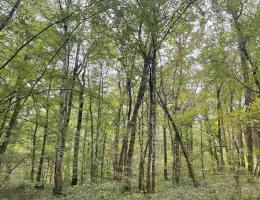
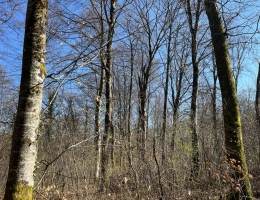
From the Doller and Thur valleys to those of Munster and Kaysersberg, the forest climbs to the open summits of the Grand Ballon, the Markstein and the Hohneck. Silver fir, beech and spruce form large forests here, mostly owned by the communes, where red deer find quiet areas and chamois keep to cliffs and ridges. Both species are subject to the hunting plan; they are hunted on driven days, by stalking and from high seats, on slopes where recovering game and winter access take real organisation. Private properties for sale are usually hillside plots, sometimes with an upland farm or a chalet, where browsing of young fir by red deer deserves a close look.
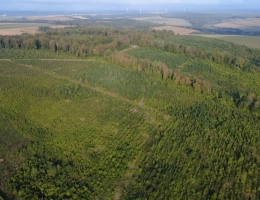
Between Mulhouse and the Rhine, the state-owned Harth forest covers broad, stony terraces; roe deer and wild boar are plentiful, and its hunting lots, let by the Office national des forêts on behalf of the State, never come onto the market. Near Colmar, the Kastenwald forest holds fallow deer, part of a Ried population that extends to the Illwald, among the hunting grounds of Bas-Rhin. To the south, the Sundgau around Altkirch alternates farmed hills, oak and beech woods and carp ponds; towards Ferrette, the Alsatian Jura adds wooded limestone slopes. This is where properties combining woodland and water most often come up, and local law offers an opening: the owner of a pond with at least five hectares of water can reserve the hunting on it. For such properties, see also our ponds and lakes on the market in Haut-Rhin.
In Haut-Rhin, the commune manages the hunting in the name and on behalf of the landowners. It leases it by public auction, by tender or by private agreement with a sitting tenant who meets the conditions, for nine years: the current period runs from 2 February 2024 to 1 February 2033. The rent goes to owners in proportion to their land, unless two thirds of them, holding two thirds of the land, decide to leave it to the commune. To reserve the hunting you need at least 25 ha in one block: a road or a stream does not break continuity, but a fenced motorway or railway that big game cannot cross does. The reserve is never automatic: it must be declared in writing to the mayor at renewal, within ten days of publication of the decision on what to do with the rent, and it lasts for the whole lease.
In practice, a large wood bought today normally stays within the communal lot until 2033, unless the seller had declared a reserve; ask the notaire how that reserve carries on after the sale. A plot of under 25 ha enclosed within a reserved holding can be leased first to the holder of the reserve. Wild boar damage is compensated by a departmental fund financed by holders of hunting rights; damage from red, fallow or roe deer is paid by whoever holds the hunting concerned. Finally, the act of 2 February 2023 applies here as elsewhere: in natural areas a fence must be raised 30 cm off the ground and kept to 1.20 m, with a deadline of 1 January 2027; see our guide to bringing fences up to standard.
Hunting properties in Haut-Rhin on ma-propriete.fr are offered by private sellers, estate agents and Alsatian notaires. The size filter helps you pick out holdings above 25 ha; add an e-mail alert, or list your property if you are selling. If woodland comes first, see our woods and forests for sale in Haut-Rhin; to compare with grounds under ordinary French hunting law, widen your search to the hunting estates for sale in Grand Est.