
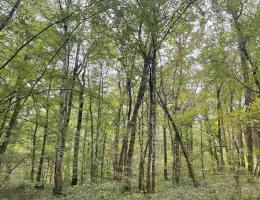
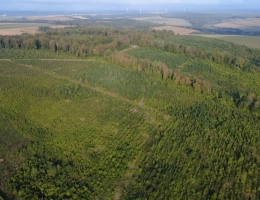
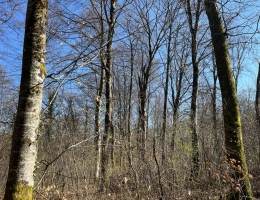
Looking for hunting property for sale in Ardennes means entering a department that has made the wild boar its emblem: Woinic, a giant steel sculpture of the animal, greets drivers on the A34 motorway between Rethel and Charleville-Mézières. In the north, the Ardenne massif, cut through by the Meuse and the Semoy, carries oak, beech, birch and spruce forest right up to the Belgian border. In the centre, the Crêtes préardennaises alternate wooded ridges with pasture; in the west, the Ardennes part of Thiérache mixes hedgerows and woodland; in the south-east, the Argonne extends its forests towards Marne and Meuse. This page brings together the hunting grounds on the market in the department, from hunting woods and forest estates with a house to farmland shoots around Rethel, listed by private sellers, estate agents and notaires.
Forest and pond prices recorded in Ardennes, together with big game culls over recent seasons, are shown just below. Then come our pointers for choosing between the main types of Ardennes ground and the checks to carry out before buying, from the status of the hunting rights to the health of the spruce stands.
A hunting estate is rarely valued with a single figure: its price adds up the value of the woodland, the ponds, the buildings and the shooting facilities. The statistics below give benchmarks for wooded land and ponds, based on sales actually recorded.
According to the ma-propriete.fr forest price observatory, built from sales recorded in the French DVF land registry database, the median price of a hectare of forest in Ardennes was €6,057/ha in 2025*, across 71 sales, with an average of €7,775/ha. That puts the department above the Grand Est median (€5,498/ha) and above the national median (€4,936/ha). Compared with 2024, the median changed by +13.1%, a movement to interpret with care given the number of sales. Over the more robust 2020-2025 period, 325 sales give a median of €5,875/ha for a median plot size of 3.0 ha.
| Indicator | Ardennes (08) | Grand Est | France |
|---|---|---|---|
| Median price 2025 | €6,057/ha* | €5,498/ha | €4,936/ha |
| Average price 2025 | €7,775/ha* | €6,545/ha | €6,214/ha |
| Number of sales 2025 | 71 | 527 | 6,329 |
| Change in median 2024 → 2025 | +13.1%* | +10.9% | +1.9% |
| Median price 2020-2025 | €5,875/ha | €4,958/ha | €4,778/ha |
| Number of sales 2020-2025 | 325 | 2,836 | 35,100 |
Nationally, the price per hectare rises with size: the large properties that appeal to hunters sell for more per hectare than medium-sized woods.
| Size of forest sold (France, 2020-2025) | Median price | Number of sales |
|---|---|---|
| 10 to 20 ha | €4,010/ha | 3,161 |
| 20 to 50 ha | €5,330/ha | 1,850 |
| 50 to 100 ha | €6,810/ha | 581 |
| Over 100 ha | €7,361/ha | 320 |
Ponds trade at a very different level: a median of €33,625/ha for the 20 ponds sold without buildings in Ardennes between 2020 and 2025†, a sample too small to be representative; regionally, the median reaches €30,112/ha.
On the listings side, 18 hunting properties are offered on ma-propriete.fr across France as of 2 October 2026, none in Grand Est at that date. Their median asking price is €888,000 for a median size of about 68 ha. These are asking prices for complete properties: they describe the supply on offer more than the average price of a wooded hectare.
* 30 to 99 sales: indicative value. † 10 to 29 sales: sample too small to be representative of the local market. Source: DVF (French tax authority), processed by ma-propriete.fr; forests of 1 ha or more, cadastral type woodland; ponds without buildings of at least 2,000 m²; July 2020 to December 2025; Moselle, Bas-Rhin and Haut-Rhin are not covered by DVF. Listings recorded on ma-propriete.fr on 2 October 2026.
The game bag records published by the French Biodiversity Agency (OFB) measure hunting pressure and, indirectly, the presence of big game. In Ardennes, 584 red deer were taken in the 2024-2025 season, about 0.6% of the national total, alongside 6,964 roe deer and 7,870 wild boar.
| Species | 2021-2022 season | 2024-2025 season | Change |
|---|---|---|---|
| Red deer | 611 | 584 | −4% |
| Roe deer | 6,895 | 6,964 | +1% |
| Wild boar | 7,951 | 7,870 | −1% |
Source: OFB, wild ungulates network, departmental big game bags (total culls, data published on data.gouv.fr).
From Rocroi to Revin, and from Monthermé to the Croix-Scaille, the highest point, which sits right on the border, forest covers most of the high ground. The Ardennes regional nature park, created in 2011, takes in much of this area. State forests stand alongside large private woods dominated by sessile oak, birch and spruce, the latter planted mainly from the mid-twentieth century, together with coppice left over from the old slash-and-burn practice known as sartage. Red deer and wild boar find large unbroken areas and quiet valleys; hunting is mostly by driven days, on steep slopes where the placing of standings, safe shooting angles and well-kept rides matter as much as game density.
Further west, the Rocroi plateau, a patchwork of coppice, meadows and peaty heaths called rièzes, gives way to the Ardennes part of Thiérache, around Signy-le-Petit and Rumigny, where woods alternate with grazing and hedges on more open ground. Roe deer are everywhere, boar follow the woodland edges and woodcock use the coppice in autumn. Ponds in this area can round off a shoot: see our lakes and ponds for sale in Ardennes.
The Crêtes préardennaises, from Signy-l’Abbaye to Vendresse, are a series of wooded scarps divided by grassy valleys: good country for a medium-sized family hunting wood, shot among neighbours. To the south-east, the Ardennes side of the Argonne, around Grandpré and the Croix-aux-Bois woods, continues the large forest blocks of Marne and Meuse; red deer move freely from one department to the next, which gives real weight to management agreements between neighbouring grounds, as with the hunting estates of Marne. Finally, to the south-west, the Porcien and the Champagne country around Rethel already belong to the plain: there you would look for a small game hunting ground for pheasant, partridge and hare, with a few wooded coverts.
The first issue is the state of the woodland. In the massif, spruce makes up a large share of private woods, and it is highly vulnerable to bark beetle after dry summers. A ground whose spruce stands have been clear-felled changes character: more light and food for game, but less cover and a depleted timber asset. Have the standing volume valued by a forestry expert before negotiating the price.
The second is the hunting rights: ACCA communal hunting associations are not compulsory in Ardennes, but a few municipalities have created one, and a wood of less than 20 ha in a single block within such a commune falls in principle under the association. The department is, however, among those where wildfowl may be shot at night from a fixed hide that existed on 1 January 2000 and has been declared, which matters if you are buying a pond or a valley marsh. The third is fencing: in natural areas, the act of 2 February 2023 requires a 30 cm gap above the ground and a maximum height of 1.20 m, and non-compliant fences put up since 1993 must be altered before 1 January 2027; our article on the anti-fencing act explains the exceptions. Lastly, consider boar damage to nearby grassland and crops: the departmental hunters’ federation pays compensation, but a ground that does not cull enough can be asked to contribute.
The Ardennes hunting properties shown on ma-propriete.fr are posted by private sellers, agents and notaires; sort them by size or price, set up an alert to follow new arrivals and post your own listing if you are selling a shoot. If you are mainly buying woodland, see our forests and woods for sale in Ardennes; to compare with the Meuse side of the Argonne, the Vosges or Alsace, browse the hunting estates for sale in the Grand Est.