
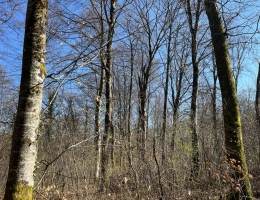
Hunting property for sale in Bas-Rhin is found mainly in the uplands. In the north-west, the Northern Vosges, covered with Scots pine and beech on sandstone, form a cross-border biosphere reserve with Germany’s Pfälzerwald; further south, the Donon massif, the Champ du Feu and the Bruche valley offer large fir and beech forests, red deer country. The plain adds other kinds of ground: the edges of the jointly owned Haguenau forest, the floodplain woods of the Ried and the Rhine, and the woods and farmland of the Outre-Forêt in the far north. On ma-propriete.fr these properties appear among our woods and hunting estates on sale throughout France, whether a hillside forest, a lowland property with a pond or a house surrounded by its own woodland.
The price benchmarks and game bag tables shown just below take one local feature into account: because they are recorded in the livre foncier (the Alsace-Moselle land register), sales in Bas-Rhin are missing from the national DVF database. The rest of the page describes the department’s forests, then the hunting regime specific to Alsace-Moselle, with no ACCA associations and no Verdeille Act, which decides what you will actually be able to hunt.
A hunting estate is rarely valued with a single figure: its price adds up the value of the woodland, the ponds, the buildings and the shooting facilities. The statistics below give benchmarks for wooded land and ponds, based on sales actually recorded.
According to the ma-propriete.fr forest price observatory, built from sales recorded in the French DVF land registry database, no departmental price can be published in Bas-Rhin: Moselle, Bas-Rhin and Haut-Rhin use the Alsace-Moselle land register (livre foncier), so their sales do not appear in DVF. The closest benchmark is Grand Est, calculated on the region’s seven other departments: a median of €5,498/ha in 2025, across 527 sales, with an average of €6,545/ha. Over 2020-2025, the regional median comes to €4,958/ha (2,836 sales), against €4,778/ha nationally.
| Indicator | Grand Est | France |
|---|---|---|
| Median price 2025 | €5,498/ha | €4,936/ha |
| Average price 2025 | €6,545/ha | €6,214/ha |
| Number of sales 2025 | 527 | 6,329 |
| Median price 2020-2025 | €4,958/ha | €4,778/ha |
Nationally, the price per hectare rises with size: the large properties that appeal to hunters sell for more per hectare than medium-sized woods.
| Size of forest sold (France, 2020-2025) | Median price | Number of sales |
|---|---|---|
| 10 to 20 ha | €4,010/ha | 3,161 |
| 20 to 50 ha | €5,330/ha | 1,850 |
| 50 to 100 ha | €6,810/ha | 581 |
| Over 100 ha | €7,361/ha | 320 |
On the listings side, 18 hunting properties are offered on ma-propriete.fr across France as of 2 October 2026, none in Grand Est at that date. Their median asking price is €888,000 for a median size of about 68 ha. These are advertised prices for whole properties, sometimes with a house or a pond, not recorded sale prices per hectare like those in the DVF database.
Source: DVF (French tax authority), processed by ma-propriete.fr; forests of 1 ha or more, cadastral type woodland; ponds without buildings of at least 2,000 m²; July 2020 to December 2025; Moselle, Bas-Rhin and Haut-Rhin are not covered by DVF. Listings recorded on ma-propriete.fr on 2 October 2026.
The game bag records published by the French Biodiversity Agency (OFB) measure hunting pressure and, indirectly, the presence of big game. In Bas-Rhin, 2,016 red deer were taken in the 2024-2025 season, about 2% of the national total, alongside 9,906 roe deer and 14,213 wild boar.
| Species | 2021-2022 season | 2024-2025 season | Change |
|---|---|---|---|
| Red deer | 2,080 | 2,016 | −3% |
| Roe deer | 14,623 | 9,906 | −32% |
| Wild boar | 21,917 | 14,213 | −35% |
| Fallow deer | 77 | 88 | +14% |
Source: OFB, wild ungulates network, departmental big game bags (total culls, data published on data.gouv.fr).
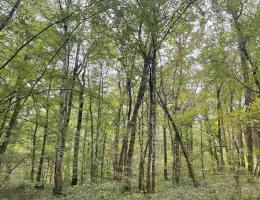
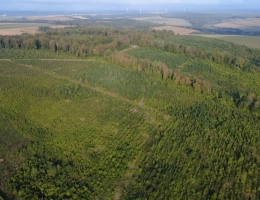
In the Northern Vosges, from La Petite-Pierre to Niederbronn-les-Bains, sandstone forests follow one another over hills cut by narrow valleys, and red deer move freely across the German border. Further south, the Donon massif, shared with the hunting grounds of Moselle, and the heights of the Champ du Feu carry fir and beech forests where the stags can be heard roaring every autumn. The Donon and Schneeberg ridges, a special protection area for the capercaillie, also call for particular care over forestry work and hunting. Communal and state forests take up much of this upland: private properties for sale are often hillside plots, sometimes a holding of several dozen hectares with a chalet, rarely in one block. Fir stands strained by recent droughts and steep slopes weigh on timber value as much as on the hunting.
The Haguenau forest, owned jointly by the State and the town, dominates the north of the plain with Scots pine and oak on sandy soils; its hunting lots are not for sale, but they shape the neighbourhood of the private woods around it. In the centre, between Strasbourg and Sélestat, the Ried combines flood meadows, reed beds and floodplain forest. The Illwald, near Sélestat, holds the historic fallow deer population of Alsace, reintroduced in the 19th century, which also occurs towards Marckolsheim and as far as the Kastenwald, among the hunting estates of Haut-Rhin. Lowland grounds are smaller, busier and often close to villages: a hunting ground there is valued above all for its quiet and its continuity.
In Alsace-Moselle, the hunting right still belongs to the landowner, but the commune exercises it on the owners’ behalf and leases it in lots for nine years, currently from 2 February 2024 to 1 February 2033. Public auction is the rule; a tender or a private agreement with the sitting tenant are also allowed. In Bas-Rhin, the standard lease terms set a minimum lot size of two hundred hectares and require a tenant who is a private individual to live within one hundred and twenty kilometres of the commune as the crow flies, and an association or company may also take the lease. The owner of a small wood receives a share of the rent, unless the owners have voted, by a double two-thirds majority in number and in area, to leave it to the commune.
There are three ways to hunt on your own land. The first is the reserve: with at least 25 ha in one block, or a pond with at least five hectares of water, an owner may reserve the hunting, provided this is declared when the leases are renewed, within ten days of publication of the council’s decision on the use of the rent. The second is to join the tenant of the lot covering the property, as a partner or guest gun. The third is to bid at the next auction. Before signing, ask whether the seller declared a reserve for the current period and have its effect after the sale checked. Wild boar damage is covered by the departmental compensation fund, which all holders of hunting rights must join; damage by red, fallow or roe deer is paid directly by whoever holds the hunting. If the property is fenced, the act of 2 February 2023 also applies: our article on fencing rules for enclosed estates explains its requirements, exemptions and 1 January 2027 deadline.
Bas-Rhin listings on ma-propriete.fr bring together properties entrusted by owners, estate agents and notaires. Sort them by size and price, create an alert to hear about new offers, or post your listing. For a purchase focused on timber, see our woods and forests on the market in Bas-Rhin; to compare with departments under ordinary French hunting law, browse the hunting properties in Grand Est.