
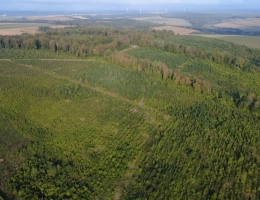
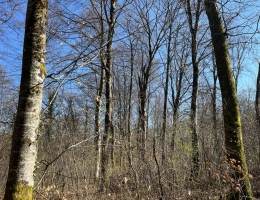
Hunting property for sale in Moselle falls under the same local law as Alsace, even though the department belongs to Lorraine: there are no ACCA associations and no Verdeille Act, but hunting leased out by each commune for nine years. In the south-east, the sandstone Vosges around Dabo and Abreschviller form, with the Donon, a large red deer massif; in the north-east, the Pays de Bitche belongs to the Northern Vosges; in the south, the pond country around Dieuze and Lindre combines water, reed beds and oak woods; towards Saint-Avold, the Warndt and the woods of the Lorraine plateau complete the picture. This page gathers the hunting properties on offer in Moselle: large woods, estates with a pond, chalets and farms with their land.
The data section below brings together the price benchmarks available, since Moselle sales are recorded in the livre foncier (the local land register) and stay outside the DVF database, then the OFB game bag records. Next come the two main types of ground and a step-by-step guide to local hunting law.
A hunting estate is rarely valued with a single figure: its price adds up the value of the woodland, the ponds, the buildings and the shooting facilities. The statistics below give benchmarks for wooded land and ponds, based on sales actually recorded.
According to the ma-propriete.fr forest price observatory, built from sales recorded in the French DVF land registry database, no departmental price can be published in Moselle: Moselle, Bas-Rhin and Haut-Rhin use the Alsace-Moselle land register (livre foncier), so their sales do not appear in DVF. The closest benchmark is Grand Est, calculated on the region’s seven other departments: a median of €5,498/ha in 2025, across 527 sales, with an average of €6,545/ha. Over 2020-2025, the regional median comes to €4,958/ha (2,836 sales), against €4,778/ha nationally.
| Indicator | Grand Est | France |
|---|---|---|
| Median price 2025 | €5,498/ha | €4,936/ha |
| Average price 2025 | €6,545/ha | €6,214/ha |
| Number of sales 2025 | 527 | 6,329 |
| Median price 2020-2025 | €4,958/ha | €4,778/ha |
Nationally, the price per hectare rises with size: the large properties that appeal to hunters sell for more per hectare than medium-sized woods.
| Size of forest sold (France, 2020-2025) | Median price | Number of sales |
|---|---|---|
| 10 to 20 ha | €4,010/ha | 3,161 |
| 20 to 50 ha | €5,330/ha | 1,850 |
| 50 to 100 ha | €6,810/ha | 581 |
| Over 100 ha | €7,361/ha | 320 |
On the listings side, 18 hunting properties are offered on ma-propriete.fr across France as of 2 October 2026, none in Grand Est at that date. Their median asking price is €888,000 for a median size of about 68 ha. These are advertised prices for whole properties, sometimes with a house or a pond, not recorded sale prices per hectare like those in the DVF database.
Source: DVF (French tax authority), processed by ma-propriete.fr; forests of 1 ha or more, cadastral type woodland; ponds without buildings of at least 2,000 m²; July 2020 to December 2025; Moselle, Bas-Rhin and Haut-Rhin are not covered by DVF. Listings recorded on ma-propriete.fr on 2 October 2026.
The game bag records published by the French Biodiversity Agency (OFB) measure hunting pressure and, indirectly, the presence of big game. In Moselle, 1,001 red deer were taken in the 2024-2025 season, about 1.1% of the national total, alongside 15,276 roe deer and 16,494 wild boar.
| Species | 2021-2022 season | 2024-2025 season | Change |
|---|---|---|---|
| Red deer | 1,010 | 1,001 | −1% |
| Roe deer | 16,842 | 15,276 | −9% |
| Wild boar | 24,263 | 16,494 | −32% |
Source: OFB, wild ungulates network, departmental big game bags (total culls, data published on data.gouv.fr).
South-east of Sarrebourg, around Abreschviller, Saint-Quirin, Walscheid and Dabo, the Vosges sandstone carries vast forests of fir, beech and spruce, where red deer are at home; the massif runs on without a break towards the Donon and Bas-Rhin. In the north-east, the Pays de Bitche, the Moselle part of the Northern Vosges regional nature park, lines up sandstone hills, Scots pine, beech woods and valley ponds as far as the German border. In both massifs, supplementary feeding is tightly restricted by the departmental game management plan: ask which rules apply where the property lies. Private properties range from a hillside plot to a hunting wood of several dozen hectares with a chalet; only the largest, in one block, let you hunt your own land.
Between Dieuze, Réchicourt-le-Château and Fénétrange, the pond country, the Moselle section of the Lorraine regional nature park, brings together ponds long managed for fish farming, starting with the Étang de Lindre, and reservoirs that feed the canals, such as those of Gondrexange and Le Stock. Duck are shot at evening flight and wild boar driven from the reeds and woods. Here, a body of water reaching five hectares at high water gives its owner the option of keeping the hunting on it. To the west, the Saulnois around Château-Salins and, further north, the Nied country alternate crops, grassland and oak and hornbeam woods; towards Saint-Avold and Creutzwald, the Warndt, a forest shared with Saarland, spreads over the former coalfield. For a property where water dominates, see our lakes and ponds for sale in Moselle.
First principle: the commune manages the hunting on the land within its boundaries, state forests being leased separately by the national forest office (ONF), and lets it in lots, normally by public auction, for nine years. The current period began on 2 February 2024 and ends on 1 February 2033, under standard lease terms set by the prefect of Moselle. Second principle: an owner can reserve the hunting only from 25 ha in one block owned outright, or five hectares of water, and only by declaring it at renewal, for the whole lease. Two neighbours, even relatives, cannot pool their land to reach that threshold, whereas a forestry group or joint ownership that is the sole owner can. A large wood bought mid-period therefore stays in the communal lot until 2033 unless the seller has already declared a reserve: you receive your share of the rent, unless a double two-thirds majority leaves it to the commune, but you have no automatic right to hunt there.
Third principle, enclaves: a plot under 25 ha lying wholly or mostly within reserved land may be leased first to the owner of the largest reserved holding, provided they apply together with their declaration. Fourth principle, damage: wild boar damage, a major issue in Moselle, is compensated by a departmental fund that every holder of hunting rights must join; damage by other big game is paid by whoever holds the hunting concerned. Before buying a reserved holding, ask for the history of damage and contributions, and for the cull plan allocations. Finally, if the property is fenced, the act of 2 February 2023 applies here too; our article on fencing on hunting estates recalls its standards and the 1 January 2027 deadline.
Moselle hunting properties on ma-propriete.fr are entrusted to us by private sellers, estate agents and notaires; sort them by budget or by the area you need, set up an e-mail alert or list your own property. For a mainly forestry purchase, see our woods and forests for sale in Moselle; to compare with ground under ordinary French law, such as hunting in neighbouring Meurthe-et-Moselle, or with the region as a whole, browse the hunting estates of Grand Est.