
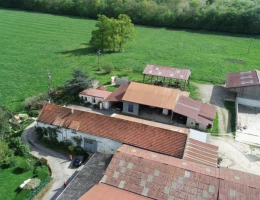
Are you looking at a poultry farm for sale in Hauts-de-France? In a region shaped by arable farming, poultry has largely grown as a second enterprise alongside cereals or a dairy herd: contract broilers, turkeys, and laying-hen units supplying eggs to packing centres. The listings gathered here are placed by farmers preparing a handover, specialist rural agencies and notaries, and set out the building area, the production system and the outlet currently in place. They belong to the wider selection of poultry farms for sale across France.
Beyond the listings themselves, this page gathers the benchmarks worth having before committing: farmland prices in the region, the departments where supply turns over fastest, the true condition of the buildings and the sector-specific checks. If you are setting up from scratch, our white paper « Créer une exploitation agricole » (in French) sets out the route from funding to the agricultural qualification.
Land remains the largest item when buying a poultry farm. According to sales recorded by the French tax administration (DVF, vineyards excluded), the median price of agricultural land in Hauts-de-France stood at €7,976/ha in 2025, with an average of €8,940/ha across 1,365 sales; 80% of transactions fall between €6,000 and €14,000/ha, against a national median of €5,307/ha.
The SAFER benchmark of land values (2025 figures) puts vacant land and pasture at €10,890/ha (-0.5% year on year, +9.4% over ten years), against a national average of €6,460/ha; land already let sells around 17% lower.
The value of a holding here rarely rests on hectares alone. Buildings weigh more heavily: usable length, insulation, ventilation, heating, feed silos and a washing area. Then come the production system, whether standard, free range, label rouge or organic, the presence of an adjoining outdoor range, and the strength of the contract that secures the batches. To judge an asking price, use our land price observatory and test your takeover plan with our financial calculators.
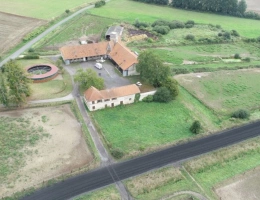
The regional stock mixes houses built when standard production expanded, some of them extended since, newer buildings fitted with a heat exchanger, and laying units on the floor or in aviaries. When you inspect a chicken farm, look at the frame and roof, wall insulation, the type of ventilation, the heating system, the feed auger and silos, and also the biosecurity entry room, the floor treatment and whether lorries can reach the site in all weathers. A building already brought up to standard trades well above an older volume that will need refurbishing before the first batch goes in.
Most broiler units run under an integration contract: the producer group supplies chicks and feed, then organises collection. For an egg farm, value rests instead on the production code, the approval of the partner packing centre or breaking plant, and the regularity of collections. Where a holding comes with a dwelling house and land, ask for an item-by-item breakdown: the production tool, the machinery, the land and the house are not valued against the same references, nor taxed in the same way.
Somme and Pas-de-Calais hold a good share of the units, often grafted onto arable holdings in the Artois, the Ternois or the Picardy plateau, on contested land that pushes up the price of complete farms. In the Aisne, the bocage of the Thiérache combines poultry with grass more readily, while the south of the department stays firmly arable. The Oise has scattered units across the Picardy plateau and towards the Pays de Bray. The Nord mainly offers smaller units in the Avesnois and the inland Flanders, on some of the dearest land in the region.
Supply follows retirements rather than market conditions: it turns over more in inland Picardy and the Aisne than near the Lille or Amiens conurbations, where pressure on land limits what comes available. A buyer is therefore well advised to track several departments at once, accepting some distance from the main roads in exchange for a lower entry price.
Under the French classified installations regime, the number of birds kept determines whether the unit needs a declaration, a registration or an authorisation, while any handover of the business is notified to the prefecture. Ask for the order in force and read its requirements, since an old text can carry conditions that have become burdensome. Then check the biosecurity plan, the state of fencing and surroundings, the management of outdoor ranges and the avian influenza precautions, which also apply along the migration corridors of the coast and the wet valleys.
On effluent, the manure spreading plan and storage capacity govern any extension, in a region largely classified as a nitrate vulnerable zone. On land, part of the parcels is often rented: the rural lease continues with the new farmer subject to the landlord's agreement, and the transaction remains subject to the structures control, the French authorisation regime for taking over farmland, and to SAFER's pre-emption right. Have the buildings, the machinery and the land valued separately rather than accepting one overall figure.
Private sellers, rural estate agencies and notaries are behind the listings you see here. Filter by department, building area or budget, set up an alert to hear about new listings as they appear, and widen your search to all farms for sale in Hauts-de-France.