
Taking over a poultry farm for sale in Nord puts a buyer in an unusual setting: a densely populated department where every hectare counts, but also an immediate market for birds and eggs. Poultry keeping wears two faces here, contract units attached to cereals or a herd, and farm-scale holdings raising chickens, guinea fowl, ducks and laying hens for short supply chains around the towns. Farmers preparing a handover, rural agencies and notaries pass these holdings to us with the built area, the production system and the outlet described. Every listing enriches our national selection of poultry farms for sale.
Through this page you will find what a listing alone does not provide: the level of land values in the Nord, the districts where units change hands, the parts of the buildings to check, and the health obligations of the sector. If your horizon is setting up, our white paper « Créer une exploitation agricole » (in French) works through the steps, from legal status to financing.
Land remains the largest item when buying a poultry farm. According to sales recorded by the French tax administration (DVF, vineyards excluded), the median price of agricultural land in Nord (59) stood at €7,910/ha in 2025, with an average of €9,021/ha across 347 sales; 80% of transactions fall between €5,570 and €15,000/ha, against a national median of €5,307/ha.
The SAFER benchmark of land values (2025 figures) puts vacant land and pasture at €13,560/ha (+1.1% year on year, +6.8% over ten years), against a national average of €6,460/ha; land already let sells around 17% lower.
The value of a unit here rests first on the buildings and their immediate surroundings: capacity per batch, insulation, ventilation, heating, silos, entry room, a collection apron a lorry can use, and an adjoining range where the specification demands one. The outlet weighs comparably, whether an integration contract or an established clientele, as does the goodwill attached to a farm shop or a regular selling round. A packing room for table eggs adds value of its own. Compare using our land price observatory and our financial calculators.
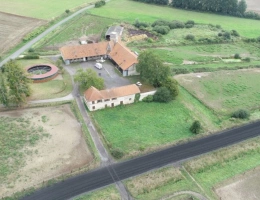
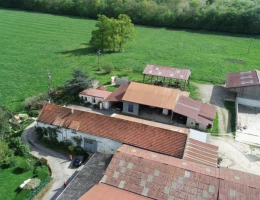
You will meet mechanised houses standing on mixed arable holdings, smaller buildings attached to a brick farmstead, and converted outbuildings whose clear height, airflow and roof condition need measuring. The points examined are always the same: frame, insulation, ventilation, heating, silos and feed augers, drinkers, floor condition, compliance of the entry room, and whether a serious empty period can be kept between batches. Feed storage and access for heavy goods vehicles matter sharply in densely built communes, where manoeuvring can be awkward and directly affects collection.
Then comes the way batches are marketed. Under an integration contract, the unit is worth what the building and the relationship with the production organisation are worth; selling direct, most of the value may lie in the goodwill, the health approval of the cutting room and an urban clientele already won over. Holdings combining a dwelling house, buildings and land call for a precise breakdown, since the house price is pulled upwards here by residential demand.
The Avesnois, around Avesnes-sur-Helpe, Le Quesnoy and Maubeuge, remains the department's historic livestock area: hedged country, pasture, dairy and farm-scale holdings where a poultry unit sits naturally, with more affordable land. Inner Flanders, from Bailleul to Hazebrouck, is intensively cropped and leaves little room for new livestock buildings. The Cambrésis and the Douaisis, arable country, mainly hold isolated units backed by a rotation. The Pévèle and the fringes of the Lille conurbation combine strong demand for short supply chains with very limited land availability.
The consequence is direct: the further you move from the conurbation, the more complete farmsteads become reachable, and the more realistic it is to lay out an outdoor range. Conversely, a house close to the towns costs dearly, but benefits from a dense consumer base and a well-established network of markets and producer shops. Between the two, the Avesnois keeps the most complete farmsteads, with adjoining pasture and outbuildings that can be converted.
Depending on the flock housed, the unit falls under declaration, registration or authorisation as a classified installation, and the change of operator is notified to the prefecture. In such an urbanised department, neighbours are a central question: distances to dwellings, any past complaints, the requirements of the operating order and the local planning documents determine whether enlargement is even possible. Read those papers before offering. Add the biosecurity plan, the avian influenza measures and, for outdoor units, the conditions for protecting and maintaining the ranges.
As the department is classified a nitrate vulnerable zone, the spreading plan and manure storage capacity must match the area genuinely controlled; failing that, a verifiable manure transfer agreement becomes necessary. On the land side, a large share is rented and the lease continues with the buyer subject to the landlord's agreement; the transaction remains subject to the structures control, the French authorisation regime for taking over farmland, and to SAFER, heavily involved given local pressure on land.
Private vendors, rural estate agencies and notaries' offices publish their holdings here as they come up. Select the building area, the budget or the production system that matches your search, including laying hens and free-range flocks, create an alert so no listing escapes you, and then move on to all poultry farms for sale in Hauts-de-France.