
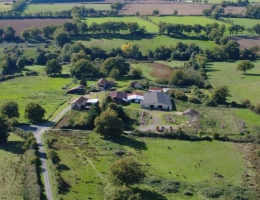
A poultry farm for sale in Vienne usually appears as an indoor unit backed by arable land: broiler houses add value to the cereals grown on the holding and bring in steady income alongside wheat, barley and oilseed rape. Alongside them are farm-scale holdings with outdoor range and a few laying-hen units supplying shops across the Poitou. Retiring farmers, rural property firms and notaries pass these holdings to us, stating the covered area, the equipment and the outlet. Every listing enriches the national offer of poultry farms for sale.
You will also find here what the listing leaves out: where land values stand in the department, the districts where handovers appear, the parts of the buildings to have surveyed and the health obligations of the sector. For a first project, our white paper « Créer une exploitation agricole » (in French) describes the whole route, from the farming qualification to the funding package.
Land remains the largest item when buying a poultry farm. According to sales recorded by the French tax administration (DVF, vineyards excluded), the median price of agricultural land in Vienne (86) stood at €5,121/ha in 2025, with an average of €5,288/ha across 285 sales; 80% of transactions fall between €3,032 and €7,804/ha, against a national median of €5,307/ha.
The SAFER benchmark of land values (2025 figures) puts vacant land and pasture at €5,360/ha (+1.3% year on year, +11.7% over ten years), against a national average of €6,460/ha; land already let sells around 17% lower.
Hectares alone do not set the price. Usable length and insulation come into it, along with ventilation and its controls, heating, silos and feed lines, the state of the slab and the biosecurity entry room, and access a lorry can use. Add to that feed self-sufficiency where the crops supply the unit, the steadiness of collections organised downstream and, on a farm geared to direct selling, the cutting room and the customer base already built. Get your bearings in our land price observatory, then model the takeover with our financial calculators.
Local stock is dominated by houses built for meat birds, often generously sized and sited away from the farmstead, and less often by floor or aviary laying units. Buyers examine the frame and roof, the quality of the insulation, the ventilation system, the heating, the silos, the water and power supply, and whether the biosecurity entry room complies. The date of construction and any upgrading explain much of the spread in prices. Being able to harvest, store and mix part of the feed on the holding is a lasting financial advantage in a cereal-growing department.
Most units depend on an operator that supplies chicks and feed then collects the batches: the incoming farmer needs the remaining term and the transfer conditions before making an offer. Label rouge and organic holdings with outdoor range are judged on other criteria, notably the area of range available and how long certification has been held. Where a property is sold with house, sheds and land, ask for the price to be broken down item by item: it makes financing and the tax side of the takeover simpler.
The north of the department, from the Loudunais to the land around Mirebeau and Neuville, holds large arable holdings where the poultry unit plays a supporting role; buildings there are often recent and of good capacity. The Châtellerault area continues that pattern along the Vienne valley, with road access that suits collections. To the south-east, the Montmorillonnais and the brandes heath country show more fragmented parcels, cheaper land and more farm-scale holdings with range. The Civray area and the south readily combine poultry with goats and cattle on medium-sized structures.
Land values follow that geography: higher in the northern cereal plains and around Poitiers, more affordable in the heath and bocage districts of the south-east. The contrast often decides what buyers go for, between a recent facility on expensive land and a holding to renovate, more modestly valued but calling for work.
Depending on flock size, a poultry unit falls under declaration, registration or authorisation as a French classified installation, and a change of operator is notified to the prefecture. Read the applicable order: it fixes distances to third parties, operating requirements and sometimes limits that would complicate an enlargement. The biosecurity plan, how empty periods between batches are organised, the management of ranges and the avian influenza measures come first among the checks. Water supply and available electrical capacity also deserve attention where an extension is planned.
Manure storage and the spreading plan should be checked against the area genuinely available, since part of the land is often rented. The rural lease continues with the buyer subject to the landlord's agreement, and the transaction remains subject to the structures control, the French authorisation regime for taking over farmland, and to SAFER's pre-emption right. Valuing land, buildings and machinery separately avoids unpleasant surprises and speeds up the bank's assessment.
The holdings gathered on this page are entrusted by private sellers, agencies specialising in rural property and notarial offices. Narrow by covered area, by price or by production, from a broiler farm backed by arable land to an egg farm, and set up an alert to follow new listings. A step wider, the regional page brings together the poultry farms for sale in Nouvelle-Aquitaine.