
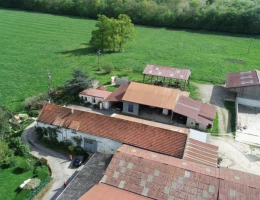
Buying a market garden for sale in the Nord means stepping into a department where endive holds a leading place, where the Flemish plain grows field vegetables and where the urban belts sustain ornamental growers and nurseries. The files you read here reach us from producers arranging their withdrawal, from firms dealing solely in rural property and from local notaries; each file gives the cropped area, how much stands under cover, the irrigation available, the packing equipment and the outlets in place. You will find them again within our national picture of market gardens and nurseries for sale.
Beyond the particulars, this page gathers the bearings that are usually missing when a decision has to be made: what land is worth locally, the districts where handovers cluster, how to read a set of greenhouses and a forcing room, and the controls specific to the vegetable trade. Putting a start-up project together is covered in our white paper « Créer une exploitation agricole » (in French).
Land value drives much of the asking price for a market garden or nursery. French tax transfer statistics (DVF, vineyards excluded) show, for 2025, a median of €7,910/ha in Nord (59), an average of €9,021/ha and 347 sales; 80% of transactions settle between €5,570 and €15,000/ha, against a national median of €5,307/ha.
On the SAFER side, the value of vacant land and pasture is set at €13,560/ha for 2025, moving +1.1% over a year and +6.8% over ten, against €6,460/ha nationally; expect an average discount of 17% where a lease is running.
Beyond the hectares, what is being paid for in this department is equipment and a flow of trade. Into the balance go the covered area and the age of the frames, the forcing capacity, the refrigeration available to hold the roots, the washing line, the licensed borehole and its drip network, the lifting machinery, and finally the wholesale, garden centre or market customers attached to the business. Set the land element against our land price observatory, and put the takeover plan through our financial calculators.
The equipment differs entirely according to what the holding does. An endive business is judged on its forcing room: hydroponic trays, temperature control, insulation of the building, cold stores for the roots and a trimming area. A greenhouse business in ornamentals reads quite differently, with its glass, its multi-span houses, its thermal screen, its boiler house, its growing benches and its sub-irrigation. On open-field vegetable farms, look at the planter, the lifter, the washer, the grader, the grading shed and the storage capacity. A block of greenhouses stripped of its machinery never trades on the same terms as a complete working site.
The route to market counts for as much as the plant. Supplying a packer or a cooperative calls for steady volumes and graded lots; selling short, on markets, through a producers' shop or a box scheme, passes on a customer base and a local standing above all. Where the dwelling, the buildings and the land change hands together, ask for a figure against each element: a house, a production unit and farmland are not appraised against the same references, and loans do not run over the same terms.
Inland Flanders, around Hazebrouck, Bailleul and Steenvoorde, carries much of the endive activity and of the field vegetables, on silts valued for how evenly they behave. The maritime plain behind Dunkerque and Bergues works polder soils that are straightforward to manage. Around Lille, the Pévèle and the Weppes hold market gardens geared to direct selling along with ornamental growers supplying garden centres, florists and municipal landscape departments. The Cambrésis and the Douaisis combine arable farming with vegetables grown for processing, while the Avesnois, more given to grassland, leaves vegetables little room.
Availability follows that same geography. On the fringes of the Lille conurbation, of Valenciennes or of the Dunkerque coast, competing urban uses thin out the offer and push up the price of anything already equipped; towards the Cambrésis and the Avesnois, ground comes at a more measured entry cost, in exchange for delivery logistics that have to be rethought. A smallholding within reach of a mid-sized town often reconciles steady outlets with a workable budget.
Start with water: the borehole's declaration or licence, the volume granted by prefectoral order, whether the sector falls within a water allocation zone, the restrictions imposed in dry spells, the condition of the buried network. On the low ground of the maritime plain and the valleys, drainage, ditch maintenance and the easements attached to watercourses deserve an inspection on site, because any failure is paid for every winter. Then check that planning consents were properly obtained for the greenhouses and the packing buildings, since their absence blocks any later extension. How the parcels are classified locally will say what the site can become.
An authorisation to farm is required under the structures control, the French regime governing who may take over farmland, and SAFER holds a right of pre-emption over the transfer; rented parcels remain governed by their rural lease, which you take on. Have the certification body confirm how long any organic conversion has been running and what remains of it. Lastly, plan for seasonal labour, needed for trimming as much as for harvest, and for housing it, which is hard to find near the conurbations.
Private sellers, rural property agencies and notaries based in the department feed this selection, which turns over as businesses change hands. Set your criteria for area, budget and type of production, save an alert so you hear of a holding the day it appears, then widen the search to market gardens for sale in Hauts-de-France.