
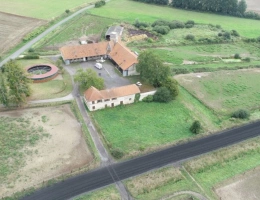
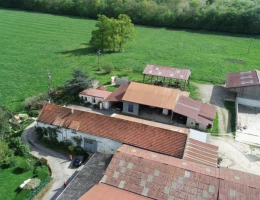
Looking for a market garden for sale in Hauts-de-France means prospecting one of the country's major vegetable regions, where open-field crops grown for processing sit alongside green belts geared to direct selling and a long-established ornamental horticulture trade. The holdings shown here are entrusted to us by growers preparing their handover, by firms specialising in rural property and by notaries; they set out the cropped area, the surface under glass and tunnels, the irrigation available and the outlets already in place. You will find them within our national selection of market gardens and nurseries for sale.
Beyond the listings, this page gathers the benchmarks that matter when you make an offer: regional land values, the departments where supply is turning over, the condition of the structures and equipment, and the checks specific to vegetable growing and to nursery work. Setting up is a separate exercise: legal form, qualification and funding are covered in the white paper « Créer une exploitation agricole » (in French).
Land value drives much of the asking price for a market garden or nursery. French tax transfer statistics (DVF, vineyards excluded) show, for 2025, a median of €7,976/ha in Hauts-de-France, an average of €8,940/ha and 1,365 sales; 80% of transactions settle between €6,000 and €14,000/ha, against a national median of €5,307/ha.
On the SAFER side, the value of vacant land and pasture is set at €10,890/ha for 2025, moving -0.5% over a year and +9.4% over ten, against €6,460/ha nationally; expect an average discount of 17% where a lease is running.
Land tells only part of the story. What also counts is the covered area and its condition, the water resource together with the abstraction permit attached to it, the washing and packing line, the cold storage available, the planting machinery and, where the sale covers a going concern, the customer base of market stalls, farm shops and garden centres that goes with it. Orders of magnitude help here: the land price observatory shows where local land values stand, the financial calculators test the borrowing effort.
The regional stock mixes glasshouses inherited from ornamental growing, more recent plastic multi-span structures and long runs of cold tunnels set on deep loam. Buyers look at the age of the frame, the state of the hoops and gutters, how well the films seal, whether a thermal screen is fitted and how the crop is heated, since heating weighs heavily on the running costs of a greenhouse business. Next come the drip irrigation network, the borehole and its abstraction permit, the storage pond, the washing station, the cold room and the hard standing where young plants are held. A block of greenhouses still fitted with its growing benches sells above a structure stripped of its equipment.
On open-field holdings, the bed former, the harvester, the precision drill and the storage capacity make the difference, along with the grading and palletising buildings. Value also rests on the contract tying the grower to a cannery or a shipper, and on how much room is left for short supply chains. Where a dwelling house is included, ask for an item-by-item breakdown: the house, the production tool and the land are not valued against the same references, and merging them distorts the negotiation.
Nord and Pas-de-Calais form the vegetable heartland: chicory is an emblematic crop here, the Audomarois marshes around Saint-Omer sustain a form of wetland market gardening found nowhere else in France, and the Lille conurbation supports nurseries and ornamental growers supplying garden centres and local authorities. Somme grows vegetables for processing on the Picardy plateaux and keeps, with the hortillonnages of Amiens, an urban market gardening tradition. Oise benefits from its closeness to the Paris consumer basin, which feeds both direct sales and wholesale shipping. Aisne, from the Soissonnais to the Laonnois, combines arable farming with field vegetables delivered to industry.
Land availability varies sharply from one area to the next. Around Lille, Dunkerque and Creil, pressure from urban uses thins out the plots and pushes up the price of equipped hectares, whereas inland Aisne and southern Somme offer larger holdings at a lower entry cost. Being close to a shipping platform, a wholesale market or a processing plant remains a real criterion, as does road access. For a first purchase, ground within reach of a mid-sized town usually reconciles steady outlets with an affordable price.
Water governs everything else: confirm that the borehole is declared, check the volume authorised by prefectural order, find out whether the area falls within a water allocation zone, and ask about the use restrictions imposed in dry spells. Greenhouses and packing buildings require valid planning consents; without them, any extension becomes difficult. Marsh and valley soils, usually drained, call for an inspection of the ditches, the hydraulic works and the maintenance easements. Organic certification passes on with whatever conversion period is left to run, and should be confirmed by the certifying body before signature.
An authorisation to farm, issued by the prefecture under the structures control, is required here as elsewhere, and SAFER may step in even where the equipped area is small. Ground held on a rural lease keeps that lease, which runs on with the incoming grower once the landlord has agreed. If the price includes a going concern, have the seller spell out what is actually transferred, from the customer base to market pitches and garden centre contracts, and plan ahead for seasonal labour housing, since availability of staff governs how the crops can be run.
The properties shown here come from growers selling directly, from rural estate agencies and from notaries based in the region. Narrow your search by covered area, by budget or by type of production, switch on an alert that will flag every new listing, and browse more widely through the farms for sale in Hauts-de-France.