

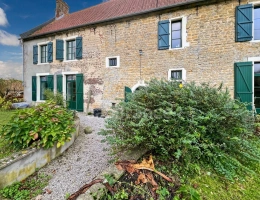
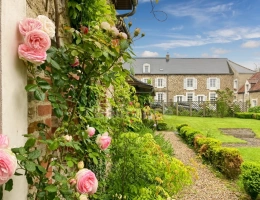
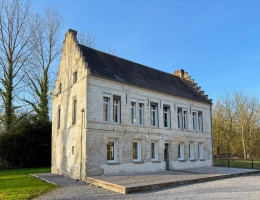
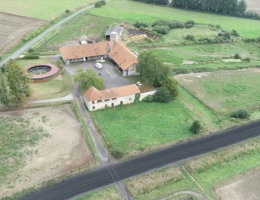
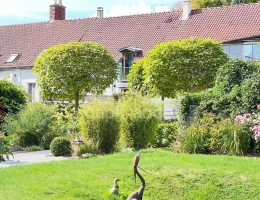
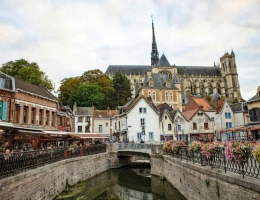
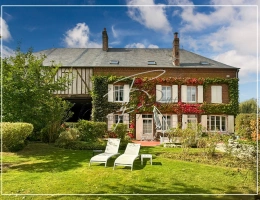
An arable farm for sale in Somme puts you on some of the most productive ground in the Paris Basin: the deep loams of the Santerre and the Vermandois carry wheat, winter barley, oilseed rape, sugar beet, potatoes and vegetables grown under contract for nearby processing plants. What you see here is entrusted to us by farmers arranging their retirement, by firms specialising in rural property and by notaries in Amiens, Péronne or Montdidier; every file states the cropping plan, how the ground splits between ownership and tenancy, the delivery contracts in force and the machinery on the yard. They also appear in the national selection of arable farms for sale.
What follows goes beyond the particulars: local land values, the districts where holdings come to market most often, how to read a set of stores and sheds, and the checks that apply to a cereal farm tied into industrial cropping contracts. Our white paper « Créer une exploitation agricole » (in French) supports anyone building an entry-into-farming project.
Pricing the land comes first in any plan to buy an arable farm. On the basis of 2025 DVF sales (vineyards excluded), the median in Somme (80) works out at €8,655/ha and the average at €9,402/ha, across 267 transactions. The central range covering 80% of sales runs from €6,364 to €13,926/ha; nationally the median is €5,307/ha.
The SAFER benchmark, the market's second yardstick, gives €10,100/ha in 2025 for vacant land and pasture (-2.1% over twelve months, +4.8% over ten years), beside a national €6,460/ha; tenanted land is worth about 17% less.
At comparable acreage, the value of a Picardy unit rests on what surrounds it: the water-holding capacity of the loam, a drainage network kept in order, an abstraction permit allowing potatoes and vegetables to be irrigated, blocks gathered around the yard, bin and intake-pit capacity, a concrete apron lorries can work on, the condition of harvesters and self-propelled machines, basic payment entitlements, and the delivery contracts held with a cooperative or grain merchant. Weigh an asking price against our land price observatory and run the figures through our financial calculators.
The Santerre and the Vermandois sit on thick loams with a generous water reserve, able to carry long and demanding rotations: milling wheat, winter barley, oilseed rape, sugar beet, potatoes, flax and vegetables destined for canning or freezing. That mix changes the nature of the purchase, because part of the income depends on cropping contracts negotiated with processors rather than on grain markets alone. Ask for soil analyses, block-by-block yield records and the list of contracts in force; they tell you far more about how steady the business is than any brochure. Conservation tillage is gaining ground on the plateaux and alters the value of the cultivation kit taken over.
Buildings combine brick farmsteads, older barns and steel-framed sheds added as the holding expanded. Look at the roof structure, bin ventilation, the drier, and the potato store with its temperature control, often the deciding item on a crop farm in this part of the department. Lorry access and the distance to a collection silo weigh on the negotiation too. Where a manor house comes with the business, have it valued separately: the residential market around Amiens moves to a rhythm of its own.
The Santerre, around Roye, Nesle and Chaulnes, is the beet and vegetable heartland of the department; fields have been reorganised into large blocks and neighbours compete hard for anything that comes up. The Vermandois, towards Péronne and Ham, carries the same model with holdings of similar character. Further west, the Amiénois and the Doullennais alternate cropped plateaux with damp valleys, and blocks of arable land come in more modest lots. The Ponthieu and the Marquenterre, behind the bay of the Somme, mix cropping with grassland on uneven soils, while the Vimeu keeps a clear livestock presence.
Value gaps follow that geography closely: pressure peaks where beet and potatoes are contracted, and eases along the coastal margins and in the more fragmented districts. Comparing several districts before fixing a funding plan is worth the effort, since the price gap feeds straight through to the annual repayment an incoming buyer can carry.
The deal falls under the structures control, the French authorisation regime governing entries into farming and expansion, and SAFER, the rural land agency, may pre-empt once the notary has notified the sale. Take the rural leases one at a time and note the remaining term, the rent, any environmental clauses and the pre-emption right held by the sitting tenant. The department lies in a nitrate vulnerable zone, which sets application periods, cover crop obligations and soil nitrogen testing. Water catchment protection areas on the plateaux may further restrict practices on specific fields, so ask for the applicable orders and check how far they actually reach.
Then confirm that basic payment entitlements transfer properly and that CAP declaration deadlines are met, compare the graphical field register with the advertised acreage, and have the fate of beet contracts and vegetable commitments spelled out, since they do not pass automatically to a successor. Where the business is held in a company, the sale may cover shares: tax treatment, warranties against liabilities and the position of the machinery then differ markedly from a land purchase.
Retiring owners, rural estate agencies and Picardy notaries keep this page supplied as mandates come in. Refine by area, budget or district, switch on an alert so a grain farm reaches you the day it is listed, and widen the search to arable farms for sale in Hauts-de-France.


