

Looking for a goat farm for sale in Côtes-d'Armor means targeting a department where caprine farming remains a niche: modest herds, on-farm cheesemaking almost as a rule, and a customer base that swells the moment the coast fills up. The files gathered here come from keepers arranging their retirement, from firms that specialise in rural land and from notarial offices across the department. Each states how many dairy goats are milked, how the building is laid out, what milking equipment is installed, whether a make room is attached and which grass parcels go with it. All of them sit inside our national selection of goat farms for sale.
This page reaches beyond the list of properties: local land values, the areas where farmsteads come free, the expensive items to spot in an older goat house, and the duties attached to farmhouse processing and slurry spreading. Before you put figures on a start-up or a takeover, read our white paper « Créer une exploitation agricole » (in French), which walks through the administrative path and the funding that can be raised.
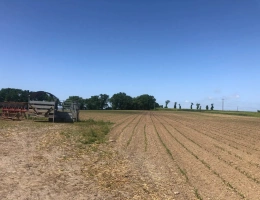
Land weighs heavily on the budget for a goat farm. Transfers published by the French tax authorities (DVF, excluding vineyards) put the median for farmland in Côtes-d'Armor (22) at €5,584/ha in 2025, with an average of €5,872/ha over 371 sales. Eight transactions in ten settle between €3,914 and €8,226/ha, where the national median is €5,307/ha.
A second reference, the SAFER land value benchmark, sets vacant land and pasture at €5,890/ha for 2025, +1.9% in a year and +23.2% over a decade; the French average is €6,460/ha, and a sitting tenant costs a plot roughly 17% of its value.
Beyond the grass, buildings and goodwill open the gaps in price. What counts is the goat house and the air it holds, the parlour and milk room, the drying room and cellar where the farm ripens its own cheese, the sales point, then the herd and the steadiness of its lactations. On top sits the asset hardest to buy back: a loyal clientele, markets, cheesemongers and producers' shops included. Place those items in the local market with our land price observatory and test your funding plan with our financial calculators.
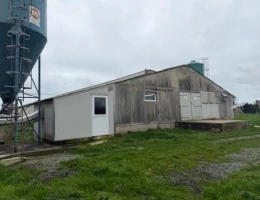
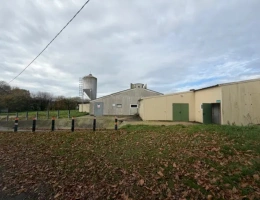
Goat housing here rarely occupies a building designed for it: more often a former cattle shed, a disused pig unit or a storage barn has been converted. Inspection starts with the roof structure, the covering and the cladding, then with everything that handles moisture, ridge ventilation, floor falls and drainage around the walls, because Atlantic air is paid for in coughing as soon as the atmosphere deteriorates. Next come the feed passage, the kid-rearing space, covered hay and straw storage, and finally the milking platform and its chiller unit.
A make room changes the nature of what is on the market. Moulding room, drying room, ripening cellar, cold store and sales point are each judged in turn, against the health approval or the direct-supply exemption held, the volumes genuinely handled and the standing built up on local markets. Where the farm is offered with a dwelling, granite outbuildings and pasture, ask for the price to be split in writing: in this department the appeal of old stone weighs heavily on demand and is not financed like a working asset.
The interior holds most of the openings. The Kreiz Breizh, around Rostrenen, Corlay and Callac, offers grassland holdings with well-grouped parcels at prices coastal parishes no longer see. The heights of the Mené and the Loudéac country extend that inland corridor, with heath and sloping ground suited to rough grazing. The farmed Trégor, behind Lannion, and the Guingamp area mix grass, cereals and vegetables. The Penthièvre and the surroundings of Lamballe, heavily taken up by dairying and the food industry behind it, leave less room for a goat enterprise.
Along the coastal fringe, from the Goëlo to the Côte de Granit rose by way of Paimpol and Perros-Guirec, competition between housing and farming makes a complete holding hard to buy, yet nothing matches its direct-sale potential in season. Many newcomers therefore buy inland, within reach of Saint-Brieuc or Dinan, and sell their cheese on coastal markets.
Herd size dictates the regime: below a given number the unit answers to the departmental health regulation, above it the holding enters the classified installations nomenclature, first by declaration then by registration, and any change of operator is notified to the prefecture. The whole department is classified as a nitrate vulnerable zone, and several bays are covered by programmes against green algae, so the spreading plan and the receiving area deserve to be checked with the documents in hand.
On animal health, ask for the screening history for caprine arthritis-encephalitis virus and the paratuberculosis follow-up: the real worth of a dairy goat holding rests largely on how clean the herd you take on is. Where the farm processes, the approval is reissued in the new operator's name through the veterinary services, supported by the food safety plan. No protected goat cheese designation covers Brittany, so value comes from the farm's own name and sometimes from organic certification. Lastly, confirm the status of rented parcels, the passage through the structures control, the French authorisation regime for taking over farmland, and SAFER's right to step in.
This page lives on properties placed by retiring owners, by rural property agencies and by notaries working between Saint-Brieuc, Guingamp and Dinan. Sort by grassland area, by budget or by the way the milk is valued, then save an e-mail alert: openings are scarce and go quickly. Preparing a handover of your own? Publish it here. Carry your search on through goat farms for sale in Brittany.