
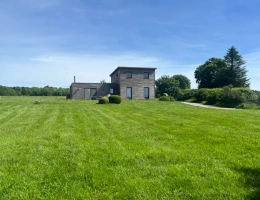
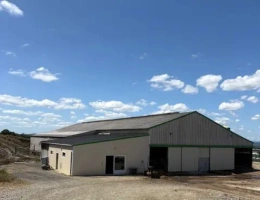
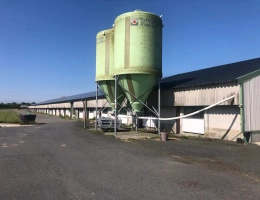
Buying a goat farm for sale in Finistère usually means taking on a self-contained business: goat milk collection barely exists on the Breton peninsula, so holdings make their own cheese and sell it themselves, very often under organic certification. The properties shown here are released by keepers preparing a handover, by rural property agencies and by local notaries. They set out herd size, the breeds kept, mostly Alpine and Saanen, how the goat house is arranged, the milking equipment, what the make room contains and how much heath and rough grazing comes with the land. All feed our national picture of goat farms for sale.
You will also find the markers no listing ever carries: local land values, the parishes where farms change hands, the true condition of buildings and milking equipment, and the health paperwork tied to cheesemaking. Our white paper « Créer une exploitation agricole » (in French) covers the professional qualification, the grants open to new entrants and the way a funding plan is built.
Land weighs heavily on the budget for a goat farm. Transfers published by the French tax authorities (DVF, excluding vineyards) put the median for farmland in Finistère (29) at €5,751/ha in 2025, with an average of €6,059/ha over 276 sales. Eight transactions in ten settle between €3,909 and €9,022/ha, where the national median is €5,307/ha.
A second reference, the SAFER land value benchmark, sets vacant land and pasture at €5,560/ha for 2025, +2.6% in a year and +16.3% over a decade; the French average is €6,460/ha, and a sitting tenant costs a plot roughly 17% of its value.
What is really paid for in such a holding goes well past the area: how the goat house is fitted out, the milk line and the tank, the make room with its drying room and cellar, the farm shop and where it stands, the genetics of the herd and the way it is run. Then comes the value of the trade itself, summer markets, box schemes, delicatessens and coastal restaurants, hard to rebuild from nothing. Set these against the land market through our land price observatory, then model your purchase with our financial calculators.
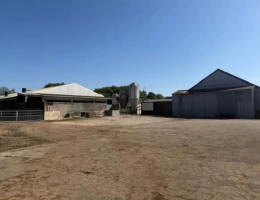
Caprine units here sit in inherited volumes: stone longhouses, cattle sheds freed up when a dairy herd stopped, buildings stretched by successive extensions. Look first at ventilation, decisive in this damp climate, then at the orientation against prevailing winds, the state of the bedded areas and covered hay storage, since forage is hard to dry in some years. Move on to the parlour, the number of units and the washing system, the milk room and the chiller.
Nearly every goat farm in the department processes its own milk, so the make room, drying room, cellar and sales point account for a real share of the asking price, along with the health approval or exemption that goes with them. Where the listing covers a whole farmstead, with house, lean-to buildings and land, insist on a clear split between dwelling, working buildings and ground: within reach of the sea, the residential share alone can carry most of the value.
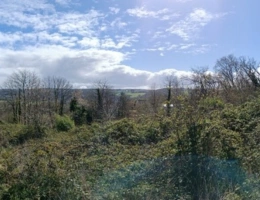
The Monts d'Arrée and the edges of the Armorique regional nature park, around Sizun, Commana, Brasparts and Huelgoat, remain the most favourable ground: heath, acid soils, permanent pasture and contained entry prices have drawn in many newcomers from outside farming families. The centre of the department, from Châteaulin along the Aulne valley to the Carhaix country, offers larger grassland blocks. In Cornouaille, between Quimper, Douarnenez and the Pays Bigouden, farms are scarcer but local demand is strong. In the vegetable-growing Léon, around Saint-Pol-de-Léon, Plouescat and Landivisiau, land trades at the top of the scale and a goat project rarely gets off the ground.
The tourist season alters the arithmetic: on the Crozon peninsula, the Abers coast and the hinterland behind Morlaix, a caprine unit sells its summer output without difficulty, provided you accept intense months. A holding set inland but served by a fast road often combines the best of both: affordable ground and customers within an hour's drive.
Depending on numbers kept, the farm answers either to the departmental health regulation or to the classified installations nomenclature, in which case the takeover is declared to the prefecture. The department's classification as a nitrate vulnerable zone makes it essential to check effluent storage capacity and the strength of the spreading plan, all the more so where receiving land is contested. If part of the ground lies within a Natura conservation site, inside the regional nature park or on wetland, establish what that means for buildings, fencing and stocking. Forage self-sufficiency deserves a close look: hay stocks and the quality of the grazing.
Ask for screening results for caprine arthritis-encephalitis virus and paratuberculosis, together with the herd register, before making any offer. Where cheese is made, the approval is reissued in the buyer's name and the food safety plan has to be rewritten. Brittany falls under no protected goat cheese designation, so nothing underpins the selling price of the cheese beyond the reputation the seller has built. On land, expect the structures control, the French authorisation regime for taking over farmland, and SAFER scrutiny, and get written confirmation that existing rural leases pass to you.
Owners closing a career, rural agencies and notarial offices in Quimper, Morlaix or Carhaix keep this section supplied. Narrow your search by area, by budget or by the presence of a processing unit, then create an alert so every new file reaches you before it circulates. Selling your own holding? Place it here. Then widen the net to goat farms for sale in Brittany.