

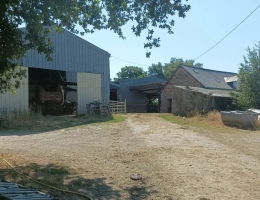
A goat farm for sale in Ille-et-Vilaine changes hands in an unusual setting: a densely farmed department, a city that buys a great deal of farm produce and land among the most contested in western France. The properties gathered here are entrusted to us by keepers arranging their succession, by advisers who specialise in rural estates and by local notaries. Each file details how many dairy goats are milked, the type and age of the livestock building, the milking installation, whether processing facilities exist and how the area splits between pasture, forage crops and rough grazing. They join our national selection of goat farms for sale.
Added to that is what no listing supplies: the level of the local land market, the districts where supply genuinely renews itself, the common weak points of converted buildings and the health rules attached to processing and spreading. To shape a takeover or a start-up, lean on our white paper « Créer une exploitation agricole » (in French), which deals with professional qualification, grants and forecasts.
Land weighs heavily on the budget for a goat farm. Transfers published by the French tax authorities (DVF, excluding vineyards) put the median for farmland in Ille-et-Vilaine (35) at €5,100/ha in 2025, with an average of €5,387/ha over 357 sales. Eight transactions in ten settle between €3,114 and €8,000/ha, where the national median is €5,307/ha.
A second reference, the SAFER land value benchmark, sets vacant land and pasture at €5,280/ha for 2025, -1.7% in a year and +11.9% over a decade; the French average is €6,460/ha, and a sitting tenant costs a plot roughly 17% of its value.
An asking price is rarely read by the hectare. It is built on the building and the air within it, on the milking platform and the tank, on the cheese room with its drying room and cellar where they exist, on the farm shop and on the make-up of the herd. Above all, in this department, it carries a scarce commercial asset: box rounds, market pitches and arrangements with cheesemongers or restaurants, none of which is rebuilt in a single season. Weigh these against our land price observatory and test whether they hold up using our financial calculators.
Most caprine units in the department were born of a conversion: a dairy shed freed up, a poultry house reworked, a barn insulated and partitioned to hold the groups. A careful buyer therefore dwells on the structure and covering, on asbestos in older roofing, on ventilation and natural light, then on the internal layout: feed passage, bedded area per group, kid-rearing space and isolation pens. The milking side deserves a full technical review, from the number of units to automatic washing, from the tank to the chiller, since bringing it up to standard is one of the heaviest outlays after a purchase.
Where the farm processes, every room counts in the price: making room, drying room, ripening cellar, cold store, wash-up area and sales point, together with the health approval or direct-supply exemption attached to them. Many holdings come with a fine stone house or a restored longhouse, outbuildings and land; within easy reach of Rennes the residential share can make up the dominant part of the value. A written split between dwelling, working asset and land is essential before any offer goes in.
The Fougères and Vitré countries, with the Coglais and the Marches de Bretagne, hold a concentration of grassland farms and a fabric of holdings that process on site; demand is strong there but supply does renew. The south of the department, from the Vallons de Vilaine to the Redon country, offers more reachable ground, sometimes wet, suited to moderate stocking. The Brocéliande massif, around Paimpont, combines heath, woodland and pasture with a flow of visitors that favours selling at the gate. The Bretagne romantique, towards Combourg, stays sought after by residential buyers.
The ring around Rennes stands apart for the depth of its outlets, box schemes, producers' shops and public catering, yet land there reaches levels a goat enterprise alone struggles to service. Towards Saint-Malo and the Côte d'Émeraude, residential pressure produces the same effect. In practice, many buyers settle three quarters of an hour from the city and deliver into it each week.
The administrative regime follows animal numbers: the departmental health regulation for small herds, then declaration and registration under the classified installations system beyond that, with the prefecture informed when the operator changes. As the whole department is a nitrate vulnerable zone, effluent storage, the spreading plan and any land made available by neighbours must be checked against the documents, especially as competition for that land is fierce. Confirm as well the setback distances from dwellings, sensitive wherever new housing has crept towards farmsteads.
A dairy goat holding is judged on its animals too: ask for caprine arthritis-encephalitis screening, the paratuberculosis record and the average age of the goats. Where a cheese room is sold, the approval has to be reissued in the buyer's name. With no protected goat cheese designation covering Brittany, value depends entirely on the farm's own name and, where it applies, on organic certification. Finally, land here is overwhelmingly rented: the continuation of leases, the structures control, the French authorisation regime for taking over farmland, and SAFER's opinion all shape the deal, and an overlap period with the seller eases the transfer of customers.
What appears on this page comes from retiring owners, rural estate agencies and notarial offices spread between Rennes, Fougères, Vitré and Redon. Pick an area, a budget bracket or the presence of a cheese room, and save an alert: in this department a holding finds its buyer within weeks. Passing yours on? Publish it. Continue through goat farms for sale in Brittany.