
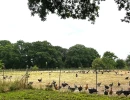
Hunting for a goat farm for sale in Morbihan means dealing with two departments in one: a farming interior where land stays affordable, and a coastal fringe much in demand, rich in customers but where buying a complete holding turns into an obstacle course. What is published here is passed on by keepers selling their business, by rural property agencies and by local notaries. The entries give herd numbers, the breeds kept, how the goat house is designed, the milking equipment, whether a cheese room exists and what the forage area consists of. Each appears in our national register of goat farms for sale.
To that we add markers a listing never carries: local land values, the districts where farms come free, the usual weak points of converted buildings, and the formalities tied to farmhouse processing. Whether you are starting from a blank page or taking over an existing unit, our white paper « Créer une exploitation agricole » (in French) sets out the stages, from professional qualification to the bank file.
Land weighs heavily on the budget for a goat farm. Transfers published by the French tax authorities (DVF, excluding vineyards) put the median for farmland in Morbihan (56) at €5,507/ha in 2025, with an average of €5,980/ha over 293 sales. Eight transactions in ten settle between €3,748 and €9,162/ha, where the national median is €5,307/ha.
A second reference, the SAFER land value benchmark, sets vacant land and pasture at €5,360/ha for 2025, +3.7% in a year and +26.4% over a decade; the French average is €6,460/ha, and a sitting tenant costs a plot roughly 17% of its value.
With this kind of property, value hides in the detail: how the goat house is designed and how comfortable the herd is, the parlour, milk room and tank, the making room, drying room and cellar where the farm ripens its cheese, the shop and its footfall, and finally the quality of the animals and the steadiness of their yield. The outlet settles the rest, whether a contract with a creamery or a clientele built on markets and shared sales points. Cross these with our land price observatory and cost the purchase through our financial calculators.
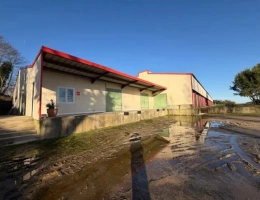
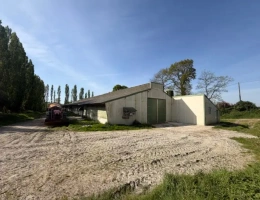
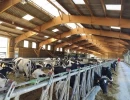
Buildings designed from the outset for goats are rare: most of the local stock comes from cattle sheds, pig units or barns put to another use. So you measure the air volume available, how well the shed ventilates, how rainwater is carried away, the state of floors and bedded areas and the space set aside for young stock. Milking is judged item by item, with the milk line, the washing system, the tank and the chiller. Covered hay storage weighs heavily in the decision, because buying forage in every year quickly unbalances a purchase budget.
The herd is valued separately from the property: animals in milk, average age, the number of replacement goatlings, bucks on site, organic management and milk recording results either justify the asking figure or do not. Where a dwelling and outbuildings come with the business, always ask for the price to be split between residential building, working building and land: the bank, the insurer and SAFER do not reason on the same basis, and the tax treatment of the sale follows from it.
The middle of the department, around Pontivy, Baud, Locminé and Guéméné-sur-Scorff, still buys the most ground for a given budget, even though intensive livestock and the food industry behind it compete for that land. The Landes de Lanvaux, from the Baud country across to Elven, offer light soils and broken parcels that suit rough grazing. The Ploërmel country and the edges of Brocéliande combine pasture and woodland. Towards Le Faouët and the Scorff valley, scattered settlement and medium-sized farms lend themselves well to a goat unit with processing.
The Gulf of Morbihan, the Rhuys peninsula and the surroundings of Auray and Vannes provide dense custom all year and saturated custom in summer, but land priced out of reach for a livestock project. The Redon country and the Oust valley, more affordable, let you settle within sensible distance of the coastal markets. That is usually where the trade-off between purchase cost and access to consumers is settled.
Depending on herd size, the farm falls under the departmental health regulation or the classified installations nomenclature, by declaration then registration, with any change of operator brought to the prefecture's notice. Because the whole territory is a nitrate vulnerable zone, storage structures, the spreading plan and agreements signed with neighbours call for close examination, particularly in the centre of the department where organic loading is high. Enquire too about water catchment protection perimeters, which sometimes cap the extension of a building.
Ask the seller for the herd register, the caprine arthritis-encephalitis screening and the paratuberculosis follow-up, all decisive for the worth of the animals you take on. Goat milk collection is thinly organised in the region: if the unit supplies a creamery, get written confirmation that the contract passes to you; if it does not, processing and direct sale are the heart of the model, with the health approval to be reissued. No protected goat cheese designation exists in Brittany. Finally, verify that rural leases continue, that the structures control, the French authorisation regime for taking over farmland, has been cleared, and that SAFER will not intervene, before you sign.
This section takes in properties from retiring owners, rural estate agencies and notarial offices in Pontivy, Ploërmel, Vannes or Redon. Compare on grassland area, budget or the presence of a processing unit, then schedule an e-mail alert, because few holdings reach the market and many are settled privately. Selling your own herd and buildings? Post the listing. Then widen the search to goat farms for sale in Brittany.