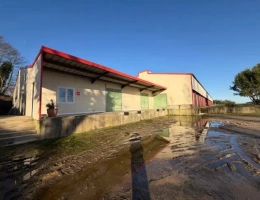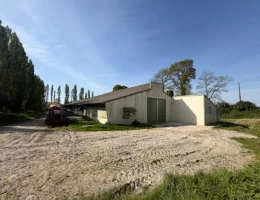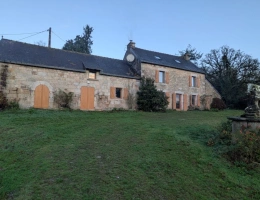
Between central Brittany and the shores of the gulf the contrast is stark, and it runs right through the listings of farms for sale in Morbihan: one may be a finishing unit in the Pontivy country, the next a run of meadows wedged between two coastal communes where farmland shrinks every year. The department lives on solid mixed farming, backed by numerous housed livestock units and hedgerow that is still well kept. Sellers — stockmen at the end of the road, families settling an inheritance, rural agencies and notaries of the Vannetais or the Argoat — describe how the system is run, the state of the buildings, the consents held and the machinery in the deal. These holdings also appear among farms for sale in France.
Beyond the listing itself, this page supplies the bearings needed before an offer: what land costs according to distance from the sea, which productions dominate each Morbihan pays, where retirements feed the market, and which rules bear on a takeover. First-time entrants will find the whole route in our white paper « Créer une exploitation agricole » (in French).
Land forms the base of a farm's value. DVF, the property sales database published by the French tax administration (vineyards excluded), records a 2025 median of €5,507 per hectare in Morbihan (56), an average of €5,980 and 293 sales; four transactions in five fall between €3,748 and €9,162, against a national median of €5,307.
The SAFER land value benchmark sets €5,360 per hectare for vacant land and pasture offered for sale in the same year, +3.7% over one year and +26.4% over ten, against €6,460 nationally. Land sold with a tenancy in place is valued at €4,700, a discount of about 12%.
Against the Bretagne region, whose median is €5,500 per hectare, this department sits 0% higher. For commune-level detail and comparisons with neighbouring areas, see our land price observatory, then cost your purchase with our financial calculators.
Mixed farming remains the dominant model: cereals and maize grown for the herd, grassland, and one or two livestock enterprises depending on the holding. Poultry units and pig enterprises are especially dense in the centre of the department, tied to organised supply chains and a network of feed manufacturers. Milk matters greatly in the inland Vannetais and towards Ploërmel, where dairy holdings run systems combining grass and maize. Smaller productions — seed crops, vegetables for processing, soft fruit — occupy the valleys and the soundest ground.
The purchase logic follows Breton practice, with one local twist: many sites carry several enterprises at once, which complicates valuation. Ask how the result splits between livestock and crop sales, how old each building is, what capacity is authorised and how close the neighbours are. A working farm with two distinct enterprises needs a buyer comfortable in both trades, or a reorganisation whose cost should be estimated at the viewing.
The centre of the department, around Pontivy, Locminé and Baud, is the liveliest sector: housed livestock, well-equipped dairy businesses, frequent handovers and measured land values. The Landes de Lanvaux and the pays de Ploërmel, out to the edge of Brocéliande, combine stock, forage crops and woodland parcels. To the west, the pays du Faouët and the inland marches continue the Argoat, with grazing and low entry prices. The south-east, towards Redon and the Oust valley, mixes marsh, flood meadow and cropping on the terraces.
The coastal strip, from the Auray country to the gulf, the Rhuys peninsula and the Quiberon area, is a market of its own. Land there is wanted for other uses, farming retreats, parcels fragment and values pull well away from the rest of the department. An agricultural property on that fringe usually serves a specialised project — market gardening, direct selling, small ruminants — rather than a conventional system, for want of enough adjoining ground.
In communes governed by the coastal planning regime, new construction must sit in continuity with existing built-up areas: a livestock building, a store or a dwelling cannot simply be placed where it suits, and any extension plan should be tested with the commune before an offer is made. Wetlands, common in the south and along the Oust, add their own restrictions on drainage and on ploughing out grassland.
Elsewhere, a takeover meets the same filters as across the peninsula. Housed units fall under the classified-installation rules, with notification of the change of operator and close reading of the order in force. The department lies in a nitrate vulnerable zone, which governs effluent storage and spreading. SAFER, alerted by the notary, may pre-empt. Authorisation to farm depends on the regional structural plan. And the sitting tenant keeps both first refusal and the protection of the lease.
Two filters save time in this department: distance from the sea, which drives the price, and the number of livestock enterprises, which drives the workload. Combine them with area and budget, then save the search so an e-mail reaches you whenever something close comes up. Local sellers can post a site in minutes. Comparison with neighbouring departments starts from farms for sale in Brittany.