

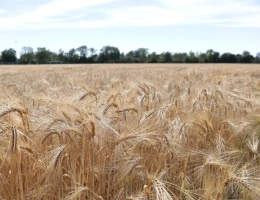
Looking for a goat farm for sale in Aube means searching a department split between open arable plain, vineyard and grassland country, where goat herds settled wherever large-scale cropping left room. The properties shown here are entrusted to us by keepers winding up, by rural estate agencies and by notaries in Troyes or the Bar towns; herd size, grass and forage area, the milking plant and the way the milk is turned to account are all set out. They join our national inventory of goat farms for sale.
You will find more here than a list: local land values, the districts where caprine handovers appear, benchmarks for judging a livestock building and a cheese room, and the checks specific to the sector. Once a start-up project takes shape, the white paper « Créer une exploitation agricole » (in French) sets out how it unfolds.
Land weighs heavily on the budget for a goat farm. Transfers published by the French tax authorities (DVF, excluding vineyards) put the median for farmland in Aube (10) at €11,373/ha in 2025, with an average of €10,929/ha over 179 sales. Eight transactions in ten settle between €5,000 and €17,000/ha, where the national median is €5,307/ha.
A second reference, the SAFER land value benchmark, sets vacant land and pasture at €11,270/ha for 2025, +5.2% in a year and +17.4% over a decade; the French average is €6,460/ha, and a sitting tenant costs a plot roughly 17% of its value.
Acreage accounts for only a fraction of what is asked. What is genuinely being paid for, on a dairy goat holding in this department, is the goat house and its fit-out, the parlour and its bulk tank, the make room, the drying room and cellar, the haymaking machinery, the worth of the herd and above all the customer base built through short supply chains. Refer those items to our land price observatory, then test your figures with our financial calculators.
Buildings on offer range from converted farm sheds through old sheepfolds to recent structures raised for goats. Look at orientation and airflow, the width of feed passages, whether dry does, replacement kids and bucks can be housed apart, the state of the bedded areas and how easily they are cleared. Forage storage counts twice over in a department where buying hay in quickly erodes the margin: roomy covered storage, or barn drying, carries weight in a negotiation. For milking, assess the number of units, the age of the plant and whether cooling meets requirements.
Where a cheese workshop exists, it shapes the income and therefore the asking price. Review the approval held, the one-way flow of production, ventilation in the drying room, cellar volume and the real outlet: farm shop, Troyes markets, producers' stores, weekly boxes. If the deal takes in a house, have dwelling, farm buildings, animals and land clearly distinguished, since that split bears on funding as much as on tax treatment.
The Pays d'Othe, towards Aix-Villemaur-Pâlis and Saint-Mards-en-Othe, keeps a landscape of hedgerows, orchards and woodland that suits a goat herd, and farmsteads change hands there at more affordable levels. The Champagne humide, around Brienne-le-Château and the large reservoirs, offers pasture and available buildings. The Barrois, from Bar-sur-Aube to Bar-sur-Seine, pairs vine slopes with grassy valleys: livestock occupies the margins of the vineyard, with worthwhile visitor custom close at hand through the season.
The Champagne crayeuse, between Arcis-sur-Aube, Méry-sur-Seine and Nogent-sur-Seine, remains dominated by arable cropping and by land values high enough to leave little room for a caprine takeover. Note that no protected goat cheese designation applies in Aube: Chaource, the emblematic cheese of the south-west of the department, is made from cow's milk. A goat unit therefore builds its reputation under its own name.
The regime that applies follows herd size: departmental health rules for small flocks, then declaration, registration or authorisation under the classified installations regime, with a change of operator to be reported. Check siting distances from neighbours, particularly where buildings adjoin a village, together with the spreading plan and effluent storage capacity, governed by the nitrate rules that cover wide parts of the department. Ask as well for borehole compliance and abstraction permits wherever stock water does not come from the mains, and for the record of any complaint lodged by neighbours.
The herd calls for the same rigour: CAEV history, eradication results, the worm control plan, cell counts, replacement rate. For the workshop, request the food safety plan and its self-monitoring records. Finally, taking on the land runs through the structures control, the French authorisation regime for farmland takeovers, in a department where candidates for expansion are numerous: consent is never a given, and SAFER may step in.
Private vendors, specialist agencies and notarial offices keep this page stocked. Narrow the selection by district, by budget or by whether a goat cheese farm comes with its own make room, and ask to be told by e-mail as soon as something matches: opportunities stay scarce. Arranging the handover of your own smallholding? Post the listing. Carry on to goat farms for sale in Grand Est.