

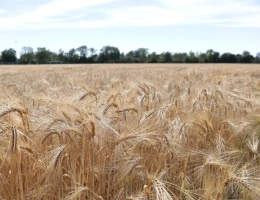
A goat farm for sale in Ardennes belongs to a department of grass and hedgerow country, where goats remain a niche enterprise run by keepers who almost always process their own milk. Sellers approaching retirement, agencies specialising in rural land and notarial offices in Charleville-Mézières, Rethel or Vouziers bring these properties forward; the descriptions give herd size, forage area, milking equipment, whether a make room exists and how the produce is sold. They appear in the national catalogue of goat farms for sale.
This page adds what weighs on a decision: local farmland values, the districts where offers surface, the condition of buildings frequently inherited from cattle farming, and the points to verify before taking on a farmhouse workshop. The white paper « Créer une exploitation agricole » (in French) supports the preparation of a start-up.
Land weighs heavily on the budget for a goat farm. Transfers published by the French tax authorities (DVF, excluding vineyards) put the median for farmland in Ardennes (08) at €5,702/ha in 2025, with an average of €7,559/ha over 209 sales. Eight transactions in ten settle between €4,229 and €14,812/ha, where the national median is €5,307/ha.
A second reference, the SAFER land value benchmark, sets vacant land and pasture at €6,850/ha for 2025, -1.0% in a year and +25.0% over a decade; the French average is €6,460/ha, and a sitting tenant costs a plot roughly 17% of its value.
Grassland hectares alone will not account for a price. On a dairy goat holding here, the buyer is mostly paying for the livestock building and its internal fit-out, the parlour and tank, the cheese room with its drying room, cellar and cold store, the forage machinery, the animals, and then the trade itself: delivery rounds, producers' shops, town markets, public catering. Place those against our land price observatory and our financial calculators.
Many caprine units in the Ardennes occupy former cow byres or converted cattle sheds. That conversion is rarely neutral: ceiling height, ventilation of a volume designed for other stock, damp in the walls, floor falls and effluent removal all deserve serious inspection. Hay storage capacity governs winter self-sufficiency in a department where grass growth stops early; barn drying or well-sized covered storage is a genuine advantage. On the milking side, check the number of units against the herd, the state of the milk line, the washing system and the electrical compliance of the whole installation.
Where a cheese room accompanies the herd, it usually carries most of the income. Look at the health approval or the exemption covering direct sales, the separation of clean and dirty routes, the condition of the cold stores and how steady sales are across the year, month by month. Properties on offer often combine house, buildings and land: ask for an item-by-item breakdown, since the residential share can markedly change the funding plan and the tax treatment of the deal.
The north of the department, between the Ardennes massif and the Meuse valley, combines woodland, permanent pasture and narrow parcels; takeovers there involve small units, on some of the most affordable land in the region. The Thiérache ardennaise, around Signy-le-Petit, Rumigny and Liart, remains hedgerow and grass country well suited to a goat herd. The Crêtes préardennaises, from Signy-l'Abbaye to Launois-sur-Vence, mix livestock with arable. Further south, the Argonne ardennaise towards Vouziers and Grandpré retains grassland and available buildings.
By contrast, the arable plains of the Rethélois and the Porcien see fierce competition for every parcel released, which lifts land values and makes takeovers harder to assemble. No protected goat cheese designation covers the department: value rests on the reputation each goat cheese farm builds under its own name, carried by Charleville-Mézières, Sedan, cross-border Belgian custom and the markets of the Reims area.
Depending on herd size, the unit falls under departmental health regulations or under the French classified installations regime, by declaration, registration or authorisation, with a change of operator to be notified. Check the distances between buildings and neighbouring houses, a sensitive matter in the long street villages of the Ardennes, along with the manure spreading plan, its capacity and the parcels genuinely available for it. Parts of the department are designated nitrate vulnerable zones, which govern spreading periods and storage capacity: ask to see the paperwork rather than rely on a verbal account.
As for the herd, ask for the CAEV history, eradication programme results, the parasite control record — damp valley pasture raises that exposure — and cell counts for recent seasons. A goat unit being handed over is also judged on replacement kids and the average age of the milkers. Finally, taking on the rented land stays subject to the structures control, the French authorisation regime for farmland takeovers, and to SAFER's scrutiny.
The properties shown come from private sellers as much as from rural property professionals and notarial offices. Use the filters for area, budget or how the milk is valued, then switch on the e-mail alert: a smallholding of this kind is seldom flagged long in advance. Handing yours over? Publish it here. Widen the search to goat farms for sale in Grand Est.