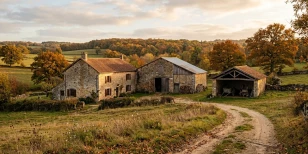

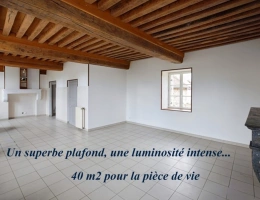
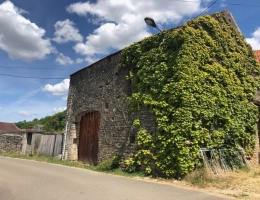
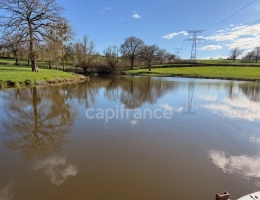
Finding a mill for sale in Territoire de Belfort (90) takes patience: this small department, wedged between the Vosges and the Jura foothills of Alsace, has fewer former mills than its Doubs or Haute-Saône neighbours, though the Savoureuse, the Rosemontoise and the Allaine once powered flour mills and water-driven sawmills into the 20th century. Ma-propriete.fr brings together here the mills for sale in Territoire de Belfort: converted former watermills, valley flour mills and millers' houses with outbuildings. A handful of former water-powered sawmills, a legacy of the small Vosges timber industry, also occasionally come up for sale.
This page also gives price benchmarks from actual sales, an overview of where these properties are still found, and the points to check before buying a mill. To plan your project, see our white paper on setting up a rural gîte, useful for making the most of a former mill's outbuildings. Listings are scarce here, so each new one deserves close attention.
There are no official statistics dedicated to mills: sales are too rare and too varied (a ruin to restore, a habitable mill, a flour mill with a turbine). The most reliable market benchmark remains the price of country houses, which a habitable mill resembles, with a premium for the water, the character and the water rights, and a discount for the work required.
How much does a country house cost in Territoire de Belfort (90)? According to DVF data (notarised sales) analysed by the ma-propriete.fr observatory, the median price of a country house in Territoire de Belfort (90) stood at €203,840 in 2025, with an average price of €207,443 and a median price of €1,730/m² of living space (191 house sales in rural municipalities over the year). The price range is wide: 10% of houses sold for less than €122,500 (floor price, 1st decile) and 10% for more than €306,321 (ceiling price, 9th decile). The typical country house here offers 121 m² of living space on an average plot of 1,956 m², i.e. around 0.2 ha.
This market is well above the regional median (Bourgogne-Franche-Comté: €157,000) and above the national median (€189,200). Since the second half of 2020, the median price has risen from €200,000 to €203,840, i.e. +1.9%; over one year (2024-2025) the change is +1.9%.
| 2025 indicator | Territoire de Belfort | Bourgogne-Franche-Comté | France |
|---|---|---|---|
| Median price | €203,840 | €157,000 | €189,200 |
| Average price | €207,443 | €168,680 | €207,100 |
| Floor price (1st decile) | €122,500 | €74,000 | €90,000 |
| Ceiling price (9th decile) | €306,321 | €279,670 | €340,000 |
| Median price per m² of living space | €1,730/m² | €1,525/m² | €1,830/m² |
| Average living space | 121 m² | 108 m² | 108 m² |
| Average plot size | 1,956 m² | 2,805 m² | 3,181 m² |
| Number of sales in 2025 | 191 | 11,450 | 150,313 |
A departmental average hides large gaps. A smallholding to renovate, a restored longère with its outbuildings, a farmhouse on several hectares of land or a manor house with parkland do not sell at the same price, and the location matters as much as the building: coastline, tourist area, peri-urban countryside close to a job market or deep countryside. The table below shows the median price of country houses in Territoire de Belfort (90) by type of municipality (cumulative sales from mid-2020 to 2025) and its change between 2021 and 2025.
| Type of municipality | Median price 2020-2025 | Median price per m² | Change 2021-2025 | Sales 2020-2025 |
|---|---|---|---|---|
| Peri-urban countryside (city catchment area) | €210,000 | €1,825/m² | -1.2% | 875 |
| Deep countryside (outside urban influence) | €203,950 | €1,794/m² | +28.8% | 207 |
These benchmarks help you assess a listing, estimate a property before putting it up for sale, or set your budget for a holiday home or a permanent move to the French countryside. To go further, see our observatory of country house prices in France (national, regional and departmental analysis, downloadable annual report) and work out the full cost of your purchase, including French notary fees, with our notary fees calculator.
Territoire de Belfort is a foothill department where textile and metalworking industry largely replaced traditional milling from the 19th century onwards. The Savoureuse, running through Belfort, Giromagny and Sermamagny, and the Rosemontoise around Rougemont-le-Château nonetheless fed a handful of watermills and valley flour mills, now rare on the market and often converted into homes with a millrace and remains of a water wheel. Some of these sites combined milling with a small craft activity, a mixed use that explains the variety of outbuildings still found around the main structure today.
Windmills are essentially absent from the department, given the Vosges relief and continental climate, and there is no tide-mill tradition either, since the territory lies far from any coastline. Most of the stock on offer is therefore small to medium watermills, with an attached mill house. Buyers seeking real authenticity should therefore widen their search towards neighbouring Doubs or Haute-Saône, where the supply of classic mills is larger.
The Savoureuse valley, between Belfort and Giromagny, served by the Belfort-Montbéliard TGV station, holds most of the older water-powered buildings, in a still-wooded setting at the foot of the Ballon d'Alsace. The Rougemont-le-Château area and the Rosemontoise valley are quieter but the market there is thinner. Around Delle and the Swiss border, watercourses are smaller and mills even rarer. Proximity to Basel-Mulhouse airport and cross-border job markets also explains part of the demand in this small territory. Commuters working across the Swiss and German borders often favour this valley for its combination of countryside living and easy access to jobs.
Properties near Belfort and its urban area sell well above the departmental average, helped by jobs and the TGV link; the southern part of the department, towards Delle, remains more affordable but with a limited number of listings. A tighter budget will point towards the rural south-west of the department, less sought-after than the Belfort urban ring.
Given how scarce this building type is, check the water rights attached to the property carefully: many small Vosges mills have lost their status as a mill fondé en titre for lack of continuous operation. The condition of the millrace, sluice gates and weir should be examined, along with ecological-continuity obligations on the classified stretches of the Savoureuse and its tributaries. It is also worth requesting the history of the site's uses from the town hall or departmental archives, since a mill has often changed function several times over the centuries.
The building, often in Vosges sandstone, is exposed to valley-floor damp: check drainage and flood zoning. Where present, outbuildings allow for a gîte project, an appealing option so close to the trails of the Vosges massif. Finally, check year-round vehicle access to the mill, which can be isolated at the bottom of a valley, before making any offer. A local architect familiar with regional heritage rules can help plan a sympathetic renovation that respects the sandstone facades typical of the area.
On ma-propriete.fr, mill listings in Territoire de Belfort are published by private sellers, estate agents and notaries. Filter by budget, living space and land area, set up an email alert to be told of new listings, and browse all mills for sale in Bourgogne-Franche-Comté if your search extends beyond the department. It is also worth comparing properties in Territoire de Belfort with those in neighbouring Doubs, where the mill market is more active.