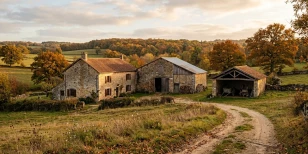

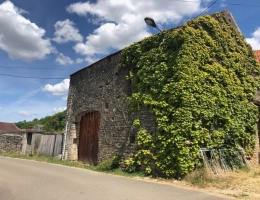
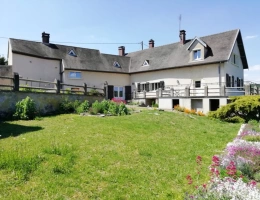
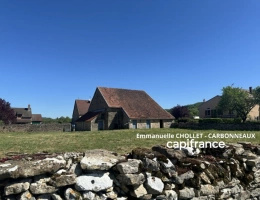
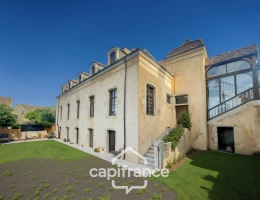
Buying a mill for sale in Côte-d'Or (21) means choosing a department where Burgundy's vineyards meet its rivers: the Ouche and the Canal de Bourgogne around Dijon, the Armançon and the Brenne in the Auxois, the Vingeanne and the Tille towards the eastern plain, once drove hundreds of watermills until the mid-20th century. On this page, ma-propriete.fr brings together the mills for sale in Côte-d'Or: watermills to renovate, restored former mills, converted flour mills and millers' houses with millrace.
You will also find price benchmarks based on actual sales, an overview of the areas where these properties are concentrated, and the specific points to check before buying a mill. To prepare your project, read our guide to creating a rural gîte, useful for turning outbuildings into tourist accommodation near the vineyards. An Auxois mill can also retain an old, unused water right, and bringing it back into service requires prior administrative steps.
There are no official statistics dedicated to mills: sales are too rare and too varied (a ruin to restore, a habitable mill, a flour mill with a turbine). The most reliable market benchmark remains the price of country houses, which a habitable mill resembles, with a premium for the water, the character and the water rights, and a discount for the work required.
How much does a country house cost in Côte-d'Or (21)? According to DVF data (notarised sales) analysed by the ma-propriete.fr observatory, the median price of a country house in Côte-d'Or (21) stood at €198,000 in 2025, with an average price of €204,119 and a median price of €1,900/m² of living space (1,634 house sales in rural municipalities over the year). The price range is wide: 10% of houses sold for less than €90,000 (floor price, 1st decile) and 10% for more than €324,140 (ceiling price, 9th decile). The typical country house here offers 111 m² of living space on an average plot of 1,947 m², i.e. around 0.2 ha.
This market is well above the regional median (Bourgogne-Franche-Comté: €157,000) and close to the national median (€189,200). Since the second half of 2020, the median price has risen from €175,000 to €198,000, i.e. +13.1%; over one year (2024-2025) the change is +3.7%.
| 2025 indicator | Côte-d'Or | Bourgogne-Franche-Comté | France |
|---|---|---|---|
| Median price | €198,000 | €157,000 | €189,200 |
| Average price | €204,119 | €168,680 | €207,100 |
| Floor price (1st decile) | €90,000 | €74,000 | €90,000 |
| Ceiling price (9th decile) | €324,140 | €279,670 | €340,000 |
| Median price per m² of living space | €1,900/m² | €1,525/m² | €1,830/m² |
| Average living space | 111 m² | 108 m² | 108 m² |
| Average plot size | 1,947 m² | 2,805 m² | 3,181 m² |
| Number of sales in 2025 | 1,634 | 11,450 | 150,313 |
A departmental average hides large gaps. A smallholding to renovate, a restored longère with its outbuildings, a farmhouse on several hectares of land or a manor house with parkland do not sell at the same price, and the location matters as much as the building: coastline, tourist area, peri-urban countryside close to a job market or deep countryside. The table below shows the median price of country houses in Côte-d'Or (21) by type of municipality (cumulative sales from mid-2020 to 2025) and its change between 2021 and 2025.
| Type of municipality | Median price 2020-2025 | Median price per m² | Change 2021-2025 | Sales 2020-2025 |
|---|---|---|---|---|
| Inland tourist areas (hinterland, mountains) | €126,000 | €1,205/m² | +31.2% | 437 |
| Peri-urban countryside (city catchment area) | €220,000 | €2,044/m² | +3.7% | 6,973 |
| Deep countryside (outside urban influence) | €134,450 | €1,271/m² | +11.4% | 2,924 |
These benchmarks help you assess a listing, estimate a property before putting it up for sale, or set your budget for a holiday home or a permanent move to the French countryside. To go further, see our observatory of country house prices in France (national, regional and departmental analysis, downloadable annual report) and work out the full cost of your purchase, including French notary fees, with our notary fees calculator.
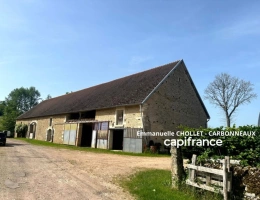
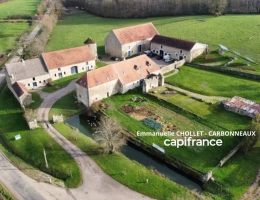
The Armançon and its tributary the Brenne, around Semur-en-Auxois and Montbard, together with the young Seine near Châtillon-sur-Seine, once powered numerous watermills in the Auxois, a land of hedgerows and cattle farming. Near Dijon, the Ouche and the Canal de Bourgogne also retain former mill sites, now converted. Many of these Auxois mills have kept a typical Burgundy stone architecture, with a shallow-pitched roof covered in flat tiles. Dressed-stone lintels and door and window surrounds, typical of the region, are a reliable sign of the building's age.
On the plain of the Vingeanne and the Tille, in the east of the department, the smaller waterways mostly powered small village flour mills; windmills, rare in Côte-d'Or, survive only as remnants on a few hilltops without rivers, notably around the Montagne châtillonnaise. The Canal de Bourgogne, built in the 19th century, also led to the conversion or disappearance of several mills along its route. Several former mills have been converted into artists' studios, taking advantage of the quiet and light of the Burgundy valleys.
For a habitable mill with land, the Auxois, around Semur-en-Auxois, Montbard and Saulieu, served by the Montbard TGV station, offers the widest choice of characterful stone mills. The more forested Châtillonnais, around Châtillon-sur-Seine, remains more low-key. Near Dijon and the Côte de Nuits, mills are scarce but sought after for their closeness to the vineyards. The Saulieu area, on the edge of the Morvan, adds more forested mills, halfway between Burgundy and the Nivernais. The Beaune area, capital of Burgundy wine, is out of reach for a mill to renovate but influences prices nearby.
Mills within thirty minutes of Dijon or Beaune, at the heart of the vineyards, sell well above the regional average. The Auxois and the Châtillonnais, further from the motorway network, remain the most affordable areas for a mill to renovate. Properties in the Châtillonnais, more remote, often come with larger plots of land for a similar budget. Rural communes in the north of the department, around Is-sur-Tille, offer a balance between quiet and access to Dijon.
Check the existence and scope of the water rights (a mill fondé en titre or holding an authorisation), the condition of the millrace, weir and sluice gates, and ecological-continuity obligations on the Armançon and the upper Seine, both classified along several stretches. A hydroelectric turbine project requires a prior technical and administrative study. The clay-limestone soils of the Auxois can also raise ground-movement questions worth checking before any work. Vaulted cellars, common in these old buildings, can support a wine-related conversion project.
These Burgundy limestone buildings, often at the bottom of a damp valley, call for checking flood zoning, roof condition and drainage. Outbuildings — the miller's lodging, a barn, a shed — suit a gîte project well, a format suited to a region heavily visited for wine tourism. Adjoining farm buildings, barns and sheds, deserve close attention when assessing their conversion potential. A full damp survey is recommended before any project to convert the outbuildings into accommodation.
On ma-propriete.fr, mill listings in Côte-d'Or are published by private sellers, estate agents and notaries. Filter by budget, living space and land area, set up an email alert to be told of new listings, and browse all mills for sale in Bourgogne-Franche-Comté if your search extends beyond the department. Mills near major Burgundy tourist routes, such as the Route des Grands Crus, remain among the most sought after.