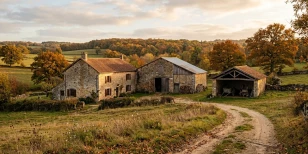

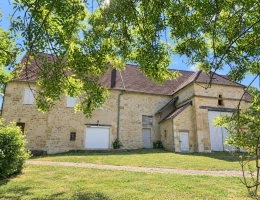
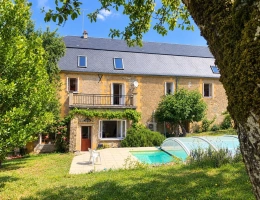
A mill for sale in Nièvre (58) is most often found along the Loire, the young Yonne or their tributaries in the Morvan: the department has kept a rural stock of watermills tied to the forests and lakes of the Morvan as well as the plains of the Nivernais. On this page, ma-propriete.fr brings together the mills for sale in Nièvre: a watermill to renovate, a former flour mill or a miller's house with outbuildings.
You will also find price benchmarks based on actual sales, an overview of the areas where these properties are concentrated, and the specific points to check before buying a mill. To prepare your project, read our white paper on creating a rural gîte, especially useful if you are considering hosting guests in the outbuildings. As elsewhere, technical surveys (drainage, electrics, mechanism condition) remain an essential first step before costing a renovation project.
There are no official statistics dedicated to mills: sales are too rare and too varied (a ruin to restore, a habitable mill, a flour mill with a turbine). The most reliable market benchmark remains the price of country houses, which a habitable mill resembles, with a premium for the water, the character and the water rights, and a discount for the work required.
How much does a country house cost in Nièvre (58)? According to DVF data (notarised sales) analysed by the ma-propriete.fr observatory, the median price of a country house in Nièvre (58) stood at €100,000 in 2025, with an average price of €105,510 and a median price of €1,065/m² of living space (1,371 house sales in rural municipalities over the year). The price range is wide: 10% of houses sold for less than €46,000 (floor price, 1st decile) and 10% for more than €172,900 (ceiling price, 9th decile). The typical country house here offers 97 m² of living space on an average plot of 3,364 m², i.e. around 0.3 ha.
This market is well below the regional median (Bourgogne-Franche-Comté: €157,000) and well below the national median (€189,200). Since the second half of 2020, the median price has risen from €85,000 to €100,000, i.e. +17.6%; over one year (2024-2025) the change is +7.8%.
| 2025 indicator | Nièvre | Bourgogne-Franche-Comté | France |
|---|---|---|---|
| Median price | €100,000 | €157,000 | €189,200 |
| Average price | €105,510 | €168,680 | €207,100 |
| Floor price (1st decile) | €46,000 | €74,000 | €90,000 |
| Ceiling price (9th decile) | €172,900 | €279,670 | €340,000 |
| Median price per m² of living space | €1,065/m² | €1,525/m² | €1,830/m² |
| Average living space | 97 m² | 108 m² | 108 m² |
| Average plot size | 3,364 m² | 2,805 m² | 3,181 m² |
| Number of sales in 2025 | 1,371 | 11,450 | 150,313 |
A departmental average hides large gaps. A smallholding to renovate, a restored longère with its outbuildings, a farmhouse on several hectares of land or a manor house with parkland do not sell at the same price, and the location matters as much as the building: coastline, tourist area, peri-urban countryside close to a job market or deep countryside. The table below shows the median price of country houses in Nièvre (58) by type of municipality (cumulative sales from mid-2020 to 2025) and its change between 2021 and 2025.
| Type of municipality | Median price 2020-2025 | Median price per m² | Change 2021-2025 | Sales 2020-2025 |
|---|---|---|---|---|
| Inland tourist areas (hinterland, mountains) | €85,000 | €943/m² | +19.3% | 2,513 |
| Peri-urban countryside (city catchment area) | €110,000 | €1,157/m² | -1.8% | 2,386 |
| Deep countryside (outside urban influence) | €86,940 | €964/m² | +18.8% | 3,428 |
These benchmarks help you assess a listing, estimate a property before putting it up for sale, or set your budget for a holiday home or a permanent move to the French countryside. To go further, see our observatory of country house prices in France (national, regional and departmental analysis, downloadable annual report) and work out the full cost of your purchase, including French notary fees, with our notary fees calculator.
Nièvre owes its relief to the Morvan, a granite massif dotted with streams and lakes that feed the Nièvre, Aron, the source of the Yonne and the Chalaux: these fast-flowing streams powered many, often modest, watermills used for grinding grain or sawing timber. In the Nivernais, the farming plain around La Charité-sur-Loire and Nevers, mills line the Loire itself and its calmer tributaries close to the Allier. These small structures, often built in local granite, differ from the larger industrial flour mills that survived further downstream, on rivers with a more regular flow.
Windmills are practically absent from the department, as neither the wooded Morvan bocage nor the Nivernais plains developed that tradition; the market therefore centres on watermills and former village flour mills. Slate or flat-tile roofs, depending on the part of the department, add to the architectural variety of these Nivernais and Morvan mills.
The Nivernais Morvan, around Château-Chinon, Lormes and the Pannecière and Saint-Agnan lakes, offers isolated mills deep in the forest, valued for their natural setting. Along the Loire, between Nevers, Fourchambault and La Charité-sur-Loire, there are former flour mills and more accessible plain mills. The north of the department, around Clamecy and the Yonne valley, retains rural buildings in limestone near the Nivernais canal. The Nivernais canal itself, between Corbigny and Clamecy, runs past several former mill sites converted into river stopovers or private homes.
Mills close to Nevers and the Loire corridor, well served by roads, sell for more than those deep in the Morvan, where distance from services is offset by a remarkable natural setting and more affordable prices. Properties near the Nivernais canal also benefit from growing tourist appeal linked to leisure boating and cycling routes.
As everywhere, check the mill's water rights (fondé en titre or authorised), the condition of the millrace, weir and sluice gates, and the ecological-continuity obligations that particularly concern the Morvan's trout streams, classified to protect migratory fish. An original water wheel or millstone adds heritage value, but restoration costs should be assessed before any hydroelectric project. It is also worth having any work carried out on the millrace during conversion to housing checked for origin and legality.
The building, in granite in the Morvan and limestone in the Nivernais, often sits at the bottom of a damp valley: check the drainage, flood zoning and year-round access. Outbuildings can sometimes be turned into a gîte, an activity in demand near the Morvan lakes and the Nivernais canal. It is also worth checking the electricity connection and the state of access tracks, which can be basic in the more remote hamlets of the Morvan.
On ma-propriete.fr, mill listings in Nièvre are published by private sellers, estate agents and notaries. Filter by budget, living space and land area, set up an email alert to be told of new listings, and browse all mills for sale in Bourgogne-Franche-Comté if your search extends beyond the department. Do not hesitate to ask the agent or notary handling the file for the site's known history of successive uses, useful for anticipating any administrative steps. A local surveyor familiar with Morvan properties can help estimate realistic renovation costs before an offer is made.