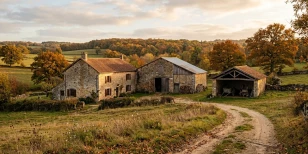

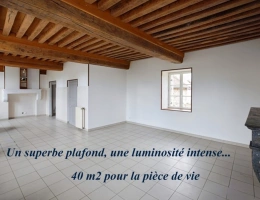
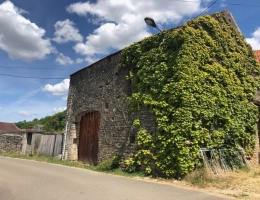
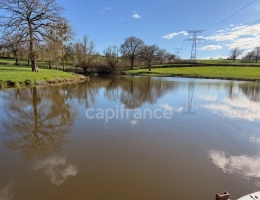
Buying a mill for sale in Doubs (25) means choosing a Jura department where the Doubs, the Loue, the Dessoubre and the Cusancin tumble through cascades and sweeping loops, having once driven both watermills for grinding grain and former forges and hammer mills that gave rise to the local watch-making and mechanical industry. On this page, ma-propriete.fr brings together the mills for sale in Doubs: watermills to renovate, former mill-forges, converted flour mills and millers' houses.
You will also find price benchmarks based on actual sales, an overview of the areas where these properties are concentrated, and the specific points to check before buying a mill. To prepare your project, read our guide to creating a rural gîte, useful for turning outbuildings into mountain accommodation. A former Doubs mill can also retain an industrial water right inherited from its past as a forge or mechanical workshop.
There are no official statistics dedicated to mills: sales are too rare and too varied (a ruin to restore, a habitable mill, a flour mill with a turbine). The most reliable market benchmark remains the price of country houses, which a habitable mill resembles, with a premium for the water, the character and the water rights, and a discount for the work required.
How much does a country house cost in Doubs (25)? According to DVF data (notarised sales) analysed by the ma-propriete.fr observatory, the median price of a country house in Doubs (25) stood at €224,920 in 2025, with an average price of €231,971 and a median price of €2,097/m² of living space (1,307 house sales in rural municipalities over the year). The price range is wide: 10% of houses sold for less than €120,000 (floor price, 1st decile) and 10% for more than €351,981 (ceiling price, 9th decile). The typical country house here offers 112 m² of living space on an average plot of 1,535 m², i.e. around 0.2 ha.
This market is well above the regional median (Bourgogne-Franche-Comté: €157,000) and well above the national median (€189,200). Since the second half of 2020, the median price has risen from €197,000 to €224,920, i.e. +14.2%; over one year (2024-2025) the change is +3.1%.
| 2025 indicator | Doubs | Bourgogne-Franche-Comté | France |
|---|---|---|---|
| Median price | €224,920 | €157,000 | €189,200 |
| Average price | €231,971 | €168,680 | €207,100 |
| Floor price (1st decile) | €120,000 | €74,000 | €90,000 |
| Ceiling price (9th decile) | €351,981 | €279,670 | €340,000 |
| Median price per m² of living space | €2,097/m² | €1,525/m² | €1,830/m² |
| Average living space | 112 m² | 108 m² | 108 m² |
| Average plot size | 1,535 m² | 2,805 m² | 3,181 m² |
| Number of sales in 2025 | 1,307 | 11,450 | 150,313 |
A departmental average hides large gaps. A smallholding to renovate, a restored longère with its outbuildings, a farmhouse on several hectares of land or a manor house with parkland do not sell at the same price, and the location matters as much as the building: coastline, tourist area, peri-urban countryside close to a job market or deep countryside. The table below shows the median price of country houses in Doubs (25) by type of municipality (cumulative sales from mid-2020 to 2025) and its change between 2021 and 2025.
| Type of municipality | Median price 2020-2025 | Median price per m² | Change 2021-2025 | Sales 2020-2025 |
|---|---|---|---|---|
| Inland tourist areas (hinterland, mountains) | €304,375 | €3,005/m² | -5.5% | 146 |
| Peri-urban countryside (city catchment area) | €206,850 | €1,923/m² | +2.9% | 4,147 |
| Deep countryside (outside urban influence) | €240,000 | €2,192/m² | +11.9% | 3,256 |
These benchmarks help you assess a listing, estimate a property before putting it up for sale, or set your budget for a holiday home or a permanent move to the French countryside. To go further, see our observatory of country house prices in France (national, regional and departmental analysis, downloadable annual report) and work out the full cost of your purchase, including French notary fees, with our notary fees calculator.
The Doubs, in its loops around Villers-le-Lac and Besançon, the Loue near Ornans, the Dessoubre near Saint-Hippolyte and the Cusancin once carried a large number of watermills, many of which kept a strong drop in elevation well suited to a water wheel or a hydroelectric turbine. Some sites still have their original wheel or turbine, occasionally once connected to a small mechanical workshop. Facades in Burgundy or Jura stone, depending on the area, stand out for their lighter tone compared with granite.
A distinctive feature of Doubs, many former mills were converted from the 19th century onward into small forges, hammer mills or watch-making workshops, giving rise to the mechanical industry of the Montbéliard area. Windmills are absent from this karst landscape rich in fast-flowing streams, where hydraulic power always dominated. The Peugeot family itself descends from a line of millers and blacksmiths established at a former mill in the Montbéliard area. Several former mill-forges have been converted into craft workshops or small local production units.
For a habitable mill with land, the Loue valley around Ornans, made famous by the painter Courbet, offers one of the most sought-after settings. The Dessoubre valley, near Saint-Hippolyte, and the Doubs valley near Morteau, at higher altitude, also hold former watch-making mills. The Besançon area, served by its TGV station, gives quick access to the loops of the Doubs. The Pontarlier area, close to the Swiss border, adds mid-mountain mills valued for their peace and quiet. The Besançon area, a well-served regional capital, adds properties closer to jobs to this offering.
Mills near Ornans and Besançon sell above the regional average, boosted by tourism and closeness to the prefecture. The Haut-Doubs, around Morteau and Pontarlier, harsher in winter, remains more accessible for a mill to renovate. Mill-forges in the Montbéliard area, more industrial in style, can be priced differently from traditional grain mills. The high plateaus of the Doubs, close to the Swiss border, appeal to cross-border buyers seeking open space.
Check the existence and scope of the water rights (a mill fondé en titre or holding an authorisation), the condition of the millrace, weir and sluice gates, and ecological-continuity obligations, as the Loue and Dessoubre are classified trout rivers under close watch since several pollution incidents. A hydroelectric turbine project is sometimes feasible but requires a rigorous prior study. The Doubs's karst landscape exposes some sites to marked flow variations between summer low water and spring flooding. A roof-frame survey is particularly advisable in this mountain climate, marked by heavy winter snowfall.
The buildings, in Jura limestone under tile or stone-slab roofs, withstand the mountain climate well but require checking damp, flood zoning in case the Doubs floods, and winter access. Outbuildings suit a gîte project well, a format much sought after along the Doubs's hiking trails. At higher altitude, check thermal insulation and road access in case of heavy snowfall. Working with local craftspeople familiar with limestone buildings and mountain roofing reduces the risk of renovation mistakes.
On ma-propriete.fr, mill listings in Doubs are published by private sellers, estate agents and notaries. Filter by budget, living space and land area, set up an email alert to be told of new listings, and browse all mills for sale in Bourgogne-Franche-Comté if your search extends beyond the department. Mills near the tourist loops of the Doubs, between Villers-le-Lac and Besançon, draw a loyal clientele seeking peace and quiet.