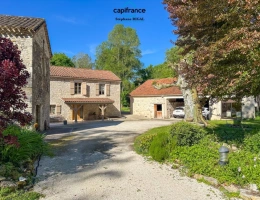
Buying a mill for sale in Lot (46) means choosing a Quercy department where watermills in the Lot, Célé and Dordogne valleys sit alongside rare dry-stone windmills on the arid causse plateaus of Gramat and Limogne. On this page, ma-propriete.fr brings together the mills for sale in Lot: watermills built into the rock or in limestone, causse windmills and millers' houses.
You will also find price benchmarks based on actual sales, an overview of the areas where these properties are concentrated, and the points to check before buying a mill. To prepare your project, read our guide to buying a country house in France, whose advice on old buildings, outbuildings and financing applies fully to a mill. The Lot valley's reputation as one of France's most scenic areas keeps tourist interest high, which feeds directly into demand for these character properties.
There are no official statistics dedicated to mills: sales are too rare and too varied (a ruin to restore, a habitable mill, a flour mill with a turbine). The most reliable market benchmark remains the price of country houses, which a habitable mill resembles, with a premium for the water, the character and the water rights, and a discount for the work required.
How much does a country house cost in Lot (46)? According to DVF data (notarised sales) analysed by the ma-propriete.fr observatory, the median price of a country house in Lot (46) stood at €168,508 in 2025, with an average price of €179,607 and a median price of €1,685/m² of living space (1,295 house sales in rural municipalities over the year). The price range is wide: 10% of houses sold for less than €90,000 (floor price, 1st decile) and 10% for more than €285,081 (ceiling price, 9th decile). The typical country house here offers 108 m² of living space on an average plot of 5,857 m², i.e. around 0.6 ha.
This market is well below the regional median (Occitanie: €210,000) and below the national median (€189,200). Since the second half of 2020, the median price has risen from €150,000 to €168,508, i.e. +12.3%; over one year (2024-2025) the change is -2.9%.
| 2025 indicator | Lot | Occitanie | France |
|---|---|---|---|
| Median price | €168,508 | €210,000 | €189,200 |
| Average price | €179,607 | €220,462 | €207,100 |
| Floor price (1st decile) | €90,000 | €107,500 | €90,000 |
| Ceiling price (9th decile) | €285,081 | €347,000 | €340,000 |
| Median price per m² of living space | €1,685/m² | €1,987/m² | €1,830/m² |
| Average living space | 108 m² | 111 m² | 108 m² |
| Average plot size | 5,857 m² | 4,162 m² | 3,181 m² |
| Number of sales in 2025 | 1,295 | 14,163 | 150,313 |
A departmental average hides large gaps. A smallholding to renovate, a restored longère with its outbuildings, a farmhouse on several hectares of land or a manor house with parkland do not sell at the same price, and the location matters as much as the building: coastline, tourist area, peri-urban countryside close to a job market or deep countryside. The table below shows the median price of country houses in Lot (46) by type of municipality (cumulative sales from mid-2020 to 2025) and its change between 2021 and 2025.
| Type of municipality | Median price 2020-2025 | Median price per m² | Change 2021-2025 | Sales 2020-2025 |
|---|---|---|---|---|
| Inland tourist areas (hinterland, mountains) | €180,000 | €1,723/m² | -1.5% | 1,407 |
| Peri-urban countryside (city catchment area) | €178,000 | €1,723/m² | +4.8% | 1,714 |
| Deep countryside (outside urban influence) | €165,000 | €1,643/m² | +1.3% | 4,621 |
These benchmarks help you assess a listing, estimate a property before putting it up for sale, or set your budget for a holiday home or a permanent move to the French countryside. To go further, see our observatory of country house prices in France (national, regional and departmental analysis, downloadable annual report) and work out the full cost of your purchase, including French notary fees, with our notary fees calculator.
The Lot, between Cahors, Puy-l'Évêque and Bouzies, winds through steep meanders where watermills benefited from a marked drop in level; several are built directly against the cliff face. The Célé, near Figeac and Cabrerets, and the Dordogne, around Souillac, complete this network with mills often built of local limestone. The Lot gorges, whose riverside villages carry a strong heritage reputation, add to the tourist appeal of these steep-valley mills.
On the causse plateaus of Gramat and Limogne, limestone tablelands with no permanent watercourse, rare dry-stone windmills can be found instead, once used to grind grain where no river was available; these are rare properties, usually sold with very little land.
The Lot valley, between Cahors and Puy-l'Évêque, holds most of the habitable mills, in a tourist area known for its vineyards and stone villages. The Célé valley, around Figeac and Cabrerets, offers a wilder setting. The Gramat causse, around Rocamadour and Gramat, and the Limogne causse further south, remain the territory of the department's rare windmills. Cahors railway station, on the Paris-Toulouse line, makes the Lot valley easy to reach from the capital. The Gourdon area, in the north-west of the department on the first foothills of the Périgord, offers a more affordable alternative to the tourist-heavy Lot and Célé valleys.
Mills in the Lot valley, highly sought after for tourism, sell for noticeably more than causse properties, where isolation and the lack of water limit demand. A mill within the protection perimeter of a listed site, common in the Lot valley, may have its renovation project overseen by the local heritage architect.
For a watermill on the Lot or the Célé, check the water rights — often fondé en titre on these historically well-equipped rivers — the condition of the millrace and sluice gates, and the ecological continuity obligations, since the Lot valley is classified for migrating shad and salmon. On the causse, the absence of a mains water network makes it essential to check for a borehole or a cistern before any permanent-residence project.
Mills built against the cliff require careful checking of rock stability and damp. On the causse, a windmill is mainly chosen for its heritage value; the outbuildings of a watermill, more common, make it possible to consider a gîte in this highly touristic region. The vaulted cellars often found beneath these cliffside mills lend themselves well to use as a wine cellar rather than as extra living space.
On ma-propriete.fr, mill listings in Lot are published by private sellers, estate agents and notaries. Filter by budget, living space and land area, set up an email alert to be told of new listings, and browse all mills for sale in Occitanie if your search extends beyond the department. It is also worth comparing nearby properties in neighbouring Tarn-et-Garonne, where some mills in the Aveyron valley share similar characteristics. A local notary in Cahors or Figeac can also flag off-market mills before they are formally advertised. Booking a visit at different times of year is particularly useful here, since water levels in the Lot and the Célé can vary considerably between seasons. A short stopover in Cahors before a viewing is also a good way to get a feel for the pace and character of the local property market.