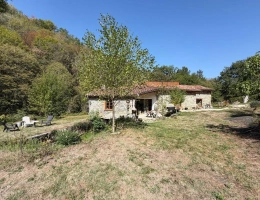
Buying a mill for sale in Ariège (09) means looking at the foot of the Pyrenees, between mountain torrents and the Lauragais plain: the department has numerous former watermills along the Ariège, Salat, Hers-Vif, Arize and Vicdessos rivers, as well as former fulling mills tied to the textile tradition of Lavelanet. On this page, ma-propriete.fr brings together the mills for sale in Ariège: mountain mills to renovate, restored former mills with their wheel and millrace, and lowland flour mills converted into homes.
You will also find price benchmarks based on actual sales, an overview of the areas where these properties are concentrated, and the specific points to check before buying a mill. To prepare your project, read our white paper on setting up a rural gîte, whose advice applies fully to converting an Ariège mill into tourist accommodation. The Pyrenean climate also means planning for winter access and the building's exposure.
There are no official statistics dedicated to mills: sales are too rare and too varied (a ruin to restore, a habitable mill, a flour mill with a turbine). The most reliable market benchmark remains the price of country houses, which a habitable mill resembles, with a premium for the water, the character and the water rights, and a discount for the work required.
How much does a country house cost in Ariège (09)? According to DVF data (notarised sales) analysed by the ma-propriete.fr observatory, the median price of a country house in Ariège (09) stood at €160,000 in 2025, with an average price of €167,339 and a median price of €1,650/m² of living space (663 house sales in rural municipalities over the year). The price range is wide: 10% of houses sold for less than €78,200 (floor price, 1st decile) and 10% for more than €265,000 (ceiling price, 9th decile). The typical country house here offers 102 m² of living space on an average plot of 4,154 m², i.e. around 0.4 ha.
This market is well below the regional median (Occitanie: €210,000) and well below the national median (€189,200). Since the second half of 2020, the median price has risen from €152,000 to €160,000, i.e. +5.3%; over one year (2024-2025) the change is +0.2%.
| 2025 indicator | Ariège | Occitanie | France |
|---|---|---|---|
| Median price | €160,000 | €210,000 | €189,200 |
| Average price | €167,339 | €220,462 | €207,100 |
| Floor price (1st decile) | €78,200 | €107,500 | €90,000 |
| Ceiling price (9th decile) | €265,000 | €347,000 | €340,000 |
| Median price per m² of living space | €1,650/m² | €1,987/m² | €1,830/m² |
| Average living space | 102 m² | 111 m² | 108 m² |
| Average plot size | 4,154 m² | 4,162 m² | 3,181 m² |
| Number of sales in 2025 | 663 | 14,163 | 150,313 |
A departmental average hides large gaps. A smallholding to renovate, a restored longère with its outbuildings, a farmhouse on several hectares of land or a manor house with parkland do not sell at the same price, and the location matters as much as the building: coastline, tourist area, peri-urban countryside close to a job market or deep countryside. The table below shows the median price of country houses in Ariège (09) by type of municipality (cumulative sales from mid-2020 to 2025) and its change between 2021 and 2025.
| Type of municipality | Median price 2020-2025 | Median price per m² | Change 2021-2025 | Sales 2020-2025 |
|---|---|---|---|---|
| Inland tourist areas (hinterland, mountains) | €136,500 | €1,532/m² | +11.4% | 1,411 |
| Peri-urban countryside (city catchment area) | €184,500 | €1,838/m² | +5.1% | 373 |
| Deep countryside (outside urban influence) | €165,000 | €1,587/m² | +6.3% | 2,625 |
These benchmarks help you assess a listing, estimate a property before putting it up for sale, or set your budget for a holiday home or a permanent move to the French countryside. To go further, see our observatory of country house prices in France (national, regional and departmental analysis, downloadable annual report) and work out the full cost of your purchase, including French notary fees, with our notary fees calculator.
Ariège brings together very different watercourses depending on altitude. In the upper valleys, the Ariège and Vicdessos rivers powered small mountain watermills, often modest, attached to isolated hamlets in the Couserans or Vicdessos areas. Lower down, the Salat around Saint-Girons and the Arize near Le Mas-d'Azil carried larger grain mills, some extended in the 19th century into full flour mills. The Lavelanet area also had fulling mills linked to wool and cloth production. These installations, often built in narrow valley floors, occupied sites where the natural gradient was enough to turn the wheel without major engineering.
Windmills are practically absent from the mountainous relief, though occasional remains can be found in the Lauragais plain in the north-east of the department, near Mirepoix, where the autan wind once turned small grain mills. Buyers should also expect to budget for restoring dry-stone retaining walls, common on these steep valley sides.
The Pamiers and Foix basin, served by the rail line to Toulouse, holds most of the watermills within easy reach of the prefecture. The Couserans area, around Saint-Girons and Saint-Lizier, offers mills in narrow, often secluded valleys prized for their quiet. The Mirepoix area, on the edge of Ariège close to the Lauragais, has more open, plain-facing buildings, while the Vicdessos valley and the upper Sabarthès attract buyers seeking genuine mountain settings. Sheep farming and the proximity of ski resorts in the upper Vicdessos and Ariège valleys add to the appeal of these areas for buyers drawn to nature. Mountain hamlets, often served by narrow roads, mean access for construction vehicles should be checked before any major renovation project.
Mills near Foix and Pamiers, with quick access to Toulouse, remain more sought-after and therefore pricier. Mills in the upper Couserans or Vicdessos valleys, further out, are noticeably more affordable but often require significant access and renovation work.
In Ariège, the terrain adds specific risks: check the nature of the water rights attached to the mill (a mill fondé en titre or a more recent authorisation), the condition of the millrace, sluice gates and weir, particularly after the frequent flash floods of Pyrenean torrents. Ecological-continuity requirements on certain classified rivers can constrain hydroelectric turbine projects, which are much sought after in these steep, well-watered valleys. Working with a professional familiar with the department's water authority procedures greatly eases these often lengthy administrative applications.
Buildings typically combine schist and granite in the mountains, brick and river pebbles on the Lauragais plain: check for damp at the bottom of the valley, winter access, and the state of the outbuildings (barn, bread oven, miller's lodging), which lend themselves well to a gîte project in a department with strong Pyrenean tourism potential. The department's low population density also explains why some renovations proceed slowly, an advantage for buyers who prefer an unhurried project. A specialist surveyor familiar with Pyrenean mills can help price the restoration work realistically before making an offer.
On ma-propriete.fr, mill listings in Ariège are published by private sellers, estate agents and notaries. Filter by budget, living space and land area, set up an email alert to be told of new listings, and browse all mills for sale in Occitanie if your search extends beyond the department. It is worth comparing several valleys before deciding, as access conditions and sunlight exposure vary considerably from one Pyrenean slope to another. Buyers relocating from outside the region often appreciate a first visit scheduled outside the winter months, when access and light both favour a fair assessment of the property.