

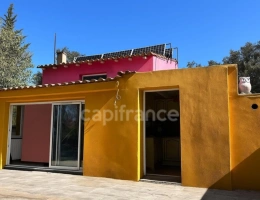
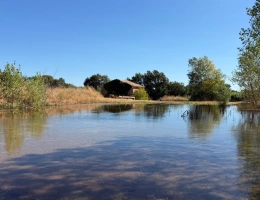
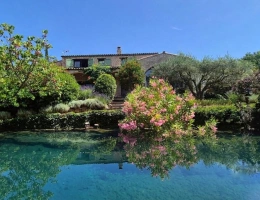
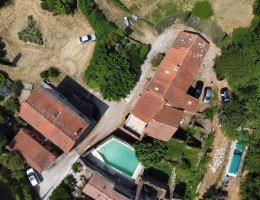
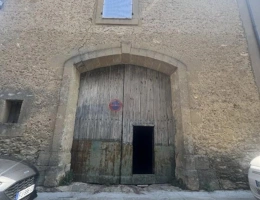
Buying a mill for sale in Hérault (34) means choosing a territory where rivers flowing down from the Cévennes and the Larzac once powered watermills, oil mills and a few flour mills: the Hérault, Orb, Lergue and Vidourle rivers still bear witness to this. On this page, ma-propriete.fr brings together the mills for sale in Hérault: watermills and oil mills to renovate at the bottom of a valley, converted flour mills, and millers' houses built in local stone.
You will also find price benchmarks based on actual sales, an overview of where these properties are concentrated, and the specific points to check before buying a mill in Hérault. To prepare your project, read our white paper on setting up a rural gîte, useful if the outbuildings could become a holiday let. Each listing states the mill type (watermill, oil mill or flour mill) and its state of repair, a useful marker for narrowing your search in Hérault.
There are no official statistics dedicated to mills: sales are too rare and too varied (a ruin to restore, a habitable mill, a flour mill with a turbine). The most reliable market benchmark remains the price of country houses, which a habitable mill resembles, with a premium for the water, the character and the water rights, and a discount for the work required.
How much does a country house cost in Hérault (34)? According to DVF data (notarised sales) analysed by the ma-propriete.fr observatory, the median price of a country house in Hérault (34) stood at €294,425 in 2025, with an average price of €304,890 and a median price of €2,726/m² of living space (1,144 house sales in rural municipalities over the year). The price range is wide: 10% of houses sold for less than €168,930 (floor price, 1st decile) and 10% for more than €459,220 (ceiling price, 9th decile). The typical country house here offers 113 m² of living space on an average plot of 1,916 m², i.e. around 0.2 ha.
This market is well above the regional median (Occitanie: €210,000) and well above the national median (€189,200). Since the second half of 2020, the median price has risen from €267,250 to €294,425, i.e. +10.2%; over one year (2024-2025) the change is -1.1%.
| 2025 indicator | Hérault | Occitanie | France |
|---|---|---|---|
| Median price | €294,425 | €210,000 | €189,200 |
| Average price | €304,890 | €220,462 | €207,100 |
| Floor price (1st decile) | €168,930 | €107,500 | €90,000 |
| Ceiling price (9th decile) | €459,220 | €347,000 | €340,000 |
| Median price per m² of living space | €2,726/m² | €1,987/m² | €1,830/m² |
| Average living space | 113 m² | 111 m² | 108 m² |
| Average plot size | 1,916 m² | 4,162 m² | 3,181 m² |
| Number of sales in 2025 | 1,144 | 14,163 | 150,313 |
A departmental average hides large gaps. A smallholding to renovate, a restored longère with its outbuildings, a farmhouse on several hectares of land or a manor house with parkland do not sell at the same price, and the location matters as much as the building: coastline, tourist area, peri-urban countryside close to a job market or deep countryside. The table below shows the median price of country houses in Hérault (34) by type of municipality (cumulative sales from mid-2020 to 2025) and its change between 2021 and 2025.
| Type of municipality | Median price 2020-2025 | Median price per m² | Change 2021-2025 | Sales 2020-2025 |
|---|---|---|---|---|
| Tourist coastline | €325,200 | €2,937/m² | +0.5% | 195 |
| Residential coastline * | €390,500 | €3,445/m² | +2.4% | 90 |
| Inland tourist areas (hinterland, mountains) | €211,700 | €2,092/m² | +2.1% | 759 |
| Peri-urban countryside (city catchment area) | €316,250 | €2,812/m² | +1.1% | 4,325 |
| Deep countryside (outside urban influence) | €255,596 | €2,412/m² | +6.5% | 1,798 |
* Between 30 and 99 sales: indicative value.
These benchmarks help you assess a listing, estimate a property before putting it up for sale, or set your budget for a holiday home or a permanent move to the French countryside. To go further, see our observatory of country house prices in France (national, regional and departmental analysis, downloadable annual report) and work out the full cost of your purchase, including French notary fees, with our notary fees calculator.
The Hérault backcountry, between Lodève, Ganges and Bédarieux, still holds many watermills built on the Hérault, Orb, Lergue and their Cévennes tributaries, built in schist or limestone depending on the local rock. Many have kept their millrace and sometimes a water wheel, inherited from grain milling or wool fulling.
The department's olive-growing tradition has also left oil mills, particularly around Clermont-l'Hérault and in the hills close to the sea, where olive trees are still common. Windmills are rarer and appear mainly on the dry hills near the Thau lagoon and the coast, away from the Cévennes valleys. Some oil mills have kept their stone press, a heritage feature appreciated by buyers drawn to the department's agricultural history. Buyers focused on this heritage should check whether the press and any associated outbuildings still function or would need dedicated restoration work.
The Lodève and Clermont-l'Hérault areas offer the highest concentration of watermills within reach of the A75 motorway. The Ganges area and the Hérault gorges, bordering the Gard Cévennes, attract buyers seeking unspoiled nature. Near Bédarieux and the Haut-Languedoc, the Orb and Jaur valleys still hold mills to renovate at gentler prices; Pézenas, further south, adds a more urban character to the offer. Buyers should also budget time for the administrative side, since a change of use on an old milling site can require sign-off from more than one local authority.
The closer you get to Montpellier and its TGV station, or to the Pézenas area prized for its lifestyle market, the higher the prices. The Haut-Languedoc, around Bédarieux and Saint-Pons-de-Thomières, remains the most affordable area for a mill to renovate. Between the two, the Ganges area and the Hérault gorges offer a balance between access and unspoiled surroundings.
Check the mill's water rights (fondé en titre or a formal authorisation) and the condition of the millrace, weir and sluice gates: Cévennes rivers, prone to flash floods, are subject to strict ecological-continuity rules. The millstone and water wheel, where they survive, are a heritage asset but require regular upkeep. It is also worth checking the river's classification with the departmental land and sea authority before any project. A notary familiar with rural Hérault property can help clarify how an old water right transfers with the sale.
As for the building, check the flood zoning risk at the bottom of a gorge, damp and drainage, as well as the soundness of the outbuildings. These lend themselves well to a gîte project, in a department whose Cévennes backcountry attracts buyers seeking quiet and hiking. Also check the building's summer exposure, as Cévennes heat sometimes calls for suitable ventilation or insulation. A structural survey focused on the retaining walls and the old mill floor is a sensible precaution before committing to a purchase, particularly on schist-built properties.
On ma-propriete.fr, mill listings in Hérault are published by private sellers, estate agents and notaries. Filter by budget, living space and land area, set up an email alert to be told of new listings, and browse all mills for sale in Occitanie if your search extends beyond the department. An online valuation is also available if you are considering selling your own mill in Hérault.