

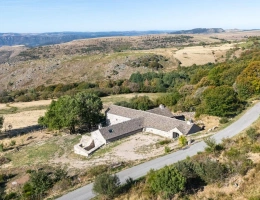
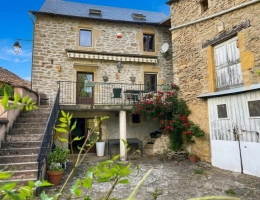
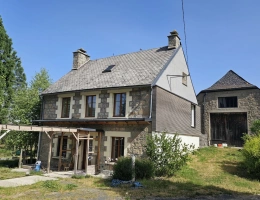
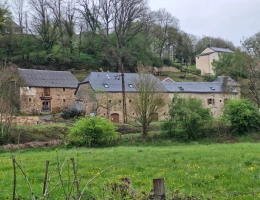
Buying a mill for sale in Lozère (48) means choosing a land of fast-flowing water and dramatic relief, where the Tarn gorges and the valleys of the Lot, Allier, Colagne and Bès rivers once powered many small watermills, often linked to flour milling, the Cévennes chestnut economy or wool fulling. On this page, ma-propriete.fr brings together the mills for sale in Lozère: watermills to restore in granite or schist, former flour or chestnut mills, and millers' houses with outbuildings.
You will also find price benchmarks based on actual sales, an overview of the areas where these properties are concentrated, and the specific points to check before buying a mill. To prepare your project, read our guide to buying a country house in France, whose advice on old buildings, outbuildings and financing applies fully to a mill. Prices vary noticeably between the touristic gorges and the more isolated plateaus, a gap worth factoring into your search.
There are no official statistics dedicated to mills: sales are too rare and too varied (a ruin to restore, a habitable mill, a flour mill with a turbine). The most reliable market benchmark remains the price of country houses, which a habitable mill resembles, with a premium for the water, the character and the water rights, and a discount for the work required.
How much does a country house cost in Lozère (48)? According to DVF data (notarised sales) analysed by the ma-propriete.fr observatory, the median price of a country house in Lozère (48) stood at €166,850 in 2025, with an average price of €174,916 and a median price of €1,726/m² of living space (326 house sales in rural municipalities over the year). The price range is wide: 10% of houses sold for less than €85,620 (floor price, 1st decile) and 10% for more than €281,785 (ceiling price, 9th decile). The typical country house here offers 102 m² of living space on an average plot of 5,277 m², i.e. around 0.5 ha.
This market is well below the regional median (Occitanie: €210,000) and below the national median (€189,200). Since the second half of 2020, the median price has risen from €132,640 to €166,500, i.e. +25.5%; over one year (2024-2025) the change is -2.1%.
| 2025 indicator | Lozère | Occitanie | France |
|---|---|---|---|
| Median price | €166,850 | €210,000 | €189,200 |
| Average price | €174,916 | €220,462 | €207,100 |
| Floor price (1st decile) | €85,620 | €107,500 | €90,000 |
| Ceiling price (9th decile) | €281,785 | €347,000 | €340,000 |
| Median price per m² of living space | €1,726/m² | €1,987/m² | €1,830/m² |
| Average living space | 102 m² | 111 m² | 108 m² |
| Average plot size | 5,277 m² | 4,162 m² | 3,181 m² |
| Number of sales in 2025 | 326 | 14,163 | 150,313 |
A departmental average hides large gaps. A smallholding to renovate, a restored longère with its outbuildings, a farmhouse on several hectares of land or a manor house with parkland do not sell at the same price, and the location matters as much as the building: coastline, tourist area, peri-urban countryside close to a job market or deep countryside. The table below shows the median price of country houses in Lozère (48) by type of municipality (cumulative sales from mid-2020 to 2025) and its change between 2021 and 2025.
| Type of municipality | Median price 2020-2025 | Median price per m² | Change 2021-2025 | Sales 2020-2025 |
|---|---|---|---|---|
| Residential coastline * | €156,750 | €1,538/m² | -16.4% | 55 |
| Inland tourist areas (hinterland, mountains) | €140,500 | €1,540/m² | +11.4% | 1,043 |
| Deep countryside (outside urban influence) | €174,000 | €1,700/m² | +8.4% | 747 |
* Between 30 and 99 sales: indicative value.
Note: in Lozère (48), the municipalities classified as "coastline" have no access to the sea. They are municipalities bordering lakes of more than 1,000 hectares (or, in Eure, the Seine estuary) covered by the 1986 Loi Littoral, which also applies to such inland lakes and estuaries.
These benchmarks help you assess a listing, estimate a property before putting it up for sale, or set your budget for a holiday home or a permanent move to the French countryside. To go further, see our observatory of country house prices in France (national, regional and departmental analysis, downloadable annual report) and work out the full cost of your purchase, including French notary fees, with our notary fees calculator.
Lozère is a land of springs: the Lot and the Tarn both rise here, joined by the Allier, the Colagne and the Bès. Along these fast mountain streams, notably in the Tarn and Jonte gorges and on the foothills of the Cévennes, small watermills were built for flour, chestnuts or wool fulling, in granite or schist depending on the massif. Most are modest in size, matching the limited flow of these upland rivers.
On the Aubrac plateau and in the Margeride, where watercourses are scarcer and wind more present, watermills become rare and windmills are almost absent from the traditional building stock; the basalt farmhouses of the plateau remain the dominant property type there, sometimes with a bread oven or a small annexe workshop recalling a milling activity long gone. It is in the Cévennes valleys and the Gévaudan, around Florac and Mende, that mill buildings are most common, the chestnut economy having long supported a milling activity of its own alongside ordinary flour mills.
The Tarn and Jonte valleys, between Florac, Ispagnac and the Point Sublime, hold a concentration of former watermills valued for their gorge setting and orientation. Around Mende, along the Lot and the Colagne, as well as towards Marvejols and Chirac, mill buildings benefit from proximity to the railway station and the A75 motorway, easing links towards Montpellier and Clermont-Ferrand. In the south of the department, near Meyrueis and the Causse Méjean, mills linked to gorge tourism are in demand, as are those on the north-eastern slopes of Mont Lozère.
Areas close to Florac and the Tarn gorges, popular with visitors, command higher prices than the departmental average, particularly where a property keeps direct access to the river. Conversely, central Lozère, around Chanac and Saint-Chély-du-Tarn, and the high ground of the Margeride, remain more affordable for a mill in need of renovation, with interesting upside potential over the long term.
As everywhere, check the existence of the water rights (a mill fondé en titre or holding an authorisation), the condition of the millrace, weir and sluice gates, and the ecological-continuity obligations on classified rivers, numerous in Lozère where several rivers are protected for migratory species, notably brown trout and Atlantic salmon on the Lot basin. The water wheel and millstone, where they survive, often need costly restoration, best costed by a carpenter or specialist millwright before committing.
The building, in granite or schist depending on the massif, calls for attention to damp and winter access, as some mills are isolated at the bottom of a valley and served by narrow roads. Outbuildings (barn, bread oven, former workshop) make it possible to plan a gîte, a well-established tourism activity around the Tarn gorges and Mont Lozère, in a department that remains one of the most sparsely populated in France.
On ma-propriete.fr, mill listings in Lozère are published by private sellers, estate agents and notaries. Filter by budget, living space and land area, set up an email alert to be told of new listings whenever a new mill comes onto the market, however remote its valley, and browse all mills for sale in Occitanie if your search extends beyond the department, including neighbouring Aveyron and Ardèche. Lozère properties often come with adjoining woodland, an asset valued for hunting or walking.