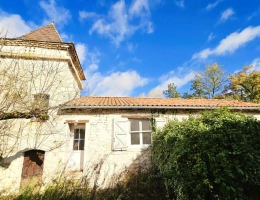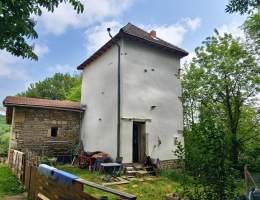
Looking for a mill for sale in Tarn-et-Garonne (82) means searching at the meeting point of three major rivers: the department was formed where the Garonne, the Tarn and the Aveyron converge, with the Lot bordering it to the north. This dense river network once powered many watermills, flour mills and oil mills, now sought after for renovation. On this page, ma-propriete.fr brings together the mills for sale in Tarn-et-Garonne: former flour mills along the Tarn, watermills on the Lomagne plateau, and millers' houses with outbuildings. Where the original machinery survives, it bears witness to a milling and oil-pressing activity that occupied the banks of the Tarn and the Aveyron until the mid-20th century.
You will also find price benchmarks based on actual sales, an overview of the areas where these properties are concentrated, and the specific points to check before buying a mill. To prepare your project, read our white paper on setting up a rural gîte, particularly useful for making the most of a former mill's outbuildings. Technical surveys (electricity, drainage, hydraulics) are often more complex than for an ordinary house, which is why it pays to be well advised before committing.
There are no official statistics dedicated to mills: sales are too rare and too varied (a ruin to restore, a habitable mill, a flour mill with a turbine). The most reliable market benchmark remains the price of country houses, which a habitable mill resembles, with a premium for the water, the character and the water rights, and a discount for the work required.
How much does a country house cost in Tarn-et-Garonne (82)? According to DVF data (notarised sales) analysed by the ma-propriete.fr observatory, the median price of a country house in Tarn-et-Garonne (82) stood at €200,000 in 2025, with an average price of €199,749 and a median price of €1,857/m² of living space (1,187 house sales in rural municipalities over the year). The price range is wide: 10% of houses sold for less than €110,000 (floor price, 1st decile) and 10% for more than €285,465 (ceiling price, 9th decile). The typical country house here offers 113 m² of living space on an average plot of 5,069 m², i.e. around 0.5 ha.
This market is close to the regional median (Occitanie: €210,000) and above the national median (€189,200). Since the second half of 2020, the median price has risen from €180,000 to €200,000, i.e. +11.1%; over one year (2024-2025) the change is +0.0%.
| 2025 indicator | Tarn-et-Garonne | Occitanie | France |
|---|---|---|---|
| Median price | €200,000 | €210,000 | €189,200 |
| Average price | €199,749 | €220,462 | €207,100 |
| Floor price (1st decile) | €110,000 | €107,500 | €90,000 |
| Ceiling price (9th decile) | €285,465 | €347,000 | €340,000 |
| Median price per m² of living space | €1,857/m² | €1,987/m² | €1,830/m² |
| Average living space | 113 m² | 111 m² | 108 m² |
| Average plot size | 5,069 m² | 4,162 m² | 3,181 m² |
| Number of sales in 2025 | 1,187 | 14,163 | 150,313 |
A departmental average hides large gaps. A smallholding to renovate, a restored longère with its outbuildings, a farmhouse on several hectares of land or a manor house with parkland do not sell at the same price, and the location matters as much as the building: coastline, tourist area, peri-urban countryside close to a job market or deep countryside. The table below shows the median price of country houses in Tarn-et-Garonne (82) by type of municipality (cumulative sales from mid-2020 to 2025) and its change between 2021 and 2025.
| Type of municipality | Median price 2020-2025 | Median price per m² | Change 2021-2025 | Sales 2020-2025 |
|---|---|---|---|---|
| Inland tourist areas (hinterland, mountains) | €185,000 | €1,743/m² | -0.6% | 245 |
| Peri-urban countryside (city catchment area) | €210,000 | €1,988/m² | +2.0% | 4,779 |
| Deep countryside (outside urban influence) | €170,470 | €1,612/m² | +1.2% | 2,265 |
These benchmarks help you assess a listing, estimate a property before putting it up for sale, or set your budget for a holiday home or a permanent move to the French countryside. To go further, see our observatory of country house prices in France (national, regional and departmental analysis, downloadable annual report) and work out the full cost of your purchase, including French notary fees, with our notary fees calculator.
The Tarn, between Montauban, Villebrumier and its confluence with the Garonne, once carried sizeable flour mills, some still fitted with a hydroelectric turbine or the remains of a water wheel. The Aveyron, more enclosed near Bruniquel, Montricoux and Saint-Antonin-Noble-Val, has more modest watermills, often built against limestone cliffs. The Garonne itself, too wide and navigable, mostly powered mills on its tributaries and diverted millraces. Some sites also retain a former sifting room or a grain-drying loft, useful clues to the building's industrial history before any renovation work begins.
On the Lomagne plateau, west of the department around Beaumont-de-Lomagne and Lavit, watercourses become scarce and windmills once took over for grinding wheat; a number of windmill towers, often reduced to their stone shaft, still dot the landscape without always being habitable. Buyers interested in a full restoration project will find a varied choice here, from small village flour mills to isolated mills in open countryside.
Around Montauban, the well-connected préfecture with a TGV station, mills in the Tarn and Garonne valleys offer quick access to Toulouse. The Moissac and Castelsarrasin area, at the confluence of the Tarn and the Garonne, concentrates former flour mills and watermills close to the Canal des Deux Mers. Further east, Saint-Antonin-Noble-Val and the Aveyron valley offer characterful limestone mills in a much sought-after gorge setting. The Pays de Serres, between Montauban and Auvillar, completes this picture with a few isolated mills on smaller tributaries of the Tarn.
Mills close to Montauban and Moissac, well connected to Toulouse, sell for noticeably more than the departmental average. The Lomagne plateau and the north of the department, around Caussade and Lauzerte, remain more affordable for a mill or a former milling site in need of renovation.
Always check the water rights attached to the property (a mill fondé en titre or holding an authorisation) and the condition of the millrace, weir and sluice gates: on the Tarn and the Aveyron, ecological-continuity obligations on classified structures can constrain a hydroelectric project using a turbine. An original millstone or mechanism is a genuine heritage asset but calls for a separate restoration budget. Always ask the department's water-police authority about the obligations attached to the structure before making an offer. These findings apply broadly across the department, though each valley has its own particular pace of renovation activity.
These limestone or local-brick buildings, often set right at the water's edge, need a careful check of damp, flood zoning and drainage. Adjoining outbuildings (miller's house, barn, drying room) lend themselves well to a rural gîte project, an activity already well established in this touristic department. It is also worth checking year-round road access, since some secluded mills on the Lomagne plateau are only reached by narrow local lanes. Also budget for renewing the joinery and the electrical wiring, which are often outdated in this type of older building.
On ma-propriete.fr, mill listings in Tarn-et-Garonne are published by private sellers, estate agents and notaries. Filter by budget, living space and land area, set up an email alert to be told of new listings, and browse all mills for sale in Occitanie if your search extends beyond the department. Do not hesitate to ask the seller for the history of the water rights and any documentation on works already carried out on the structure.