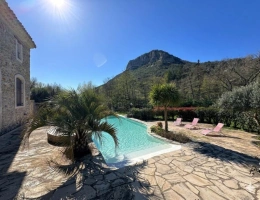
Looking for a mill for sale in Gard (30) means discovering a department where the silk industry left a unique mark: the Cévennes area of Gard, around Anduze and Alès, once had hundreds of silk-throwing mills powered by the Gardons rivers, while the garrigue scrubland is dotted with olive-oil mills, two very different faces of the same department, separated by only a few dozen kilometres. On this page, ma-propriete.fr brings together the mills for sale in Gard: watermills to renovate, former silk-throwing mills, olive mills or millers' houses with water rights.
You will also find price benchmarks based on actual sales, an overview of the areas where these properties are concentrated, and the specific points to check before buying a mill, especially regarding the risk of Cévennes flash floods. To prepare your project, read our white paper on setting up a rural gîte, whose advice applies fully to a mill in Gard, whether it once handled silk, olives or grain, three activities that shaped Gard's economy for generations.
There are no official statistics dedicated to mills: sales are too rare and too varied (a ruin to restore, a habitable mill, a flour mill with a turbine). The most reliable market benchmark remains the price of country houses, which a habitable mill resembles, with a premium for the water, the character and the water rights, and a discount for the work required.
How much does a country house cost in Gard (30)? According to DVF data (notarised sales) analysed by the ma-propriete.fr observatory, the median price of a country house in Gard (30) stood at €265,000 in 2025, with an average price of €279,110 and a median price of €2,584/m² of living space (1,532 house sales in rural municipalities over the year). The price range is wide: 10% of houses sold for less than €160,000 (floor price, 1st decile) and 10% for more than €420,000 (ceiling price, 9th decile). The typical country house here offers 109 m² of living space on an average plot of 2,883 m², i.e. around 0.3 ha.
This market is well above the regional median (Occitanie: €210,000) and well above the national median (€189,200). Since the second half of 2020, the median price has risen from €240,000 to €265,000, i.e. +10.4%; over one year (2024-2025) the change is -1.9%.
| 2025 indicator | Gard | Occitanie | France |
|---|---|---|---|
| Median price | €265,000 | €210,000 | €189,200 |
| Average price | €279,110 | €220,462 | €207,100 |
| Floor price (1st decile) | €160,000 | €107,500 | €90,000 |
| Ceiling price (9th decile) | €420,000 | €347,000 | €340,000 |
| Median price per m² of living space | €2,584/m² | €1,987/m² | €1,830/m² |
| Average living space | 109 m² | 111 m² | 108 m² |
| Average plot size | 2,883 m² | 4,162 m² | 3,181 m² |
| Number of sales in 2025 | 1,532 | 14,163 | 150,313 |
A departmental average hides large gaps. A smallholding to renovate, a restored longère with its outbuildings, a farmhouse on several hectares of land or a manor house with parkland do not sell at the same price, and the location matters as much as the building: coastline, tourist area, peri-urban countryside close to a job market or deep countryside. The table below shows the median price of country houses in Gard (30) by type of municipality (cumulative sales from mid-2020 to 2025) and its change between 2021 and 2025.
| Type of municipality | Median price 2020-2025 | Median price per m² | Change 2021-2025 | Sales 2020-2025 |
|---|---|---|---|---|
| Residential coastline * | €370,000 | €3,327/m² | -4.1% | 67 |
| Inland tourist areas (hinterland, mountains) | €221,885 | €2,278/m² | -7.2% | 1,308 |
| Peri-urban countryside (city catchment area) | €273,000 | €2,575/m² | +5.6% | 5,089 |
| Deep countryside (outside urban influence) | €269,625 | €2,606/m² | +7.5% | 3,140 |
* Between 30 and 99 sales: indicative value.
These benchmarks help you assess a listing, estimate a property before putting it up for sale, or set your budget for a holiday home or a permanent move to the French countryside. To go further, see our observatory of country house prices in France (national, regional and departmental analysis, downloadable annual report) and work out the full cost of your purchase, including French notary fees, with our notary fees calculator.
The Cévennes area of Gard built its 19th-century prosperity on silk farming: the Gardons rivers of Anduze, Alès and Saint-Jean, along with the Salindrenque and the upper Hérault near Le Vigan, in a landscape of narrow, steep-sided valleys planted with chestnut and mulberry trees, powered dozens of moulinages, watermills specialised in throwing silk thread, alongside classic watermills used for grinding grain, some of which operated until the mid-20th century and can still be seen along the riverbanks.
In the garrigue scrubland and the vineyard plain, it is mostly olive oil mills that survive, notably around Uzès and the Cèze valley, where the picholine olive variety is still widely grown for its fruity, slightly peppery oil. Windmills are rare in Gard, more often found in the Rhodanian part of Gard, near Bagnols-sur-Cèze and the Rhône valley, on land more exposed to wind and the mistral, which blows hard and often along the Rhône corridor.
The Cévennes, around Anduze, Alès and Saint-Jean-du-Gard, hold the highest concentration of former silk mills along the banks of the Gardons, amid wooded valleys and chestnut terraces, often hard to reach away from the main roads, along narrow winding lanes carved into the hillside. The Uzès area, drier, and the Cèze valley near Bagnols-sur-Cèze, are better suited to olive oil mills in the garrigue. Proximity to Nîmes and its TGV station makes access from Paris and Lyon easy.
Mills near Uzès, the Pont du Gard and Nîmes are clearly above the department average, driven by the tourist appeal of this World-Heritage-listed area near the famous Roman aqueduct and its ochre-stone villages. The Cévennes valleys around Alès and Le Vigan, more isolated, remain more affordable for a former silk mill to renovate, provided you accept limited winter access.
Check the water rights attached to the mill, the condition of the millrace, weir and sluice gates, and the ecological-continuity obligations that apply to the Gardons rivers, prone to violent Cévennes flash floods and classified as sensitive for eel and shad. Original silk-throwing machinery, where it survives, is a rare industrial heritage but costly to restore and rarely brought back into working order, except for a heritage-association or museum project supported by local volunteers.
The building, in limestone or schist depending on the valley, is often set in a gorge: check flood zoning, particularly critical in the Cévennes during autumn heavy-rain episodes capable of raising the Gardons rivers by several metres within just a few hours. Outbuildings lend themselves to a gîte project, a well-developed activity in the touristic Cévennes and the neighbouring national park, popular with hikers and nature lovers.
On ma-propriete.fr, mill listings in Gard are published by private sellers, estate agents and notaries across the whole department. Filter by budget, living space and land area, set up an email alert to be told of new listings, and browse all mills for sale in Occitanie if your search extends beyond the department, for instance towards Hérault or neighbouring Lozère, both equally shaped by silk farming and olive growing.