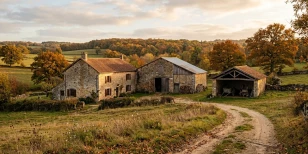

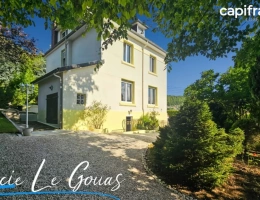
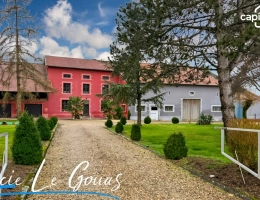
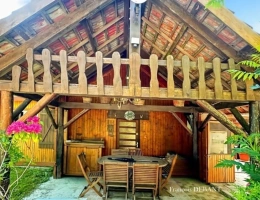
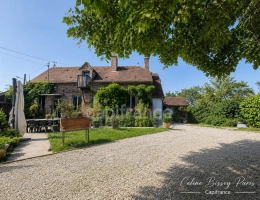
Buying a mill for sale in Haute-Marne (52) means choosing a department of river sources, where the Marne rises near Langres and the Meuse in the Bassigny area, joined by the Blaise, the Rognon and the Suize: these rivers once powered both flour watermills and former hydraulic forges, a legacy of the department's long metalworking tradition. On this page, ma-propriete.fr brings together the mills for sale in Haute-Marne: stone watermills to renovate, former mill-forge sites, flour mills and millers' houses with outbuildings.
You will also find price benchmarks based on actual sales, an overview of the areas where these properties are concentrated, and the specific points to check before buying a mill. To prepare your project, read our guide to buying a country house in France, whose advice on old buildings, outbuildings and financing applies fully to a mill. Price gaps between the touristic Der valley and the Langres plateau are noticeable, worth anticipating.
There are no official statistics dedicated to mills: sales are too rare and too varied (a ruin to restore, a habitable mill, a flour mill with a turbine). The most reliable market benchmark remains the price of country houses, which a habitable mill resembles, with a premium for the water, the character and the water rights, and a discount for the work required.
How much does a country house cost in Haute-Marne (52)? According to DVF data (notarised sales) analysed by the ma-propriete.fr observatory, the median price of a country house in Haute-Marne (52) stood at €105,000 in 2025, with an average price of €107,545 and a median price of €968/m² of living space (803 house sales in rural municipalities over the year). The price range is wide: 10% of houses sold for less than €43,000 (floor price, 1st decile) and 10% for more than €178,760 (ceiling price, 9th decile). The typical country house here offers 109 m² of living space on an average plot of 2,035 m², i.e. around 0.2 ha.
This market is well below the regional median (Grand Est: €150,000) and well below the national median (€189,200). Since the second half of 2020, the median price has risen from €92,500 to €105,000, i.e. +13.5%; over one year (2024-2025) the change is +5.0%.
| 2025 indicator | Haute-Marne | Grand Est | France |
|---|---|---|---|
| Median price | €105,000 | €150,000 | €189,200 |
| Average price | €107,545 | €156,757 | €207,100 |
| Floor price (1st decile) | €43,000 | €70,000 | €90,000 |
| Ceiling price (9th decile) | €178,760 | €255,000 | €340,000 |
| Median price per m² of living space | €968/m² | €1,400/m² | €1,830/m² |
| Average living space | 109 m² | 112 m² | 108 m² |
| Average plot size | 2,035 m² | 2,025 m² | 3,181 m² |
| Number of sales in 2025 | 803 | 7,886 | 150,313 |
A departmental average hides large gaps. A smallholding to renovate, a restored longère with its outbuildings, a farmhouse on several hectares of land or a manor house with parkland do not sell at the same price, and the location matters as much as the building: coastline, tourist area, peri-urban countryside close to a job market or deep countryside. The table below shows the median price of country houses in Haute-Marne (52) by type of municipality (cumulative sales from mid-2020 to 2025) and its change between 2021 and 2025.
| Type of municipality | Median price 2020-2025 | Median price per m² | Change 2021-2025 | Sales 2020-2025 |
|---|---|---|---|---|
| Residential coastline | €120,000 | €1,237/m² | +3.2% | 181 |
| Inland tourist areas (hinterland, mountains) | €74,260 | €678/m² | -8.4% | 348 |
| Peri-urban countryside (city catchment area) | €115,000 | €1,071/m² | +8.7% | 2,057 |
| Deep countryside (outside urban influence) | €88,000 | €824/m² | -5.4% | 2,373 |
Note: in Haute-Marne (52), the municipalities classified as "coastline" have no access to the sea. They are municipalities bordering lakes of more than 1,000 hectares (or, in Eure, the Seine estuary) covered by the 1986 Loi Littoral, which also applies to such inland lakes and estuaries.
These benchmarks help you assess a listing, estimate a property before putting it up for sale, or set your budget for a holiday home or a permanent move to the French countryside. To go further, see our observatory of country house prices in France (national, regional and departmental analysis, downloadable annual report) and work out the full cost of your purchase, including French notary fees, with our notary fees calculator.
The Marne, which rises near Langres, the Meuse, whose source lies in the Bassigny area, and the Blaise near Wassy and Joinville, the Rognon and the Suize around Chaumont, carried a dense network of flour watermills as well as former forges and hammer mills, Haute-Marne having been a major ironworking centre before the industrial era. Many of these hydraulic sites still have their millrace and weir, even where the wheel has disappeared. Even where the wheel is long gone, the millrace and forge foundations often survive as clear traces of the site's industrial past.
The drier Langres plateau has fewer mills than the Der and Bassigny valleys; windmills are practically absent, as water power was always favoured in this department rich in lakes, ponds and forests, one of the least densely populated in France. This industrial legacy gives some mill-forge sites a built volume noticeably larger than that of an ordinary flour mill.
The Marne valley, between Chaumont, Saint-Dizier and Lake Der, holds former mills and forge sites near the Paris-Basel road axis, with easy access via the A5 motorway. The Bassigny area, around Bourbonne-les-Bains and the source of the Meuse, offers a more rural, wooded setting, valued for its quiet and low population density. Towards Langres and the plateau, the Suize and its tributaries offer smaller mills close to Chaumont's Intercités station. The Intercités link to Paris from Chaumont remains a valued criterion for Paris-region buyers seeking quiet.
The shores of Lake Der and the Marne valley, more geared to tourism thanks to watersports and migratory bird watching, sell for more than the Bassigny or Langres plateau areas, where a mill to renovate remains among the most affordable properties in the region. Buyers should also weigh the appeal of Lake Der's leisure activities against the deeper quiet of the Bassigny countryside.
Check the water rights (a mill fondé en titre or holding an authorisation), the condition of the millrace, weir and sluice gates, and the ecological-continuity obligations on the Marne, Meuse and Blaise rivers, where several hydromorphological restoration schemes are under way. On a former forge site, also check for any historical contamination linked to ironworking, a point specific to this type of property. Buyers should also budget for repointing old stonework, a recurring cost on properties of this age.
The building, in limestone under tile or slate depending on the area, can include substantial outbuildings (coal store, workshop, miller's house) suited to a gîte project or a small-scale hydroelectric scheme, to be assessed case by case depending on available flow and the relevant authorisation. A prior survey by a heritage specialist remains advisable before any renovation project.
On ma-propriete.fr, mill listings in Haute-Marne are published by private sellers, estate agents and notaries. Filter by budget, living space and land area, set up an email alert to be told of new listings, and browse all mills for sale in Grand Est if your search extends beyond the department. Buyers of mills in Haute-Marne often value the quiet and open space of a department still little known to the wider public. Several municipalities in Haute-Marne also offer local advice on heritage renovation grants worth investigating before starting work.