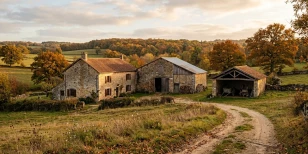

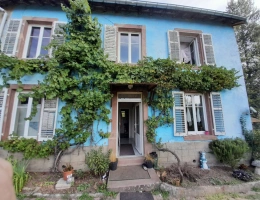
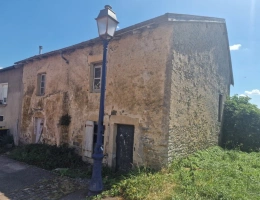
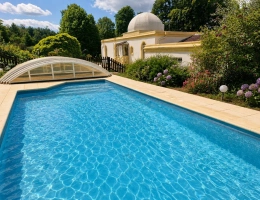
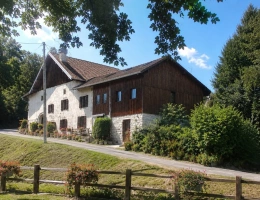
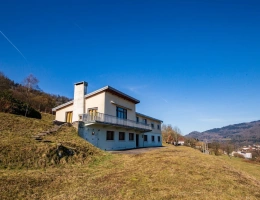
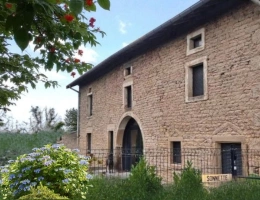
Looking for a mill for sale in Vosges (88) means turning to valleys where water long powered not only flour mills but also sawmills and textile factories: the Moselle, the Moselotte, the Vologne and the Meurthe flow down from the Vosges peaks with a hydraulic force that shaped an entire industry. On this page, ma-propriete.fr brings together the mills for sale in Vosges: a watermill to renovate on the Vologne, a former mill-sawmill in the Moselotte valley, or a mill house with outbuildings. Many of these former mill-factories still keep a chimney, an engineered water drop or a late-19th-century turbine, evidence of the early industrialisation of the Vosges valleys.
You will also find price benchmarks based on actual sales, an overview of the areas where these properties are concentrated, and the specific points to check before buying a mill. To prepare your project, read our white paper on setting up a rural gîte, whose advice on outbuildings and financing applies fully to a mill. This variety of past uses explains very different building layouts, from a simple family mill to a former industrial site made up of several buildings.
There are no official statistics dedicated to mills: sales are too rare and too varied (a ruin to restore, a habitable mill, a flour mill with a turbine). The most reliable market benchmark remains the price of country houses, which a habitable mill resembles, with a premium for the water, the character and the water rights, and a discount for the work required.
How much does a country house cost in Vosges (88)? According to DVF data (notarised sales) analysed by the ma-propriete.fr observatory, the median price of a country house in Vosges (88) stood at €147,900 in 2025, with an average price of €151,368 and a median price of €1,411/m² of living space (1,654 house sales in rural municipalities over the year). The price range is wide: 10% of houses sold for less than €70,000 (floor price, 1st decile) and 10% for more than €241,000 (ceiling price, 9th decile). The typical country house here offers 108 m² of living space on an average plot of 2,704 m², i.e. around 0.3 ha.
This market is close to the regional median (Grand Est: €150,000) and well below the national median (€189,200). Since the second half of 2020, the median price has risen from €127,000 to €147,900, i.e. +16.5%; over one year (2024-2025) the change is +2.4%.
| 2025 indicator | Vosges | Grand Est | France |
|---|---|---|---|
| Median price | €147,900 | €150,000 | €189,200 |
| Average price | €151,368 | €156,757 | €207,100 |
| Floor price (1st decile) | €70,000 | €70,000 | €90,000 |
| Ceiling price (9th decile) | €241,000 | €255,000 | €340,000 |
| Median price per m² of living space | €1,411/m² | €1,400/m² | €1,830/m² |
| Average living space | 108 m² | 112 m² | 108 m² |
| Average plot size | 2,704 m² | 2,025 m² | 3,181 m² |
| Number of sales in 2025 | 1,654 | 7,886 | 150,313 |
A departmental average hides large gaps. A smallholding to renovate, a restored longère with its outbuildings, a farmhouse on several hectares of land or a manor house with parkland do not sell at the same price, and the location matters as much as the building: coastline, tourist area, peri-urban countryside close to a job market or deep countryside. The table below shows the median price of country houses in Vosges (88) by type of municipality (cumulative sales from mid-2020 to 2025) and its change between 2021 and 2025.
| Type of municipality | Median price 2020-2025 | Median price per m² | Change 2021-2025 | Sales 2020-2025 |
|---|---|---|---|---|
| Inland tourist areas (hinterland, mountains) | €168,000 | €1,692/m² | +13.3% | 1,010 |
| Peri-urban countryside (city catchment area) | €147,228 | €1,420/m² | +13.0% | 3,918 |
| Deep countryside (outside urban influence) | €127,000 | €1,214/m² | +10.0% | 5,173 |
These benchmarks help you assess a listing, estimate a property before putting it up for sale, or set your budget for a holiday home or a permanent move to the French countryside. To go further, see our observatory of country house prices in France (national, regional and departmental analysis, downloadable annual report) and work out the full cost of your purchase, including French notary fees, with our notary fees calculator.
The Moselle, between Remiremont and Épinal, and its tributaries the Moselotte near Le Thillot and Cornimont, and the Vologne near Bruyères and Gérardmer, have a steep gradient that allowed many watermills to be built, many converted from the 19th century onwards into textile factories or sawmills using the same water power. Many of these sites still have a millrace, a water drop, and sometimes a more recent turbine.
Further north, towards Neufchâteau and the Vosges section of the Meuse, classic grain mills are more common, in a less rugged plateau landscape. Windmills are practically absent from the Vosges, since the terrain and abundant watercourses made water power largely sufficient. The long history of industrialisation in the Vosges can still be read in many mills' buildings, between 19th-century extensions and older elements. A local architect familiar with mountain construction can be a valuable ally throughout this kind of restoration project.
The Moselotte valley, around Le Thillot and Cornimont, and the Vologne valley, near Gérardmer and Bruyères, concentrate former mill-factory sites in a mountain setting sought after for four-season tourism. Around Épinal and Remiremont, the Moselle valley offers more accessible mills, well served by road and rail. The Neufchâteau area to the west remains more rural. The Meurthe valley, around Saint-Dié-des-Vosges, completes this picture with former mills linked to woodworking and textile production.
Mills close to Gérardmer and the Vosges mountain resorts sell above the departmental average, driven by the area's mountain tourism appeal. The Neufchâteau plain and the north-west of the department remain the most affordable areas for a mill in need of renovation. These price differences mainly reflect proximity to the mountain resorts rather than the size of the building itself.
Check the water rights (a mill fondé en titre or holding an authorisation), the condition of the millrace, weir and sluice gates, and the ecological-continuity obligations that particularly affect Vosges rivers, classified over many stretches. A hydroelectric turbine project is often realistic on these steep watercourses, but requires a prior technical and regulatory study. Have the roof and frame checked, as the Vosges mountain climate, marked by heavy snow, puts considerable strain on these elements. Buyers should also allow for longer renovation timelines given the technical complexity of these former mill-factory sites. Water-related risks deserve particular attention on these fast-flowing Vosges rivers.
The buildings, in local sandstone or half-timbering depending on the valley, should be checked for damp and insulation, as the mountain climate is harsher than elsewhere. Outbuildings (workshop, shed, worker's lodging) offer good potential for a gîte catering to hikers and skiers. Also check winter access, as some mountain sites can be difficult to reach during heavy snowfall.
On ma-propriete.fr, mill listings in Vosges are published by private sellers, estate agents and notaries. Filter by budget, living space and land area, set up an email alert to be told of new listings, and browse all mills for sale in Grand Est if your search extends beyond the department. Do not hesitate to ask the seller about the site's industrial history and any residual pollution that may need checking.