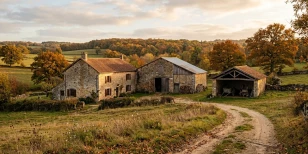

Buying a mill for sale in Meurthe-et-Moselle (54) means choosing a Lorraine department crossed by the Moselle, Meurthe and Seille rivers, which once powered many flour watermills, often built in limestone, between the Woëvre plain, the Moselle escarpment and the Saintois plateau. On this page, ma-propriete.fr brings together the mills for sale in Meurthe-et-Moselle: watermills to renovate, restored former mills, flour mills and millers' houses with outbuildings.
You will also find price benchmarks based on actual sales, an overview of the areas where these properties are concentrated, and the specific points to check before buying a mill. To prepare your project, read our guide to buying a country house in France, whose advice on old buildings, outbuildings and financing applies fully to a mill. Price gaps between the Nancy conurbation and the farming plateau are noticeable, worth factoring into your project.
There are no official statistics dedicated to mills: sales are too rare and too varied (a ruin to restore, a habitable mill, a flour mill with a turbine). The most reliable market benchmark remains the price of country houses, which a habitable mill resembles, with a premium for the water, the character and the water rights, and a discount for the work required.
How much does a country house cost in Meurthe-et-Moselle (54)? According to DVF data (notarised sales) analysed by the ma-propriete.fr observatory, the median price of a country house in Meurthe-et-Moselle (54) stood at €186,000 in 2025, with an average price of €194,026 and a median price of €1,685/m² of living space (1,219 house sales in rural municipalities over the year). The price range is wide: 10% of houses sold for less than €92,000 (floor price, 1st decile) and 10% for more than €304,920 (ceiling price, 9th decile). The typical country house here offers 118 m² of living space on an average plot of 1,499 m², i.e. around 0.1 ha.
This market is well above the regional median (Grand Est: €150,000) and close to the national median (€189,200). Since the second half of 2020, the median price has risen from €169,200 to €186,000, i.e. +9.9%; over one year (2024-2025) the change is +4.7%.
| 2025 indicator | Meurthe-et-Moselle | Grand Est | France |
|---|---|---|---|
| Median price | €186,000 | €150,000 | €189,200 |
| Average price | €194,026 | €156,757 | €207,100 |
| Floor price (1st decile) | €92,000 | €70,000 | €90,000 |
| Ceiling price (9th decile) | €304,920 | €255,000 | €340,000 |
| Median price per m² of living space | €1,685/m² | €1,400/m² | €1,830/m² |
| Average living space | 118 m² | 112 m² | 108 m² |
| Average plot size | 1,499 m² | 2,025 m² | 3,181 m² |
| Number of sales in 2025 | 1,219 | 7,886 | 150,313 |
A departmental average hides large gaps. A smallholding to renovate, a restored longère with its outbuildings, a farmhouse on several hectares of land or a manor house with parkland do not sell at the same price, and the location matters as much as the building: coastline, tourist area, peri-urban countryside close to a job market or deep countryside. The table below shows the median price of country houses in Meurthe-et-Moselle (54) by type of municipality (cumulative sales from mid-2020 to 2025) and its change between 2021 and 2025.
| Type of municipality | Median price 2020-2025 | Median price per m² | Change 2021-2025 | Sales 2020-2025 |
|---|---|---|---|---|
| Inland tourist areas (hinterland, mountains) * | €127,500 | €1,154/m² | -18.0% | 32 |
| Peri-urban countryside (city catchment area) | €190,000 | €1,701/m² | +3.1% | 4,943 |
| Deep countryside (outside urban influence) | €158,000 | €1,456/m² | +8.6% | 2,306 |
* Between 30 and 99 sales: indicative value.
These benchmarks help you assess a listing, estimate a property before putting it up for sale, or set your budget for a holiday home or a permanent move to the French countryside. To go further, see our observatory of country house prices in France (national, regional and departmental analysis, downloadable annual report) and work out the full cost of your purchase, including French notary fees, with our notary fees calculator.
The Moselle, between Toul and Pont-à-Mousson, the Meurthe near Lunéville and Saint-Nicolas-de-Port, and the Seille, a river linked to the former salt-making activity of Marsal and Vic-sur-Seille in neighbouring Moselle, supported a dense mill heritage, built in limestone from the Saintois or the Moselle escarpment. The steep valleys of the Lorraine plateau still hold many millraces and weirs, sometimes without their original machinery. Even where the machinery is long gone, the millrace and weir often survive as clear traces of the mill's original purpose.
The Saintois plateau and the Woëvre, open farming areas, have fewer mills than the Moselle and Meurthe valleys; windmills are practically non-existent there, as Lorraine always favoured water power, including for its former salt and glass industries. This diversity of rivers and buildings offers a wide range of projects, from a modest mill to a sizeable flour mill.
The Moselle valley, between Toul and Pont-à-Mousson, benefits from proximity to Nancy and the A31 motorway, a busy corridor between Metz and Nancy. The Meurthe, around Lunéville and Baccarat, offers a more rural setting on the edge of the Vosges, with a notable industrial heritage linked to glass and crystal. The Saintois area, towards Vézelise and Colombey-les-Belles, retains traditional mill buildings, less than an hour from Nancy's TGV station. Proximity to Nancy's TGV station makes trips to Paris and Strasbourg straightforward.
The areas around Nancy and the Moselle valley, much sought after, sell above the departmental average, driven by the economic dynamism of the Nancy conurbation; the Saintois and the open farming plateau remain the most affordable areas for a mill to renovate. Buyers often compare travel time to Metz or Strasbourg before making a final choice. Buyers should also compare access to the A31 corridor when weighing up a valley versus a plateau location.
Check the water rights (a mill fondé en titre or holding an authorisation), the condition of the weir, millrace and sluice gates, and the ecological-continuity obligations on the Moselle and Meurthe, rivers with significant fish-migration value. A small hydroelectric turbine project remains possible, subject to a technical and regulatory study, taking into account these rivers' sometimes irregular flow. Buyers should also budget for repointing old stonework, a recurring cost on properties of this age.
The building, in limestone under machine-made tile, needs checking for damp and drainage, particularly for properties at the bottom of a valley. Outbuildings (barn, farm shed, miller's house) lend themselves to a gîte project, a growing activity along the Lorraine urban corridor and its population base. A prior survey by an old-building specialist remains advisable, particularly for properties at the bottom of a valley.
On ma-propriete.fr, mill listings in Meurthe-et-Moselle are published by private sellers, estate agents and notaries. Filter by budget, living space and land area, set up an email alert to be told of new listings, and browse all mills for sale in Grand Est if your search extends beyond the department. Buyers of mills in Meurthe-et-Moselle value proximity to Nancy while seeking an unspoilt rural setting. Several municipalities in Meurthe-et-Moselle also offer local support on heritage renovation grants worth looking into. Local notarial support also proves valuable in securing the paperwork tied to water rights. A local notary can also help clarify the exact scope of the water rights attached to a given mill.