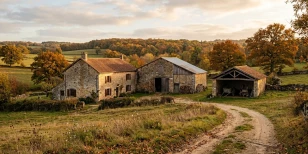

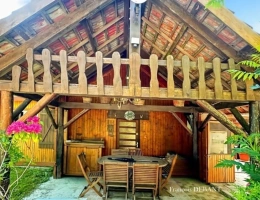
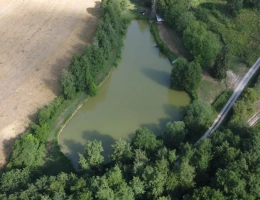
Buying a mill for sale in Ardennes (08) means choosing a department of forests and river bends, where the Meuse, Semois, Bar and Sormonne rivers drove watermills tied to grain but also, historically, to the ironworks of the Ardennes forest. ma-propriete.fr brings together on this page the mills for sale in Ardennes: watermills to restore in the Meuse valley, former mills linked to old forges, or miller's houses with their outbuildings.
You will also find price benchmarks based on actual sales, an overview of the areas where these properties are found, and the points to check before buying a mill. To prepare your project, read our guide to setting up a rural gîte, useful for turning a mill's outbuildings into guest accommodation. Our listings specify whether a property retains a link to a former ironworking activity, a heritage feature sought by some buyers.
There are no official statistics dedicated to mills: sales are too rare and too varied (a ruin to restore, a habitable mill, a flour mill with a turbine). The most reliable market benchmark remains the price of country houses, which a habitable mill resembles, with a premium for the water, the character and the water rights, and a discount for the work required.
How much does a country house cost in Ardennes (08)? According to DVF data (notarised sales) analysed by the ma-propriete.fr observatory, the median price of a country house in Ardennes (08) stood at €146,000 in 2025, with an average price of €148,310 and a median price of €1,402/m² of living space (901 house sales in rural municipalities over the year). The price range is wide: 10% of houses sold for less than €70,000 (floor price, 1st decile) and 10% for more than €230,000 (ceiling price, 9th decile). The typical country house here offers 111 m² of living space on an average plot of 2,033 m², i.e. around 0.2 ha.
This market is close to the regional median (Grand Est: €150,000) and well below the national median (€189,200). Since the second half of 2020, the median price has risen from €128,500 to €146,500, i.e. +14.0%; over one year (2024-2025) the change is +12.7%.
| 2025 indicator | Ardennes | Grand Est | France |
|---|---|---|---|
| Median price | €146,000 | €150,000 | €189,200 |
| Average price | €148,310 | €156,757 | €207,100 |
| Floor price (1st decile) | €70,000 | €70,000 | €90,000 |
| Ceiling price (9th decile) | €230,000 | €255,000 | €340,000 |
| Median price per m² of living space | €1,402/m² | €1,400/m² | €1,830/m² |
| Average living space | 111 m² | 112 m² | 108 m² |
| Average plot size | 2,033 m² | 2,025 m² | 3,181 m² |
| Number of sales in 2025 | 901 | 7,886 | 150,313 |
A departmental average hides large gaps. A smallholding to renovate, a restored longère with its outbuildings, a farmhouse on several hectares of land or a manor house with parkland do not sell at the same price, and the location matters as much as the building: coastline, tourist area, peri-urban countryside close to a job market or deep countryside. The table below shows the median price of country houses in Ardennes (08) by type of municipality (cumulative sales from mid-2020 to 2025) and its change between 2021 and 2025.
| Type of municipality | Median price 2020-2025 | Median price per m² | Change 2021-2025 | Sales 2020-2025 |
|---|---|---|---|---|
| Inland tourist areas (hinterland, mountains) * | €115,500 | €1,193/m² | +1.7% | 78 |
| Peri-urban countryside (city catchment area) | €155,000 | €1,404/m² | +11.9% | 2,408 |
| Deep countryside (outside urban influence) | €120,000 | €1,135/m² | +13.4% | 2,895 |
* Between 30 and 99 sales: indicative value.
These benchmarks help you assess a listing, estimate a property before putting it up for sale, or set your budget for a holiday home or a permanent move to the French countryside. To go further, see our observatory of country house prices in France (national, regional and departmental analysis, downloadable annual report) and work out the full cost of your purchase, including French notary fees, with our notary fees calculator.
The Meuse river, famous for its wooded bends between Monthermé and Revin, the Semois near Bouillon on the Belgian border, and the Bar and Sormonne rivers around Charleville-Mézières once drove numerous watermills with their millstones. The Ardennes stretch of the Meuse valley was also a land of ironworks and small-scale metallurgy, whose water-powered buildings often stood alongside grain mills. Proximity to Belgium, just a few kilometres north of Charleville-Mézières, shapes some building styles in the northern Ardennes. Prices for such properties vary widely depending on the condition of the mechanism and the amount of land attached to it.
On the more open plateaus of the Vouzinois area, around Vouziers and Grandpré, where the Ardennes meets the Champagne plain, a few windmills once existed, now rarer than the watermills of the Ardennes forest massif. Some former mills tied to Ardennes ironworks have kept remarkable industrial features, such as metal sluice gates or oversized wheels.
The Meuse valley, between Charleville-Mézières, Monthermé and Revin, linked to Paris by direct train, has the largest number of mills in wooded valley settings. The Sedan area and the Bar valley, as well as Rethel on the upper Aisne, have a more rural and often more affordable style of building. The Vouzinois area, around Vouziers, marks the transition towards the Champagne plains, with more scattered settlement. The Ardennes Regional Nature Park, covering much of the forest massif, frames development projects within its boundaries.
Mills near Charleville-Mézières and the touristic Meuse valley sell above the departmental average, while the Rethel and Vouzinois areas remain among the most accessible for a mill to renovate. The densely wooded Ardennes forest massif limits visibility and access to some sites, a point worth checking before any viewing. Buyers should also check winter road access in the more remote parts of the Ardennes forest, where minor roads are not always cleared quickly.
Check the water rights attached to the mill (fondé en titre or a formal authorisation), the condition of the millrace, weir and sluice gates, and the ecological-continuity obligations on classified rivers such as the Meuse or the Semois. A hydroelectric project using a turbine requires a prior technical and administrative study, best anticipated before buying. The Meuse river, classified along much of its course for migratory fish passage, strictly frames any project to restore a hydraulic structure.
The buildings, often in Ardennes schist or blue stone depending on the area, under slate roofs, need checking for damp in the wooded valley floor, drainage and flood zoning, a real issue along the Meuse. The farm outbuildings or those linked to former ironworks make it possible to plan a gîte. The cooler, damper Ardennes climate calls for particular attention to insulation and ventilation in old schist buildings. Local agents in Charleville-Mézières and Sedan are familiar with these niche properties, distinct from more common Ardennes farmhouses.
On ma-propriete.fr, mill listings in Ardennes are published by private sellers, estate agents and notaries. Filter by budget, living space and land area, set up an email alert to be told of new listings, and browse all mills for sale in Grand Est if your search extends beyond the department. It is also worth comparing mills with nearby Ardennes longhouses, sometimes listed alongside them.