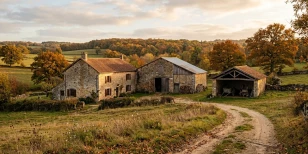

Looking for a mill for sale in Moselle (57) means exploring a hydraulic heritage tied to the Moselle, Sarre, Nied and Seille valleys: grain mills, former flour mills and water-powered sawmills once lined these Lorraine rivers. On this page, ma-propriete.fr brings together the mills for sale in Moselle: a watermill to restore, a former flour mill converted into a home, or a miller's house with outbuildings.
You will also find price benchmarks based on actual sales, an overview of the areas where these properties are concentrated, and the specific points to check before buying a mill. To prepare your project, read our white paper on creating a rural gîte, useful if the mill's outbuildings lend themselves to tourist accommodation. Technical surveys (drainage, electrics, the condition of the wheel or turbine) are particularly valuable for estimating the overall budget of a Moselle project.
There are no official statistics dedicated to mills: sales are too rare and too varied (a ruin to restore, a habitable mill, a flour mill with a turbine). The most reliable market benchmark remains the price of country houses, which a habitable mill resembles, with a premium for the water, the character and the water rights, and a discount for the work required.
DVF statistics (the French land-value database) do not cover Moselle: in Alsace-Moselle, sales are recorded in the Livre foncier and are not published in the DVF database. The benchmarks below are therefore those of the Grand Est region.
How much does a country house cost in Grand Est? According to DVF data (notarised sales) analysed by the ma-propriete.fr observatory, the median price of a country house in Grand Est stood at €150,000 in 2025, with an average price of €156,757 and a median price of €1,400/m² of living space (7,886 house sales in rural municipalities over the year). 10% of houses sold for less than €70,000 (floor price, 1st decile) and 10% for more than €255,000 (ceiling price, 9th decile). The typical country house offers 112 m² of living space on an average plot of 2,025 m², i.e. around 0.2 ha.
The region is well below the national median (€189,200). Since the second half of 2020, the regional median price has risen from €136,400 to €150,000, i.e. +10.0%; over one year (2024-2025) the change is +4.2%.
| 2025 indicator | Grand Est | France |
|---|---|---|
| Median price | €150,000 | €189,200 |
| Average price | €156,757 | €207,100 |
| Floor price (1st decile) | €70,000 | €90,000 |
| Ceiling price (9th decile) | €255,000 | €340,000 |
| Median price per m² of living space | €1,400/m² | €1,830/m² |
| Average living space | 112 m² | 108 m² |
| Average plot size | 2,025 m² | 3,181 m² |
| Number of sales in 2025 | 7,886 | 150,313 |
A regional average also hides large gaps between municipalities. A smallholding to renovate, a restored longère with its outbuildings, a farmhouse on several hectares of land or a manor house with parkland do not sell at the same price, and the location matters as much as the building: coastline, tourist area, peri-urban countryside close to a job market or deep countryside. The table below shows the median price of country houses in Grand Est by type of municipality (cumulative sales from mid-2020 to 2025) and its change between 2021 and 2025.
| Type of municipality | Median price 2020-2025 | Median price per m² | Change 2021-2025 | Sales 2020-2025 |
|---|---|---|---|---|
| Tourist coastline * | €145,000 | €1,282/m² | -23.7% | 32 |
| Residential coastline | €140,000 | €1,354/m² | -17.9% | 565 |
| Inland tourist areas (hinterland, mountains) | €137,462 | €1,350/m² | +14.6% | 1,622 |
| Peri-urban countryside (city catchment area) | €165,000 | €1,529/m² | +6.2% | 22,855 |
| Deep countryside (outside urban influence) | €125,500 | €1,178/m² | +7.4% | 23,366 |
* Between 30 and 99 sales: indicative value.
Note: in Grand Est, the municipalities classified as "coastline" have no access to the sea. They are municipalities bordering lakes of more than 1,000 hectares (or, in Eure, the Seine estuary) covered by the 1986 Loi Littoral, which also applies to such inland lakes and estuaries.
These benchmarks help you assess a listing, estimate a property before putting it up for sale, or set your budget, whether you are looking for a holiday home, a permanent move to the French countryside or a property to turn into a rural gîte. To go further, see our observatory of country house prices in France (national, regional and departmental analysis, downloadable annual report) and work out the full cost of your purchase, including French notary fees, with our notary fees calculator.
Moselle is a department of limestone plateaux and deep valleys, where rivers powered a large number of watermills until the mid-20th century: the Moselle itself between Pont-à-Mousson and Thionville, the Sarre around Sarrebourg and Sarreguemines, the French and German Nied near Boulay and Château-Salins, and the Seille and its tributaries in the Saulnois country. Many operated as flour mills, while others drove saws or forges. Some of these mills also served as sawmills or small rural forges before being gradually converted into homes during the 20th century.
The landscape of Moselle has no windmill tradition comparable to the Flemish or Beauce plains: the few known examples are reconstructions or isolated remains. The market therefore consists mainly of former watermills, some fully converted into homes, others still fitted with a partly working water wheel or turbine. Some Moselle mills have kept their wooden or iron footbridge crossing the millrace, an architectural detail that adds to the charm of these properties.
The Sarrebourg area and the Sarre valley, served by Sarrebourg's TGV station, hold several former mills set among meadows and Vosges forests. The Saulnois, around Château-Salins and Dieuze, offers mills on flat farmland along the Seille and its ponds. Further north, the Bitche area and the Nied valley, near Boulay-Moselle, retain rural buildings in the pink sandstone typical of northern Lorraine. The Canal des Salines, between Château-Salins and Dieuze, adds a further layer of hydraulic heritage, with former pumping sites linked to salt extraction.
Proximity to Metz and the Moselle valley corridor pushes prices up for well-located, easily accessible properties; the rural Saulnois and Bitche areas remain more affordable for a mill to renovate with substantial land. The more remote rural municipalities of the Pays de Nied and the Warndt round out the offer for buyers who value quiet over immediate proximity to a station.
Always check the water rights attached to the mill (a mill fondé en titre or holding an administrative authorisation), the condition of the millrace, weir and sluice gates, and the ecological-continuity obligations that apply to many classified Lorraine rivers. An original water wheel, millstone or turbine is a heritage asset, but restoring it is a cost to plan for before any hydroelectric project. It is also worth requesting the site's administrative history from the town hall or the local planning authority, which often documents the mill's successive uses.
As for the building, these sandstone or limestone-rubble constructions, often at the bottom of a valley, need careful checking for damp, flood zoning and drainage. Outbuildings (miller's house, barn, drying room) sometimes allow for a gîte project, provided access and parking allow it. A prior structural survey, covering riverside foundations and cellar waterproofing, is strongly advisable before making an offer.
On ma-propriete.fr, mill listings in Moselle are published by private sellers, estate agents and notaries. Filter by budget, living space and land area, set up an email alert to be told of new listings, and browse all mills for sale in Grand Est if your search extends beyond the department. Do not hesitate to ask the agent or notary handling the file for the known history of floods and any work already carried out on the millrace. Local estate agents can usually confirm whether a given mill has retained working machinery or was fully cleared during a past conversion.