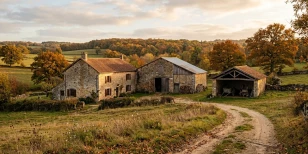

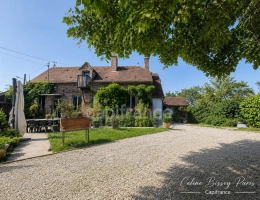
Looking for a mill for sale in Grand Est means exploring a region of very contrasting waters, from the Vosges valleys to the Lorraine rivers and Alsatian canals: the Meuse, Moselle, Sarre, Marne, Aube and Ill rivers once powered hundreds of watermills, while the chalky plains of Champagne have far fewer. On this page, ma-propriete.fr brings together the mills for sale in Grand Est: watermills to restore in Lorraine, former Alsatian flour mills, Vosges oil or fulling mills, and millers' houses with water rights.
You will also find price benchmarks based on actual sales, an overview of the areas by department, and the specific points to check before buying a mill. To prepare your project, read our white paper on setting up a rural gîte, useful if you plan to convert a mill's outbuildings.
There are no official statistics dedicated to mills: sales are too rare and too varied (a ruin to restore, a habitable mill, a flour mill with a turbine). The most reliable market benchmark remains the price of country houses, which a habitable mill resembles, with a premium for the water, the character and the water rights, and a discount for the work required.
How much does a country house cost in Grand Est? According to DVF data (notarised sales) analysed by the ma-propriete.fr observatory, the median price of a country house in Grand Est stood at €150,000 in 2025, with an average price of €156,757 and a median price of €1,400/m² of living space (7,886 house sales in rural municipalities over the year). 10% of houses sold for less than €70,000 (floor price, 1st decile) and 10% for more than €255,000 (ceiling price, 9th decile). The typical country house offers 112 m² of living space on an average plot of 2,025 m², i.e. around 0.2 ha.
The region is well below the national median (€189,200). Since the second half of 2020, the regional median price has risen from €136,400 to €150,000, i.e. +10.0%; over one year (2024-2025) the change is +4.2%.
| 2025 indicator | Grand Est | France |
|---|---|---|
| Median price | €150,000 | €189,200 |
| Average price | €156,757 | €207,100 |
| Floor price (1st decile) | €70,000 | €90,000 |
| Ceiling price (9th decile) | €255,000 | €340,000 |
| Median price per m² of living space | €1,400/m² | €1,830/m² |
| Average living space | 112 m² | 108 m² |
| Average plot size | 2,025 m² | 3,181 m² |
| Number of sales in 2025 | 7,886 | 150,313 |
Differences between departments are significant: the median ranges from €105,000 in Haute-Marne (52) to €186,000 in Meurthe-et-Moselle (54). The table below compares 2025 prices and their change since 2020.
| Department | Median price 2025 | Average price 2025 | Median price per m² | Change 2020-2025 | Sales 2025 |
|---|---|---|---|---|---|
| Ardennes (08) | €146,000 | €148,310 | €1,402/m² | +14.0% | 901 |
| Aube (10) | €140,000 | €145,120 | €1,360/m² | +2.9% | 1,043 |
| Marne (51) | €180,000 | €191,161 | €1,675/m² | +6.5% | 1,380 |
| Haute-Marne (52) | €105,000 | €107,545 | €968/m² | +13.5% | 803 |
| Meurthe-et-Moselle (54) | €186,000 | €194,026 | €1,685/m² | +9.9% | 1,219 |
| Meuse (55) | €125,750 | €128,849 | €1,121/m² | +9.8% | 886 |
| Vosges (88) | €147,900 | €151,368 | €1,411/m² | +16.5% | 1,654 |
A regional average also hides large gaps between municipalities. A smallholding to renovate, a restored longère with its outbuildings, a farmhouse on several hectares of land or a manor house with parkland do not sell at the same price, and the location matters as much as the building: coastline, tourist area, peri-urban countryside close to a job market or deep countryside. The table below shows the median price of country houses in Grand Est by type of municipality (cumulative sales from mid-2020 to 2025) and its change between 2021 and 2025.
| Type of municipality | Median price 2020-2025 | Median price per m² | Change 2021-2025 | Sales 2020-2025 |
|---|---|---|---|---|
| Tourist coastline * | €145,000 | €1,282/m² | -23.7% | 32 |
| Residential coastline | €140,000 | €1,354/m² | -17.9% | 565 |
| Inland tourist areas (hinterland, mountains) | €137,462 | €1,350/m² | +14.6% | 1,622 |
| Peri-urban countryside (city catchment area) | €165,000 | €1,529/m² | +6.2% | 22,855 |
| Deep countryside (outside urban influence) | €125,500 | €1,178/m² | +7.4% | 23,366 |
* Between 30 and 99 sales: indicative value.
Note: in Grand Est, the municipalities classified as "coastline" have no access to the sea. They are municipalities bordering lakes of more than 1,000 hectares (or, in Eure, the Seine estuary) covered by the 1986 Loi Littoral, which also applies to such inland lakes and estuaries.
These benchmarks help you assess a listing, estimate a property before putting it up for sale, or set your budget, whether you are looking for a holiday home, a permanent move to the French countryside or a property to turn into a rural gîte. To go further, see our observatory of country house prices in France (national, regional and departmental analysis, downloadable annual report) and work out the full cost of your purchase, including French notary fees, with our notary fees calculator.
In Ardennes and Meuse, the Meuse river, the Semoy and the Chiers powered numerous watermills in steep valley bottoms, often built of blue-grey stone. In Meurthe-et-Moselle and Moselle, the Moselle, the Meurthe and the Sarre carried flour mills and a few former forge-mills tied to Lorraine's iron industry. In Vosges, mountain streams (Moselotte, Vologne, and the Fecht on the Alsatian side) drove flour mills as well as sawmills and textile mills linked to the region's old weaving industry.
In Alsace, Bas-Rhin and Haut-Rhin still have watermills on the Ill, Bruche, Zorn and Thur rivers, sometimes next to half-timbered houses; some still keep their original water wheel and machinery. In Aube and Marne, by contrast, the dry chalk plains of Champagne have always had fewer mills: the rare survivors sit along the Marne, the Aube and the young Seine, whose flow is more modest. Some former millers also kept old account books, a nice extra for documenting a property's history.
The Vosges valleys around Gérardmer, Remiremont and Saint-Dié-des-Vosges hold former flour and sawmills, with easy access via the Remiremont-Épinal TGV station. In Lorraine, the area around Toul, Pont-à-Mousson and the Meuse valley near Verdun and Commercy offers stone mills at measured prices. In Alsace, the surroundings of Molsheim, Sélestat and the wine route, as well as the Bruche valley near Schirmeck, remain sought after for their scenery, close to Strasbourg's TGV station. The proximity of the Belgian and Luxembourg borders, in northern Ardennes and Meuse, also encouraged a few mills once linked to former papermaking activity.
The closer you get to Strasbourg, Colmar and the wine route, the higher the price for character properties. Conversely, rural Ardennes around Charleville-Mézières and Rethel, as well as Haute-Marne around Chaumont and Langres, remain among the most affordable areas in Grand Est for a mill to renovate. Buyers coming from the Paris region or from Germany appreciate the motorway and rail links in these areas, which partly explains these price gaps. A bilingual notary familiar with cross-border buyers can also help streamline the purchase process near the German and Swiss borders.
As everywhere, a mill is bought together with its water: check the water rights (a mill fondé en titre or holding an authorisation), the condition of the millrace, the weir and the sluice gates. On classified rivers in Lorraine and Alsace, ecological-continuity obligations can constrain a hydroelectric turbine project; check with the relevant authorities beforehand. Old machinery, millstones and water wheels need an expert assessment before any restoration. Have a technical survey of the building carried out before any negotiation, since restoring a complete mechanism can account for a significant share of the total budget. Buyers should also budget time for administrative steps, since water-rights files can take several months to review.
On the building itself, always check for damp and exposure to flood zoning at the bottom of the valley, as well as drainage. Outbuildings (miller's house, drying shed, barn) often make it possible to plan a gîte, particularly in the Vosges and Alsace, where tourist demand stays strong year-round. Also check for rights of way along the millrace, which are common where several properties share the same watercourse.
On ma-propriete.fr, mill listings in Grand Est are published by private sellers, estate agents and notaries. Filter by budget, living space and land area, set up an email alert to be told of new listings, and browse all rural properties for sale if your search extends beyond mills. Do not hesitate to ask for the history of work already carried out on the millrace and roof before making an offer.