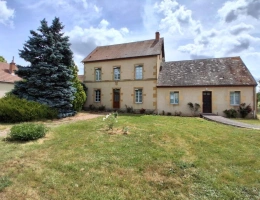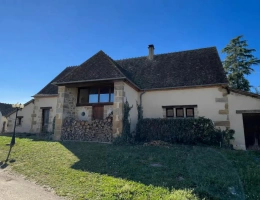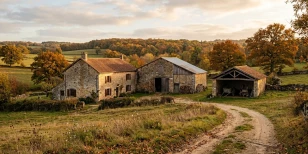
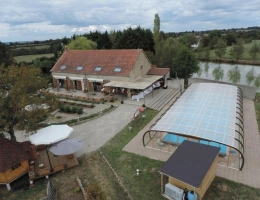
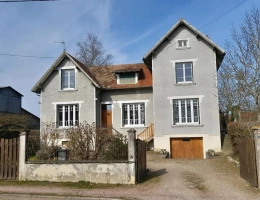
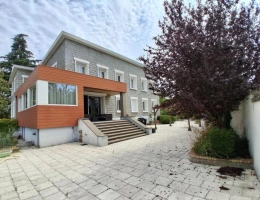
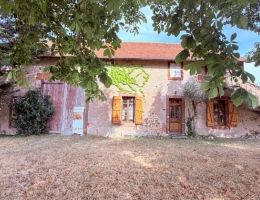
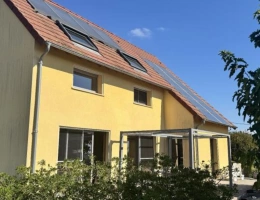
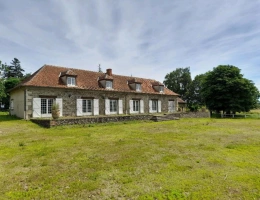
Looking for a country house for sale in Allier (03)? Between the Bourbonnais, the granite Combraille hills and the Sologne bourbonnaise, the department offers typical rural architecture: a Bourbonnais farmhouse in stone and brick, a granite Combraille house under slate, a smallholding to renovate on the edge of a forest. This page brings together the country houses for sale in Allier published on ma-propriete.fr by private sellers, estate agents and notaries.
To help you decide, we present the actual prices of country houses in Allier (notarised sales 2020-2025), the areas worth knowing from Moulins to Montluçon, and the criteria that determine the value of a house in the countryside. Our complete guide to buying a country house in France completes these benchmarks, from surveying an old building to financing.
How much does a country house cost in Allier (03)? According to DVF data (notarised sales) analysed by the ma-propriete.fr observatory, the median price of a country house in Allier (03) stood at €115,000 in 2025, with an average price of €122,419 and a median price of €1,204/m² of living space (1,587 house sales in rural municipalities over the year). The price range is wide: 10% of houses sold for less than €52,190 (floor price, 1st decile) and 10% for more than €206,024 (ceiling price, 9th decile). The typical country house here offers 101 m² of living space on an average plot of 4,565 m², i.e. around 0.5 ha.
This market is well below the regional median (Auvergne-Rhône-Alpes: €230,000) and well below the national median (€189,200). Since the second half of 2020, the median price has risen from €100,000 to €115,000, i.e. +15.0%; over one year (2024-2025) the change is +4.5%.
| 2025 indicator | Allier | Auvergne-Rhône-Alpes | France |
|---|---|---|---|
| Median price | €115,000 | €230,000 | €189,200 |
| Average price | €122,419 | €246,927 | €207,100 |
| Floor price (1st decile) | €52,190 | €98,000 | €90,000 |
| Ceiling price (9th decile) | €206,024 | €410,000 | €340,000 |
| Median price per m² of living space | €1,204/m² | €2,200/m² | €1,830/m² |
| Average living space | 101 m² | 109 m² | 108 m² |
| Average plot size | 4,565 m² | 3,243 m² | 3,181 m² |
| Number of sales in 2025 | 1,587 | 16,528 | 150,313 |
A departmental average hides large gaps. A smallholding to renovate, a restored longère with its outbuildings, a farmhouse on several hectares of land or a manor house with parkland do not sell at the same price, and the location matters as much as the building: coastline, tourist area, peri-urban countryside close to a job market or deep countryside. The table below shows the median price of country houses in Allier (03) by type of municipality (cumulative sales from mid-2020 to 2025) and its change between 2021 and 2025.
| Type of municipality | Median price 2020-2025 | Median price per m² | Change 2021-2025 | Sales 2020-2025 |
|---|---|---|---|---|
| Inland tourist areas (hinterland, mountains) | €84,775 | €926/m² | +36.8% | 452 |
| Peri-urban countryside (city catchment area) | €117,200 | €1,188/m² | +7.9% | 5,333 |
| Deep countryside (outside urban influence) | €100,000 | €1,066/m² | +8.2% | 4,321 |
These benchmarks help you assess a listing, estimate a property before putting it up for sale, or set your budget for a holiday home or a permanent move to the French countryside. To go further, see our observatory of country house prices in France (national, regional and departmental analysis, downloadable annual report) and work out the full cost of your purchase, including French notary fees, with our notary fees calculator.
In the Bourbonnais, around Moulins and Souvigny, the country house traditionally combines stone, brick and half-timbering, under a flat-tile roof. Further west, in the Combraille hills, the granite relief calls for more massive buildings in granite, topped with slate, while the smallholding to renovate, a former livestock farm, remains common across the department. Around Souvigny and Bourbon-l'Archambault, Volvic stone lintels and window surrounds sometimes appear on grander townhouse-style properties, while further west in the Combraille hills, towards Évaux-les-Bains, grey-granite hamlets blend into a more rugged landscape.
The attached land ranges from a simple garden with an orchard around a village house to several hectares of pasture or woodland for former cattle farms. Outbuildings (barn, cowshed, hay shed) are numerous, offering conversion potential into a gîte or a workshop. Some Bourbonnais farmhouses retain a dovecote or a vaulted sheepfold, remnants of livestock farming still active in the Bocage bourbonnais. Radon, a naturally occurring gas more present in the granite soils of the Combraille, is worth testing for in ground-floor or basement living spaces. Some of these barns still shelter old cattle stalls, easily converted into extra living space.
Around Vichy and Cusset, in the east of the department, the market stays more active thanks to spa and tourist appeal. The Sologne bourbonnaise, to the north-east, around Lurcy-Lévis and Le Veurdre, offers stone houses amid ponds and forests, prized for hunting and fishing. Moulins, the county town on the Allier river, anchors a still-affordable rural area. Vichy, an Art Deco spa town on the Allier river, pushes up prices in its rural surroundings as far as Bellerive and Abrest. Moulins, the county town linked by regional train to Paris and Clermont-Ferrand, remains a practical base for remote working.
To the west, the Combraille hills and the Montluçon area offer the most affordable country houses in the department, on more hilly terrain, while the south, towards Gannat and the foothills of the Chaîne des Puys, moves closer to the neighbouring Auvergne market. The Tronçais area, around the state forest and Cérilly, offers a wooded setting popular for a second home, while the south of the department, towards Gannat and Saint-Pourçain-sur-Sioule, benefits from an AOC vineyard that gives the local market a modest boost. A gîte project in this area often pairs naturally with the region's hunting and fishing tourism.
The condition of the building weighs heavily: Combraille granite houses require checking the roof frame and damp in the thick walls, while Bourbonnais stone smallholdings often need upgraded insulation. The size of the land, access to a water source, and the number of usable outbuildings noticeably affect prices. Clay shrink-swell risk affects some silty parts of the Bourbonnais, distinct from the radon risk more specific to the granite areas of the Combraille. A poorly maintained flat-tile roof on a Bourbonnais farmhouse can lead to costly damage to the timber roof frame.
Check the private drainage system, very common in rural areas, the local planning zoning for any extension or barn conversion, fibre-optic coverage for a remote-working project, and the energy rating, often poor on old uninsulated buildings. Also check flood risk along the Allier or Sioule rivers, as well as the condition of fencing and water points on adjoining agricultural land intended for grazing or hay.
On ma-propriete.fr, filter Allier country houses by budget, living space and land area, set up an email alert so you never miss a new listing, and if needed widen your search to all country houses for sale in Auvergne-Rhône-Alpes. Comparing the Bourbonnais plain with the Combraille hills often reveals a noticeable price gap for a similar stone house with a comparable amount of land.