
Looking for a country house for sale in Ardèche (07)? Between the Ardèche gorges, the Cévennes ardéchoises and the Rhône valley, the department offers strongly contrasting rural architecture: a limestone mas from the south under curved tiles, a granite and schist Cévennes house under slate, a smallholding to renovate amid chestnut groves. This page brings together the country houses for sale in Ardèche published on ma-propriete.fr by private sellers, estate agents and notaries.
To help you decide, we present the actual prices of country houses in Ardèche (notarised sales 2020-2025), the areas worth knowing from Privas to Aubenas, and the criteria that determine the value of a house in the countryside. Our complete guide to buying a country house in France completes these benchmarks, from surveying an old building to financing.
How much does a country house cost in Ardèche (07)? According to DVF data (notarised sales) analysed by the ma-propriete.fr observatory, the median price of a country house in Ardèche (07) stood at €225,000 in 2025, with an average price of €230,405 and a median price of €2,334/m² of living space (1,250 house sales in rural municipalities over the year). The price range is wide: 10% of houses sold for less than €126,390 (floor price, 1st decile) and 10% for more than €347,357 (ceiling price, 9th decile). The typical country house here offers 101 m² of living space on an average plot of 5,447 m², i.e. around 0.5 ha.
This market is close to the regional median (Auvergne-Rhône-Alpes: €230,000) and well above the national median (€189,200). Since the second half of 2020, the median price has risen from €199,000 to €225,000, i.e. +13.1%; over one year (2024-2025) the change is -0.9%.
| 2025 indicator | Ardèche | Auvergne-Rhône-Alpes | France |
|---|---|---|---|
| Median price | €225,000 | €230,000 | €189,200 |
| Average price | €230,405 | €246,927 | €207,100 |
| Floor price (1st decile) | €126,390 | €98,000 | €90,000 |
| Ceiling price (9th decile) | €347,357 | €410,000 | €340,000 |
| Median price per m² of living space | €2,334/m² | €2,200/m² | €1,830/m² |
| Average living space | 101 m² | 109 m² | 108 m² |
| Average plot size | 5,447 m² | 3,243 m² | 3,181 m² |
| Number of sales in 2025 | 1,250 | 16,528 | 150,313 |
A departmental average hides large gaps. A smallholding to renovate, a restored longère with its outbuildings, a farmhouse on several hectares of land or a manor house with parkland do not sell at the same price, and the location matters as much as the building: coastline, tourist area, peri-urban countryside close to a job market or deep countryside. The table below shows the median price of country houses in Ardèche (07) by type of municipality (cumulative sales from mid-2020 to 2025) and its change between 2021 and 2025.
| Type of municipality | Median price 2020-2025 | Median price per m² | Change 2021-2025 | Sales 2020-2025 |
|---|---|---|---|---|
| Inland tourist areas (hinterland, mountains) | €205,000 | €2,136/m² | +9.6% | 2,938 |
| Peri-urban countryside (city catchment area) | €227,325 | €2,244/m² | +10.7% | 2,614 |
| Deep countryside (outside urban influence) | €222,925 | €2,224/m² | +8.6% | 2,280 |
These benchmarks help you assess a listing, estimate a property before putting it up for sale, or set your budget for a holiday home or a permanent move to the French countryside. To go further, see our observatory of country house prices in France (national, regional and departmental analysis, downloadable annual report) and work out the full cost of your purchase, including French notary fees, with our notary fees calculator.
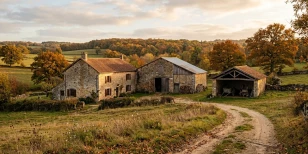
In the south of the department, towards the Ardèche gorges and Vallon-Pont-d'Arc, the country house appears as a mas built of limestone stone, under a curved-tile roof, with narrow openings that shield against summer heat. In the Cévennes ardéchoises, to the north and west, granite and schist dominate, with steeper slate roofs typical of Cévennes buildings set into hillsides. Around Vallon-Pont-d'Arc and Ruoms, limestone mas are often built around an enclosed inner courtyard, sheltered from the mistral wind. In the Cévennes ardéchoises, towards Le Cheylard or Saint-Pierreville, steeply pitched slate roofs and dark schist walls give a starker style of building, suited to the plateau's harsh winters.
The land around these houses often includes an apricot or chestnut orchard, dry-stone cultivation terraces and old outbuildings (silkworm shed, bread oven, chestnut drying rack). Many properties lie in an isolated hamlet, with open views over deep valleys. Dry-stone cultivation terraces, known locally as faisses or bancels, shape the land around Cévennes houses and long supported chestnut and vine growing. An adjoining chestnut grove, still worked on some properties, adds landscape value and sometimes a small side income.
The Rhône valley, around Annonay, Tournon-sur-Rhône and Aubenas, facing Valence, has the most active market, close to the Valence TGV station. The Ardèche gorges and the Vans basin, very popular with tourists in summer, attract second-home buyers, which supports prices around villages of character such as Balazuc or Vogüé. Privas, the county town tucked into the hills, sits away from the main roads, while Aubenas, more commercially active, anchors the south of the department with limited regional train access to Valence. The Coiron plateau, between Privas and Aubenas, offers a distinctive volcanic landscape with dark basalt houses.
The Cévennes ardéchoises, around Le Cheylard, Lamastre and the Doux valley, more remote and hilly, offer noticeably more affordable country houses, as does the Coiron plateau and the north of the department towards Boulieu-lès-Annonay. The Boutières hills and the Eyrieux valley, amid chestnut groves and peach orchards, remain popular for a modestly sized second home, while the north of the department, around Saint-Félicien and Lamastre, offers a quieter setting and more moderate prices.
Proximity to the Rhône, Valence and its TGV station weighs heavily on price, as does the condition of the building: southern stone mas require checking the watertightness of the curved-tile roof, while Cévennes schist houses can suffer from damp if the walls are not properly drained. The size of the land, especially cultivable terraces, also affects value. Clay shrink-swell risk affects some parts of the lower Vivarais and should be checked through the natural-hazard disclosure attached to any sale. Stone-slab lauze roofs, rarer but found on a few old Cévennes buildings, require specialised upkeep far more costly than a standard slate roof.
Check the private drainage system, very common in rural Ardèche, the risk of forest fire in summer, fibre-optic coverage for remote working, and local planning zoning, often restrictive on isolated Cévennes hamlets. Also check winter road access in the Cévennes ardéchoises, sometimes tricky on small ridge roads, as well as any private water catchment, common for isolated hamlets not connected to the public network.
On ma-propriete.fr, filter Ardèche country houses by budget, living space and land area, set up an email alert so you never miss a new listing, and if needed widen your search to all country houses for sale in Auvergne-Rhône-Alpes. Comparing the Rhône valley with the more remote Cévennes ardéchoises often reveals a wide price gap for a similar stone house with cultivable terraces.