

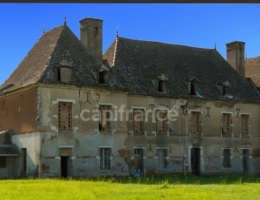
In Saône-et-Loire, a historic monument for sale in Saône-et-Loire can be a Charolais chateau in golden stone, a Cluniac priory or a fortified house in the Chalon area, protected for their Romanesque architecture, roof timbers or interior decoration. From the wine-growing Mâconnais to the Charolais hedgerow country, by way of the Cluny area and the Autun district, the department retains substantial heritage shaped by the influence of the former Cluny Abbey and the great Burgundian families. Browse the historic monuments for sale listed by private owners, agencies and notaries across Saône-et-Loire.
This page sets out the protected building types found across Saône-et-Loire, the areas where they are most numerous, the obligations and grants tied to a classified or registered building, and the checks worth making before a purchase. To approach the purchase of a character property as a whole, read our guide to buying prestige property in France.
Golden limestone from the Mâconnais clads winegrowing residences around Cluny and Tournus, while pink or grey granite from the Charolais-Brionnais dominates chateaux in the hedgerow country, often paired with flat-tile roofs. Cluniac priories retain fragments of cloisters, vaulted chapter houses and Romanesque façades with carved corbels, rare traces of the architectural influence of the former abbey. Fortified houses in the Chalon area, more modest in scale, show corner towers and moats that are today often dry. Shallow-pitched roofs covered with curved Mâconnais tiles contrast with the steeper coverings typical of the Charolais.
Outbuildings play a notable part in these protected ensembles: dovecotes, tithe barns, seigneurial chapels and farm buildings accompany most chateaux in the Charolais and the Autun district. The buildings long served cattle farming, which explains substantial barns and byres, sometimes protected alongside the main house. Interiors combine Romanesque fireplaces, old panelling and stone floors, preserved thanks to the continuous use of the residences.
The Cluny area, around Cluny and Taizé, concentrates priories and Romanesque residences in the Grosne valley; the Mâconnais, further south, between Mâcon and Tournus, offers winegrowers' houses close to the Saône. The Charolais-Brionnais, to the west, around Charolles and Paray-le-Monial, presents cattle-farming hedgerow country dotted with isolated chateaux, while the Autun district, around Autun and the Arroux valley, retains old religious and seigneurial heritage. The Chalon area, to the east, between Chalon-sur-Saône and Louhans, completes this patchwork with residences close to the Burgundian Bresse. The former mining basin, around Le Creusot and Montceau-les-Mines, adds a handful of bourgeois residences inherited from nineteenth-century industrial growth.
The department has stations served by TGV at Le Creusot and Mâcon-Loché, offering direct access to Paris and Lyon in a little over an hour; the A6 motorway crosses the area from north to south. The most sought-after areas remain the wine-growing Mâconnais and the outskirts of Le Creusot TGV, while the more rural Charolais and Autun district offer comparable monuments on more affordable terms.
Always ask whether a property is classified or registered: this distinction determines how far controls extend over future works, the whole building for a classified status, sometimes only one part for a registered one. Any work on protected elements requires the approval of the Architecte des Bâtiments de France, supported by the regional heritage office of the Bourgogne-Franche-Comté DRAC, particularly near the former Cluny Abbey. The historic-monument tax regime, which under conditions allows part of the restoration costs to be deducted, is worth confirming with a professional before any commitment.
The seller of a classified building must inform the buyer of its protected status and notify the sale to the administration, a formality the notary handles at the time of sale. Have roofing and masonry quotes prepared by qualified contractors experienced in restoring Burgundian heritage, and have the moats and foundations checked in the damper areas of the Chalon district.
Historic monument listings in Saône-et-Loire are placed by private owners, agencies specialising in heritage property and notaries; refine the search by building type, protection status and outbuildings, then set an e-mail alert to follow new listings. To compare with neighbouring departments, browse historic monuments for sale in Bourgogne-Franche-Comté.


