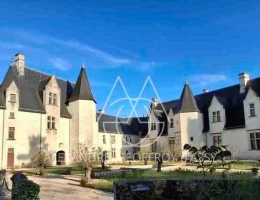
A historic monument for sale in Indre brings together varied Berry building types: a residence surrounded by ponds in the Brenne, a pink-sandstone castle in the Boischaut, a townhouse in Châteauroux or Issoudun, or a former priory on the banks of the Creuse. A land of George Sand and a thousand ponds, Indre holds a protected heritage shaped by water, local stone and a marked rural history, between hedgerow country and wide grain plains. Browse the historic monuments for sale listed by the department's private owners, agencies and notaries, from a modest residence to a more imposing castle.
This page presents the protected building types in Indre, the areas where they are most numerous, the obligations and grants tied to a classified or registered status, and the checks to make before buying. The particular features tied to the presence of water call for checks detailed further below. To approach the purchase of a character property as a whole, read our guide to buying prestige property in France.
Indre's protected buildings combine the pink sandstone of the Boischaut, used for window surrounds and corner towers, with the lighter limestone of the Châteauroux area, under flat-tile or slate roofs depending on the area. In the Brenne, residences often stand at the edge of a pond, surrounded by dykes and reed beds, while the townhouses of Châteauroux and Issoudun retain classical façades inherited from the seventeenth and eighteenth centuries.
Outbuildings vary by area: fisheries and boathouses in the Brenne, dovecotes and barns in the Boischaut, presses and cellars in the Creuse valley. Part of this heritage retains original fireplaces, floors and panelling, other buildings need the roof or masonry renewed; restorations favour local materials and careful management of water levels, particularly around old fisheries. Tree-lined driveways leading to these residences often contribute to the protected site's landscape coherence. Tree-lined driveways leading to these houses often add to the coherence of the protected site as a whole.
The Brenne, in the northwest of the department and listed as a regional nature park, concentrates residences and hunting lodges beside its many ponds, an area sought after for its calm and biodiversity. The Châteauroux area, around Châteauroux and Déols, offers a more urban heritage, while the Boischaut, around La Châtre and George Sand country, retains manors and fortified farms in hedgerow-country hills. To the east, the Champagne berrichonne, around Issoudun, offers more affordable plain residences in a more open landscape given over to large-scale farming.
Indre has no TGV station; rail access runs through Châteauroux on Intercités services to Paris, and the A20 motorway crosses the department from north to south. The fringes of the Brenne and the Creuse valley are among the most sought-after areas for their natural setting; the Champagne berrichonne, more open and further from the ponds, remains noticeably more accessible for a comparable size.
Determine first whether the building is classified or registered, since the constraints are not the same: a classified building requires the approval of the regional heritage conservation office before any intervention, while a registered building follows a declarative process with the DRAC. Within the Brenne regional nature park, works tied to ponds, dykes and reed beds are subject to specific environmental rules, in addition to the opinion of the Architecte des Bâtiments de France around any protected building, down to a simple jetty.
The buyer must be informed in writing of the protection status before the sale, a formality the notary checks, while the tax relief specific to historic monuments remains subject to conditions worth verifying case by case with a professional. Also check the watertightness of the dykes and ponds, the roof timbers and the damp levels in the sandstone walls, entrusting the works to qualified contractors familiar with protected rural buildings. Check as well any fishing rights or maintenance agreements attached to the ponds, common in this part of the Brenne. Also check fishing rights and maintenance agreements attached to the ponds, common in this part of the Brenne.
Historic monument listings in Indre are placed by private owners, agencies specialising in character properties and local notaries; filter them by type, outbuildings, area and protection status, and set an e-mail alert to hear about new listings as they appear. Several viewings, including after a spell of rain, help you better judge the condition of foundations close to the ponds. To widen your search beyond the department, browse the historic monuments for sale in Centre-Val de Loire. A visit after heavy rain often reveals more about drainage and pond management than a dry-season viewing would.