

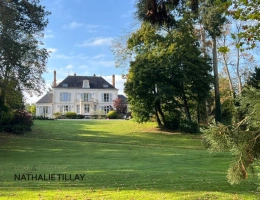
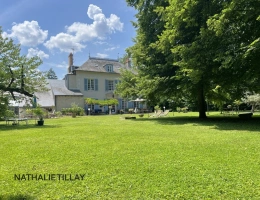

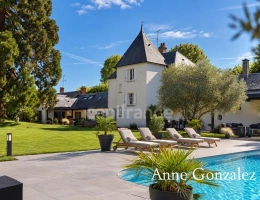
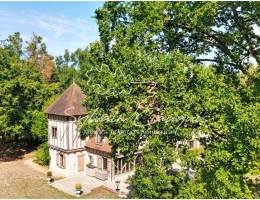
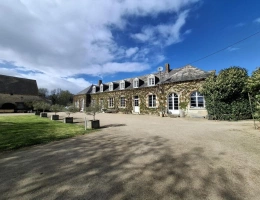
A historic monument for sale in Loiret brings together very different realities: a brick-and-stone castle on the banks of the Loire, a hunting lodge on the edge of the Sologne forest, a townhouse in old Orléans or a residence in the Gâtinais near Montargis. Crossed by the Loire and bordered by the Sologne, the department holds a protected heritage tied to the region's royal, religious and forest history, between a great river and forested ponds. Browse the historic monuments for sale listed by the department's private owners, agencies and notaries, from a lodge awaiting renovation to a residence already restored.
This page presents the protected building types in Loiret, the areas where they are concentrated, the obligations and grants tied to a classified or registered status, and the checks worth making before buying. To approach the purchase of a character property as a whole, read our guide to buying prestige property in France. Comparing several properties before committing helps gauge the real scale of works, which varies considerably from one residence to another.
Along the Loire, protected residences combine golden dressed stone with the chequerboard brick and flint typical of the Val de Loire, under slate roofs with tall attics. In the Sologne, red-brick hunting lodges and long farmhouses surrounded by ponds favour lower volumes and exposed timber framing, while the Gâtinais, around Montargis, retains plainer limestone residences inherited from the seventeenth and eighteenth centuries.
Outbuildings vary by area: ice houses and garden follies near the Loire, kennels and outhouses in the Sologne, dovecotes and barns in the Gâtinais. Many buildings retain original panelling, floors and fireplaces, others need a full renewal of the roof covering or the joinery; recent works favour local materials and insulation compatible with thick stone or brick walls, without altering the interior decoration. Parks and gardens attached to some residences, occasionally laid out in the nineteenth century, are part of the site's overall heritage value.
The Orléanais, around Orléans, Meung-sur-Loire and Beaugency, concentrates residences and lodges along the river, in an area close to the valley listed as a World Heritage site, while the Sologne, around La Ferté-Saint-Aubin and Lamotte-Beuvron, lines up lodges and ponds in dense forest country given over to hunting. Further east, the Giennois, around Gien, retains stone and brick buildings close to the Loire, and the Gâtinais, around Montargis and Châtillon-Coligny, offers more rural and more extensive properties at the edge of the Orléans forest.
Loiret has no TGV station; access runs through Orléans on Intercités or TER services to Paris, and the A10 motorway crosses the department from north to south. The immediate banks of the Loire and the Sologne close to Orléans are among the most sought-after areas; the Gâtinais and the north of the Giennois, further from the regional capital, remain more affordable for a comparable type. Market towns such as Pithiviers, to the north, occasionally list protected residences at the edge of the Gâtinais.
Carefully distinguish a classified from a registered property before planning any works: classification requires the approval of the regional heritage conservation office for every intervention, while registration follows a prior declaration to the DRAC. Within the surroundings of a protected building, including in the Sologne where garden follies and lodges are numerous, the Architecte des Bâtiments de France must approve any project involving façades, boundary walls, extensions or new construction visible from outside.
Before signing, ask a professional to clarify the conditions for applying the historic-monument tax regime, potentially attractive but subject to strict rules, and remember that the seller must disclose the property's protection status to the buyer as early as the preliminary agreement. Also ask for a check of the watertightness of the Sologne ponds and dykes, the roof timbers and rising damp near the Loire, and entrust the works to qualified contractors experienced with protected buildings. Also ask about fishing and pond-maintenance easements, common on many Sologne properties.
Historic monument listings in Loiret are offered by private owners, agencies specialising in character properties and local notaries; sort them by type, outbuildings, area and protection status, and set an e-mail alert to hear about new listings as soon as they go online. Comparing several properties before committing helps gauge the real scale of works, which varies considerably from one protected residence to another. To widen your search beyond the department, browse the historic monuments for sale in Centre-Val de Loire. A visit in wetter weather can reveal issues with pond levels and drainage that a summer viewing would miss.