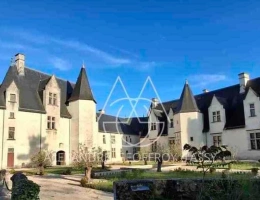
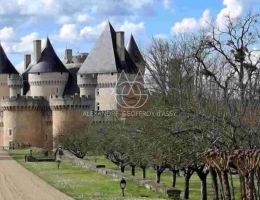
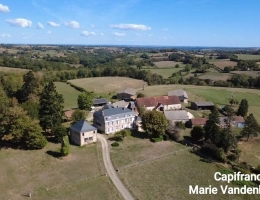
In Indre, a chateau for sale in Indre most often stands between the Boischaut, the Champagne berrichonne and the lakes of the Brenne regional nature park, a territory less well known than neighbouring Touraine but rich in old residences. The department has remodelled Renaissance residences, nineteenth-century chateaux built by great Berry families and fortified farmhouses converted into residences. Browse every chateau for sale listed by the private owners, agencies and notaries active in the department.
This page gathers real price benchmarks for large residences in Indre, the areas where they are found, the character of local buildings and the checks worth making before a purchase, whether a Champagne berrichonne residence or a property tucked among the Brenne lakes. To plan a full heritage acquisition, read our guide to buying prestige property in France.
DVF land registry data does not identify chateaux as such: the benchmarks below cover sales of houses over 300 m² of living space on 0.05 to 10 ha, above €1,000/m², tracked by our observatory. They frame the market for large residences without describing it entirely: an estate with 30 ha of parkland or a listed monument sold with its farmland falls outside this scope.
The local market is too thin to publish a reliable department-level benchmark (13 sales in five years): we give the figures for the Centre-Val de Loire region. Across the Centre-Val de Loire region, the 2025 median stands at €591,500* (52 sales), against €822,000 in France in 2025 (981 sales).
| Scope | Sales | Median price | Floor – ceiling (P10–P90) | €/m² living space (median) |
|---|---|---|---|---|
| Centre-Val de Loire (2025) | 52 | €591,500* | €400,000 – €1,098,900 | 1,570 |
| France (2025) | 981 | €822,000 | €428,000 – €3,100,000 | 2,308 |
The breakdown by stratum (coastal, rural tourist, ordinary rural) and the five-year trend are in our observatory of prestige property prices in France (in French). Before making an offer, work out purchase costs and borrowing capacity with our financial tools and calculators.
Source: DVF (DGFiP), transactions from 1 January 2021 to 31 December 2025, processed by ma-propriete.fr; prices rounded to the nearest €100. * Fewer than 100 sales: read as an indication only.
Indre buildings vary considerably with the subsoil: limestone dominates in the Champagne berrichonne, around Châteauroux and Issoudun, while brick and sandstone appear more towards the Brenne, land of a thousand lakes, where residences sit alongside fish farms. Nineteenth-century chateaux, built by families enriched by Berry farming or industry, stand alongside older Renaissance residences, some reworked in the eighteenth century. Long-pitched roofs and brick chimneys also mark some working farm chateaux in the neighbouring Boischaut, where a plainer, more functional style prevails than in the grander Loire valley to the north.
Outbuildings frequently include farm service wings, private lakes in the Brenne, a chapel or a dovecote, and sometimes a still-farmed attached property. The condition of roofs, lake dykes and foundations near wetlands should be carefully checked, as damp is a recurring issue on Brenne properties. Sunken ice houses and bread ovens, still present on some estates, point to what was once a largely self-sufficient way of life, when the property supplied most of its own food and fuel and relied very little on outside deliveries of any kind.
Properties are spread across the Champagne berrichonne around Châteauroux and Issoudun, the Brenne regional nature park to the west, known for its lakes and wildlife, and the hillier Boischaut to the south, towards La Châtre. The Creuse valley, around Argenton-sur-Creuse, forms a more picturesque area, valued for its riverside scenery. The northern Boischaut, between Levroux and Valençay, keeps a quieter rural pattern, halfway between open plain and bocage, with a mix of working farms and smaller residences set among hedgerows and orchards, closer in character to the neighbouring Boischaut than to the wide-open Champagne berrichonne farther east.
Indre has no TGV station; connections to Paris run on Intercités trains from Châteauroux or Argenton-sur-Creuse. Areas near the Brenne and the Creuse valley remain more sought-after than the farming Champagne berrichonne, more open and less prized for its setting.
Some chateaux in the department are listed or registered historic monuments; façade or roof works then require the opinion of the Architecte des Bâtiments de France. In the Brenne, the regional nature park imposes specific rules on lakes, fishing and wetlands, to be checked before any works or operating project, particularly for properties bordering the nature reserves, where seasonal water levels are managed carefully under strict oversight from the regional park authority itself.
Technically, have the dykes and sluices of lakes inspected, along with the drainage system on isolated properties, often on a private system. The heating cost of large volumes and the state of networks in rural areas deserve pricing before an offer, along with road access for the most isolated Brenne properties, which can become difficult after heavy rain in the low-lying lake country and may require a four-wheel-drive vehicle during the wettest winter weeks of the year.
Chateau listings in Indre are published by private owners, specialist agencies and notaries; you can filter them by price, living space, land area, outbuildings and the presence of lakes, then set up an e-mail alert to follow new properties coming to market. Brenne properties sit alongside the more farming-oriented residences of the Champagne berrichonne. To widen your search, browse the chateaux for sale in Centre-Val de Loire.