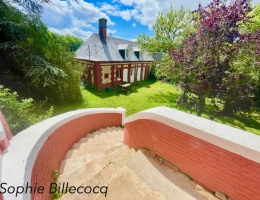
A manor house for sale in Oise most often stands on the edge of a forest, inherited from a region where court and administrative nobility built as many hunting residences as working farms. Around Compiègne, Senlis, Chantilly and Beauvais, these limestone or brick houses often still have a tree-lined approach, planted grounds and outbuildings ranged along a formal courtyard. The market ranges from residences with rebuilt roof timbers to buildings needing a full overhaul of roofs and renders. Browse the manor houses for sale listed here by the department's private owners, agencies and notaries.
This page offers real price benchmarks for these Oise residences, the areas most in demand, what characterises their architecture and the points to check before buying a gentleman's residence close to Paris. Weekend and second-home buyers from Paris compete here with local families looking for a permanent move out of the capital. To approach the purchase as a whole, read our guide to buying prestige property in France.
DVF land registry data does not identify manor houses as such: the benchmarks below cover sales of houses over 300 m² of living space on 0.05 to 10 ha, above €1,000/m², tracked by our observatory. They frame the market for large residences without describing it entirely: an estate with 30 ha of parkland or a listed monument sold with its farmland falls outside this scope.
In Oise, 123 sales were recorded from 2021 to 2025, with a median price of €770,000, a floor/ceiling range (P10–P90) of €418,400 to €1,348,000 and a median of €2,108/m² of living space, for an average of 379 m² of living space and 10,370 m² of land. Across the Hauts-de-France region, the 2025 median stands at €756,800* (79 sales), against €822,000 in France in 2025 (981 sales).
| Scope | Sales | Median price | Floor – ceiling (P10–P90) | €/m² living space (median) |
|---|---|---|---|---|
| Oise (2021-2025) | 123 | €770,000 | €418,400 – €1,348,000 | 2,108 |
| Hauts-de-France (2025) | 79 | €756,800* | €399,800 – €1,602,000 | 2,131 |
| France (2025) | 981 | €822,000 | €428,000 – €3,100,000 | 2,308 |
The breakdown by stratum (coastal, rural tourist, ordinary rural) and the five-year trend are in our observatory of prestige property prices in France (in French). Before making an offer, work out purchase costs and borrowing capacity with our financial tools and calculators.
Source: DVF (DGFiP), transactions from 1 January 2021 to 31 December 2025, processed by ma-propriete.fr; prices rounded to the nearest €100. * Fewer than 100 sales: read as an indication only.
Oise residences are readily built of soft local limestone, sometimes paired with red-brick quoins around window openings, under steeply pitched slate roofs typical of the wider Paris basin. Many of these houses stand on the edge of the great forests of Compiègne, Chantilly or Halatte, with a tree-lined drive leading to a formal courtyard flanked by low outbuildings. The style ranges from a plain rural residence to a small gentleman's residence marked by a pediment or a corner turret added in the eighteenth century. Many were remodelled again in the nineteenth century by Parisian families seeking a country retreat within reach of the city.
The outbuildings often include well-built stables, the legacy of a region long shaped by riding and stag hunting, along with barns, a dovecote and sometimes a freestanding dovecote in the grounds. A manor to renovate regularly needs roof or roof-timber work, while interior panelling and stone fireplaces remain in good condition. Recent restorations keep lime renders and favour insulation that respects old walls. Stable blocks large enough for several horses remain a genuine selling point for buyers with an equestrian project.
The Compiègne area, around the forest of Compiègne and the Aisne valley, holds a fine stock of rural houses, as does the Chantilly and Senlis district, shaped by large equestrian and forest estates. To the west, the Beauvaisis and the hillier Pays de Bray offer more secluded residences amid a damp bocage landscape, while to the south, the Oise valley, from Creil to L'Isle-Adam, keeps a dense pattern of settlement close to the Paris region. The Clermont area, between Compiègne and Beauvais, remains an in-between district, both rural and accessible.
Oise has no TGV-served station; rail access runs through Intercités and TER services to Paris-Nord from Creil, Compiègne or Beauvais, and the A1 motorway crosses the department from north to south. The most sought-after areas remain Chantilly and Senlis, close to Paris and the forest massif, while the Beauvaisis and the Pays de Bray offer comparable residences on more affordable terms. A shorter commute to Paris than most of Picardy keeps demand steadier here through changing market conditions.
Many properties in the Compiègne area and around Chantilly border state-owned forest, which means checking rights of way and clearance rules before any plan to alter the grounds. Some residences are recorded in the regional heritage inventory or stand near a listed monument, which makes exterior works subject to the opinion of the Architecte des Bâtiments de France.
Have the roof timbers and covering checked, since dry rot is regularly reported in poorly maintained roofs across the Paris basin, along with rising damp in porous limestone foundations. Check the private drainage system, often needing upgrading on isolated properties, and the status, municipal or private, of the forest or rural tracks serving the property.
Manor houses offered for sale in Oise come from private owners, agencies specialising in character properties and notaries; filter listings by price, living space, outbuildings and closeness to woodland, and set an e-mail alert to follow new properties. Given demand from Paris, well-priced listings can move quickly, so an alert is worth setting before a visit is even booked. To compare with neighbouring departments, browse the manor houses for sale in Hauts-de-France.