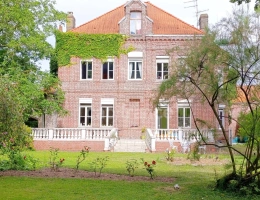
Looking for a manor house for sale in Pas-de-Calais means exploring a territory where noble houses vary widely by district: chalk and brick residences in the Artois, flint and sandstone in the Boulonnais, half-timbering in the Montreuillois. Around Arras, Saint-Omer and Montreuil-sur-Mer, these houses have often kept their entrance porch, farm outbuildings and a walled garden. Some are offered move-in ready, others need a full restoration of roofs and joinery. Browse the manor houses for sale listed here by the department's private owners, agencies and notaries.
This page gives you real price benchmarks specific to Pas-de-Calais, the most sought-after areas, what characterises the local building style and the points worth checking before buying an old residence exposed to the winds of the Côte d'Opale. Sea air and salt spray reach further inland here than in most other parts of the region, and this shapes maintenance costs. For a complete approach to buying a character property, read our guide to buying prestige property in France.
DVF land registry data does not identify manor houses as such: the benchmarks below cover sales of houses over 300 m² of living space on 0.05 to 10 ha, above €1,000/m², tracked by our observatory. They frame the market for large residences without describing it entirely: an estate with 30 ha of parkland or a listed monument sold with its farmland falls outside this scope.
In Pas-de-Calais, 110 sales were recorded from 2021 to 2025, with a median price of €613,600, a floor/ceiling range (P10–P90) of €379,700 to €1,303,000 and a median of €1,759/m² of living space, for an average of 356 m² of living space and 6,009 m² of land. Across the Hauts-de-France region, the 2025 median stands at €756,800* (79 sales), against €822,000 in France in 2025 (981 sales).
| Scope | Sales | Median price | Floor – ceiling (P10–P90) | €/m² living space (median) |
|---|---|---|---|---|
| Pas-de-Calais (2021-2025) | 110 | €613,600 | €379,700 – €1,303,000 | 1,759 |
| Hauts-de-France (2025) | 79 | €756,800* | €399,800 – €1,602,000 | 2,131 |
| France (2025) | 981 | €822,000 | €428,000 – €3,100,000 | 2,308 |
The breakdown by stratum (coastal, rural tourist, ordinary rural) and the five-year trend are in our observatory of prestige property prices in France (in French). Before making an offer, work out purchase costs and borrowing capacity with our financial tools and calculators.
Source: DVF (DGFiP), transactions from 1 January 2021 to 31 December 2025, processed by ma-propriete.fr; prices rounded to the nearest €100. * Fewer than 100 sales: read as an indication only.
In the Artois, around Arras and Béthune, houses are built in brick on a chalk plinth, with vaulted cellars cut directly into the limestone subsoil. Towards the Boulonnais and the Ternois, flint appears in the facing mixed with dressed stone, while slate roofs replace tile as you approach the sea. The layout stays plain: a rectangular main house, sometimes a projecting stair tower, and an enclosed courtyard housing a barn, a stable and a dovecote. Window shutters here are traditionally painted in muted greys or greens rather than the darker tones seen further south.
The Montreuillois stands out for its timber-framed and brick facades, inherited from a tradition close to that of neighbouring Picardy. A manor with outbuildings here often still has its dovecote, a bread oven and sometimes an ice house buried in the grounds. Old interiors, stone fireplaces and oak floors, frequently sit alongside electrics or plumbing that need full modernisation, which explains the price gap between restored residences and buildings still to be renovated. Buyers should budget for a full rewiring project on many of these houses regardless of the asking price.
Around Arras and Lens, houses sit among the farming villages of the inland Artois, while the Ternois, between Hesdin and Saint-Pol-sur-Ternoise, keeps a more rural character along the Canche. The Boulonnais, from Desvres to Samer, offers rolling countryside well suited to properties with parkland, close to Boulogne-sur-Mer. Further north, the Calaisis and the Audomarois, around Saint-Omer and its marshes, show a more scattered pattern of settlement, while the Montreuillois, from Montreuil-sur-Mer to Le Touquet, draws buyers keen on being close to the coast and the Canche estuary.
Arras, Béthune and Lens stations are linked to Paris by TGV, as are Calais-Fréthun and Boulogne; the A16 motorway runs along the coast from Calais to Somme and eases travel to the Paris region. The most expensive areas lie around Le Touquet, Montreuil-sur-Mer and the coastal Boulonnais, while the inland Artois and Ternois offer comparable built space on more moderate terms. A short drive separates most of these areas from a ferry port or the Channel Tunnel terminal, which suits cross-Channel buyers.
Many coastal and Audomarois residences fall under the Loi Littoral, which strongly restricts extensions and new construction in the municipalities concerned; check the local development plan at the town hall before any extension project. Some buildings are also recorded in the regional heritage inventory or listed as historic monuments, which makes exterior works subject to prior approval from the Architecte des Bâtiments de France.
The maritime climate calls for a close inspection of slate roofs and gutters, often tested hard by the prevailing winds, along with a check for rising damp in chalk foundations, porous by nature. Also check the private drainage of isolated properties, the stability of cellars cut into the chalk, and the status, public or private, of access tracks that sometimes cross neighbouring farmland.
Manor houses listed for sale in Pas-de-Calais come from private owners, specialist agencies and notaries; filter listings by price, size, outbuildings and proximity to the coast, and set an e-mail alert to follow new properties. Some sales are still handled through a local notary rather than an estate agency, particularly for family-owned farmhouses. To compare with neighbouring departments, browse the manor houses for sale in Hauts-de-France.