

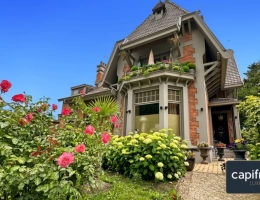
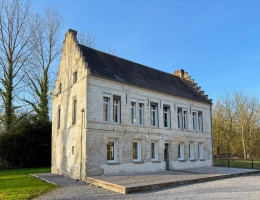
A manor house for sale in Nord is often closer to a fortified Flemish farmstead than to a château: a seigneurial residence of brick and blue stone, inherited from the large farms of the Avesnois, the Cambrésis and inland Flanders. Around Cambrai, Douai, Valenciennes and Bailleul, these houses have kept their farm outbuildings, their dovecote and their paved courtyard between two low wings. You will find both restored residences with converted outbuildings and main buildings still awaiting complete renovation. Browse the manor houses for sale listed by the department's private owners, agencies and notaries.
This page gathers real price benchmarks for these Nord residences, the areas where they are most common, what sets their brick and blue-stone construction apart, and the checks worth making on an old lowland residence. Buyers moving from a city flat to a working farmstead should expect a longer, more hands-on decision process than for an ordinary house. To prepare the purchase of a character property as a whole, read our guide to buying prestige property in France.
DVF land registry data does not identify manor houses as such: the benchmarks below cover sales of houses over 300 m² of living space on 0.05 to 10 ha, above €1,000/m², tracked by our observatory. They frame the market for large residences without describing it entirely: an estate with 30 ha of parkland or a listed monument sold with its farmland falls outside this scope.
In Nord, 161 sales were recorded from 2021 to 2025, with a median price of €732,200, a floor/ceiling range (P10–P90) of €412,000 to €1,338,500 and a median of €2,080/m² of living space, for an average of 357 m² of living space and 5,031 m² of land. Across the Hauts-de-France region, the 2025 median stands at €756,800* (79 sales), against €822,000 in France in 2025 (981 sales).
| Scope | Sales | Median price | Floor – ceiling (P10–P90) | €/m² living space (median) |
|---|---|---|---|---|
| Nord (2021-2025) | 161 | €732,200 | €412,000 – €1,338,500 | 2,080 |
| Hauts-de-France (2025) | 79 | €756,800* | €399,800 – €1,602,000 | 2,131 |
| France (2025) | 981 | €822,000 | €428,000 – €3,100,000 | 2,308 |
The breakdown by stratum (coastal, rural tourist, ordinary rural) and the five-year trend are in our observatory of prestige property prices in France (in French). Before making an offer, work out purchase costs and borrowing capacity with our financial tools and calculators.
Source: DVF (DGFiP), transactions from 1 January 2021 to 31 December 2025, processed by ma-propriete.fr; prices rounded to the nearest €100. * Fewer than 100 sales: read as an indication only.
Nord residences are first identified by their materials: red or brown brick laid in careful courses, quoins and window surrounds in blue stone quarried in the Avesnois, and steeply pitched slate or Flemish tile roofs pierced by tall dormers. The layout often follows that of the fortified farmstead: a main house flanked by outbuildings, a gate tower or corner dovecote, and a courtyard closed by a low wall and an arched gateway. These houses long served as working farm headquarters as much as family homes.
Outbuildings matter greatly to the overall value: timber-framed barns, vaulted byres, a dovecote, a bread oven and sometimes a private chapel opening onto the courtyard. A manor to renovate is regularly found in the farming villages of the Cambrésis, with roof timbers and covering to redo but original volumes and floors often preserved. Recent restorations favour lime-mortar joints, painted oak joinery and insulation suited to thick solid-brick walls. A converted barn is often used as a reception room or a separate guest wing rather than left empty.
Inland Flanders, around Bailleul, Cassel and Hazebrouck, holds a prosperous rural landscape where manor farmhouses sit alongside windmills and village belfries. Towards Dunkirk and the coastal fringe, such houses become scarcer and closer to the polders; the Douaisis and the Cambrésis, on either side of the Scarpe and the Sensée, offer lowland residences surrounded by arable land. To the south-east, the Avesnois and the French Hainaut, around Avesnes-sur-Helpe and Le Quesnoy, keep a hillier bocage landscape along the Sambre and the Helpe, with buildings typically built in blue stone.
Lille-Europe and Lille-Flandres stations are served by TGV, as are Douai, Valenciennes and Dunkirk, putting most rural areas within an hour's drive of high-speed rail; the A2 motorway links the Cambrésis to the Paris region. The area around Lille and its metropolitan fringe remains the most sought after for a manor with parkland, while the rural Avesnois and Cambrésis offer comparable built space on more accessible terms. Commuting distance to Lille is a stronger price driver here than closeness to any single town centre.
Several manor farmhouses across the department are recorded in the regional heritage inventory or protected as historic monuments: establish the exact status before any works, since the surroundings of a listed building require the approval of the Architecte des Bâtiments de France. In municipalities near the coast and the flood zones of the Scarpe, the Escaut or the Sensée, the flood-risk prevention plan strongly restricts extensions and basement works.
Have the brickwork itself checked for rising damp in old walls without a damp course, and inspect the roof timbers, since dry rot is not uncommon under poorly ventilated roofs in the region. Also check the drainage of converted farm buildings, often connected informally, and the status, municipal or private, of the rural tracks serving many of these isolated properties in open farmland.
Manor house listings in Nord come from private owners, agencies specialising in rural residences and notaries; narrow your search by price, living space, outbuildings and land, and set an e-mail alert to follow new listings. A notary sale is common for older family estates and can extend the timeline compared with an agency transaction. To widen the search to neighbouring departments, browse the manor houses for sale in Hauts-de-France.


