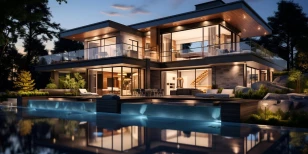


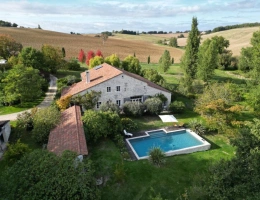
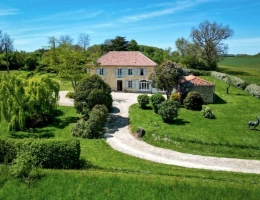


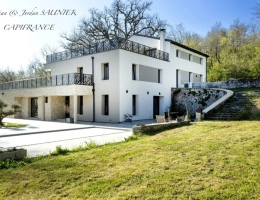
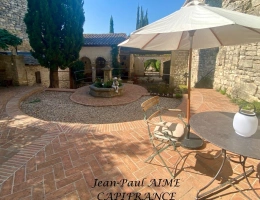
A manor house for sale in Lozère most often means a large farming manor house or a granite estate of the Gévaudan, the word manor being scarcely used in this rural, sparsely populated department. From the granite Margeride to the limestone Causses, by way of Mont Lozère and the Cévennes valleys to the south, these locally built residences combine a sturdy house with extensive farm outbuildings. Browse the manor houses for sale listed by the department's private owners, agencies and notaries.
This page brings together real price benchmarks for large residences in Lozère, the areas where they are most present, the materials of Gévaudan building tradition, and the checks to make before buying in this mid-mountain setting. Expect a market shaped by scale and remoteness rather than by proximity to a large town. To approach the whole project, read our guide to buying prestige property in France.
DVF land registry data does not identify manor houses as such: the benchmarks below cover sales of houses over 300 m² of living space on 0.05 to 10 ha, above €1,000/m², tracked by our observatory. They frame the market for large residences without describing it entirely: an estate with 30 ha of parkland or a listed monument sold with its farmland falls outside this scope.
The local market is too thin to publish a reliable department-level benchmark (0 sales in five years): we give the figures for the Occitanie region. Across the Occitanie region, the 2025 median stands at €662,500 (126 sales), against €822,000 in France in 2025 (981 sales).
| Scope | Sales | Median price | Floor – ceiling (P10–P90) | €/m² living space (median) |
|---|---|---|---|---|
| Occitanie (2025) | 126 | €662,500 | €430,000 – €1,477,000 | 1,804 |
| France (2025) | 981 | €822,000 | €428,000 – €3,100,000 | 2,308 |
The breakdown by stratum (coastal, rural tourist, ordinary rural) and the five-year trend are in our observatory of prestige property prices in France (in French). Before making an offer, work out purchase costs and borrowing capacity with our financial tools and calculators.
Source: DVF (DGFiP), transactions from 1 January 2021 to 31 December 2025, processed by ma-propriete.fr; prices rounded to the nearest €100.
In Lozère, local usage favours farming manor house or agricultural estate over the word manor: thick granite walls in the Margeride and the Aubrac, lighter limestone facades on the Causses de Sauveterre and Méjean, stone-slab or slate roofs depending on the area, built to withstand heavy winter snowfall. These residences are marked by large volumes, inherited from a long agropastoral tradition centred on cattle and sheep farming, with outbuildings often larger than the house itself.
Typical outbuildings include a hay barn, a vaulted byre, a sheepfold and sometimes a bread oven, arranged in a compact group suited to harsh winters. Most of these estates have kept a farming purpose to this day, which explains functional buildings but sometimes plain interior fittings within the house. Recent renovations favour stronger insulation, reclaimed stone slabs and thick timber joinery suited to the mountain climate. The sheer built area of some estates makes budgeting a full renovation particularly hard to pin down in advance.
The Margeride, around Saint-Chély-d'Apcher and Marvejols, and the Aubrac, towards Nasbinals, hold granite estates set apart in a landscape of plateaux and conifer forests. The Causses de Sauveterre and Méjean, around Mende and Florac, offer plainer limestone residences. The Lozère Cévennes, around Mont Lozère and Villefort, add schist houses closer to the Cévennes relief. The north of the department, towards Saint-Chély, remains the largest and most rural area. The Cévennes National Park, in the south of the department, oversees planning in part of this territory.
Lozère has no TGV station; access runs through the Cévennes line linking Mende with Clermont-Ferrand or Nîmes, or by road from the TGV stations at Montpellier or Nîmes. The most sought-after areas remain the outskirts of Mende and Marvejols, while the northern Margeride and the high Cévennes allow buyers to acquire a comparable estate for a markedly more accessible budget.
The mountain climate exposes roofs and timber frames to significant snow loads for part of the year: have the roof structure and the condition of the stone slabs or slates checked before any purchase, particularly on large barns. Part of the agropastoral building stock sits in farmland protected by the local development plan, which limits converting outbuildings into living space; check with the town hall before any change-of-use project.
Have the drainage system checked, almost always private in the department's isolated hamlets, the condition of electrical and heating networks, often old in these large estates, and any damp in the very thick granite walls. Winter access along rural tracks that can be snow-covered should be planned for, as should snow-clearing responsibility, which falls to the municipality or the owner depending on the road. Also check mobile and broadband coverage, which can still be limited in the most isolated plateau hamlets.
Manor house and farming estate listings in Lozère are placed by private owners, local agencies and notaries, whose knowledge of remote hamlets and access routes is often decisive; filter them by price, living space, land and outbuildings, and set an e-mail alert to follow new listings. To compare with neighbouring Aveyron, Gard or Haute-Loire, browse the manor houses for sale in Occitanie.