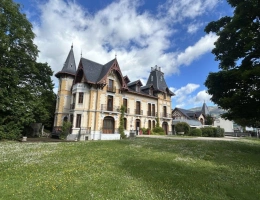
A manor house for sale in Ariège sits within a Pyrenean landscape where the word manor is seldom used: local usage prefers fortified house, seigneurial residence or gentleman's residence, often tied to the old iron-forging economy that shaped the department into the nineteenth century. From the Ariège valley around Foix to the Couserans around Saint-Girons, by way of the Pays d'Olmes, these schist or granite residences sit at the foot of the mountains, surrounded by meadows and woodland. Browse the manor houses for sale listed by the department's private owners, agencies and notaries.
This page presents real price benchmarks for large residences in Ariège, the valleys where they are most common, the materials of this mountain building tradition, and the checks specific to a secluded Pyrenean residence. To prepare calmly for this kind of purchase, read our guide to buying prestige property in France.
DVF land registry data does not identify manor houses as such: the benchmarks below cover sales of houses over 300 m² of living space on 0.05 to 10 ha, above €1,000/m², tracked by our observatory. They frame the market for large residences without describing it entirely: an estate with 30 ha of parkland or a listed monument sold with its farmland falls outside this scope.
The local market is too thin to publish a reliable department-level benchmark (14 sales in five years): we give the figures for the Occitanie region. Across the Occitanie region, the 2025 median stands at €662,500 (126 sales), against €822,000 in France in 2025 (981 sales).
| Scope | Sales | Median price | Floor – ceiling (P10–P90) | €/m² living space (median) |
|---|---|---|---|---|
| Occitanie (2025) | 126 | €662,500 | €430,000 – €1,477,000 | 1,804 |
| France (2025) | 981 | €822,000 | €428,000 – €3,100,000 | 2,308 |
The breakdown by stratum (coastal, rural tourist, ordinary rural) and the five-year trend are in our observatory of prestige property prices in France (in French). Before making an offer, work out purchase costs and borrowing capacity with our financial tools and calculators.
Source: DVF (DGFiP), transactions from 1 January 2021 to 31 December 2025, processed by ma-propriete.fr; prices rounded to the nearest €100.
In Ariège, local usage favours the fortified house or the seigneurial residence over the word manor: massive buildings with thick walls of schist, gneiss or granite depending on the valley, small openings to resist the mountain cold, and steeply pitched slate roofs in the Couserans and Séronais. Several of these residences are linked to the department's former metalworking industry, forges and hammer mills having employed forge-master families housed apart from the villages. The Pays d'Olmes, further south, keeps more modest residences, closer to the area's former textile trade.
The outbuildings include barns, vaulted byres and sometimes a bread oven, arranged around a courtyard tightened by the mountain terrain. Many of these houses were occupied into the twentieth century by farming or forge-working families, which explains plain interior fittings and roof timbers needing renewal, but also well-preserved original floors and fireplaces. Recent renovations favour local slate, lime renders and joinery suited to the mountain climate. A number of owners have converted a former forge outbuilding into a workshop or guest accommodation while keeping the original hearth and bellows pit visible.
The Ariège valley, around Foix, Tarascon-sur-Ariège and Varilhes, holds most of the residences within under an hour's drive of Toulouse. The Couserans, around Saint-Girons and Saint-Lizier, and the upper Salat valley offer more secluded houses set in steep, narrow valleys. The Pays d'Olmes, between Lavelanet and Mirepoix, and the Séronais complete the picture with residences near more sparsely populated rural areas. Areas close to the Haute-Garonne border remain the most sought-after among Toulouse-based buyers. Further south, the high valleys near Ax-les-Thermes and the Vicdessos add a handful of mountain residences prized for their views but harder to reach in winter.
Ariège has no TGV station; rail access runs through Intercités and TER services to Toulouse, under an hour from Foix, or through Toulouse-Matabiau station for high-speed connections. The most expensive areas remain those close to Foix and the Haute-Garonne border, while the Couserans and the Pays d'Olmes, further out, allow buyers to acquire a comparable mountain residence for a more modest budget. Road access via the RN20 shapes travel times across the whole department more than the rail network does.
The Pyrenean terrain exposes some areas to land movement and flash-flood risk: consult the municipality's natural risk prevention plan before any extension or outbuilding project near a watercourse. Several residences linked to the former forge industry sit in a zone protected for its industrial heritage or near a listed site, which can govern exterior works; check with the local planning office for any requirement of approval from the Architecte des Bâtiments de France.
Have the slate roof checked, often old, along with damp in the very thick schist walls, and the drainage system, usually private in mountain hamlets. Winter access via narrow rural roads or tracks should be planned for, as should the status, municipal or private, of the routes serving the most isolated plots. Ask about any former mining or quarrying activity nearby, since a handful of communes in the department carry a legacy land record worth checking before purchase.
Manor house and fortified-house listings in Ariège come from private owners, agencies specialising in character properties and notaries; filter them by price, living space, land and outbuildings, and set an e-mail alert to follow new listings. To compare with neighbouring Haute-Garonne, Gers or Hautes-Pyrénées, browse the manor houses for sale in Occitanie.