
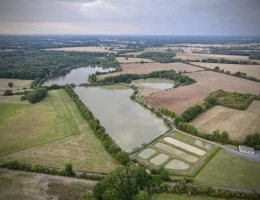
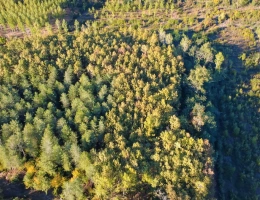
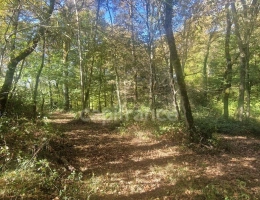
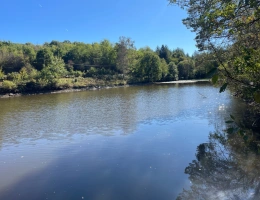
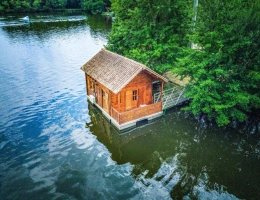
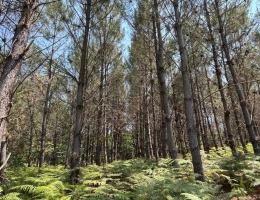
A hunting property for sale in Charente rarely looks like the large fenced estates of Sologne: the department combines medium-sized woods, hedged farmland and broad arable plains. In the east, the Charente limousine, around Confolens, Chabanais and Montembœuf, is granite country where roe deer and wild boar find hedgerows, chestnut groves and wooded valleys. To the south, the maritime pines and oaks of the Double saintongeaise reach the countryside around Brossac and Baignes-Sainte-Radegonde. In between, the limestone Angoumois, the Ruffécois and the Cognac country are better suited to small game. The hunting estates and shooting grounds for sale on this page range from a wood of a few hectares to a wooded estate with a house, listed by private sellers, estate agents and notaires.
Further down, you will find the prices actually paid for woods and ponds in Charente, the big game culls published by the French Biodiversity Agency (OFB), and our advice on examining a shoot before you commit: how hunting is organised locally, the cull plan, game damage and fencing. Our article on forest price trends in Nouvelle-Aquitaine puts these figures in context.
A hunting estate is rarely valued with a single figure: its price adds up the value of the woodland, the ponds, the buildings and the shooting facilities. The statistics below give benchmarks for wooded land and ponds, based on sales actually recorded.
According to the ma-propriete.fr forest price observatory, built from sales recorded in the French DVF land registry database, the median price of a hectare of forest in Charente was €2,147/ha in 2025*, across 55 sales, with an average of €3,015/ha. That puts the department below the Nouvelle-Aquitaine median (€3,995/ha) and below the national median (€4,936/ha). Year on year, the departmental median moved by −10.1%: a change to read with caution on fewer than a hundred sales, where a few large estates can shift the median. Over the more robust 2020-2025 period, 274 sales give a median of €2,443/ha for a median plot size of 4.4 ha.
| Indicator | Charente (16) | Nouvelle-Aquitaine | France |
|---|---|---|---|
| Median price 2025 | €2,147/ha* | €3,995/ha | €4,936/ha |
| Average price 2025 | €3,015/ha* | €4,688/ha | €6,214/ha |
| Number of sales 2025 | 55 | 1,450 | 6,329 |
| Change in median 2024 → 2025 | −10.1%* | +5.5% | +1.9% |
| Median price 2020-2025 | €2,443/ha | €3,684/ha | €4,778/ha |
| Number of sales 2020-2025 | 274 | 8,009 | 35,100 |
Nationally, the price per hectare rises with size: the large properties that appeal to hunters sell for more per hectare than medium-sized woods.
| Size of forest sold (France, 2020-2025) | Median price | Number of sales |
|---|---|---|
| 10 to 20 ha | €4,010/ha | 3,161 |
| 20 to 50 ha | €5,330/ha | 1,850 |
| 50 to 100 ha | €6,810/ha | 581 |
| Over 100 ha | €7,361/ha | 320 |
Ponds trade at a very different level: a median of €15,589/ha for the 16 ponds sold without buildings in Charente between 2020 and 2025†, a sample too small to be representative; regionally, the median reaches €18,535/ha.
On the listings side, 18 hunting properties are offered on ma-propriete.fr across France as of 2 October 2026, 1 of them in Nouvelle-Aquitaine. Their median asking price is €888,000 for a median size of about 68 ha. These are asking prices for complete properties: they describe the supply on offer more than the average price of a wooded hectare.
* 30 to 99 sales: indicative value. † 10 to 29 sales: sample too small to be representative of the local market. Source: DVF (French tax authority), processed by ma-propriete.fr; forests of 1 ha or more, cadastral type woodland; ponds without buildings of at least 2,000 m²; July 2020 to December 2025; Moselle, Bas-Rhin and Haut-Rhin are not covered by DVF. Listings recorded on ma-propriete.fr on 2 October 2026.
The game bag records published by the French Biodiversity Agency (OFB) measure hunting pressure and, indirectly, the presence of big game. In Charente, 334 red deer were taken in the 2024-2025 season, about 0.4% of the national total, alongside 9,042 roe deer and 8,324 wild boar.
| Species | 2021-2022 season | 2024-2025 season | Change |
|---|---|---|---|
| Red deer | 233 | 334 | +43% |
| Roe deer | 9,219 | 9,042 | −2% |
| Wild boar | 7,118 | 8,324 | +17% |
Source: OFB, wild ungulates network, departmental big game bags (total culls, data published on data.gouv.fr).
On the crystalline soils of the Confolentais, the landscape breaks with the rest of the department: meadows grazed by Limousin cattle, thick hedges, and oak and chestnut woods clinging to the slopes of the Vienne valley and its tributaries. Roe deer and wild boar are hunted in driven days, often over ground shared between several owners; red deer, whose cull has risen markedly in Charente, now feature in some bags as well.
Further west, between Angoulême and La Rochefoucauld, the state forest of La Braconne and the adjoining Bois Blanc form the main woodland block in the centre of the department, on a limestone plateau pitted with karst sinkholes. They are not for sale, the hunting there being let by the National Forests Office (ONF), but their oak and pine stands resemble those of the private woods around them. To the east, the hedged country carries on across the departmental boundary, and hunting estates in Haute-Vienne are worth comparing.
In South Charente, the Double saintongeaise brings maritime pine, pedunculate and Pyrenean oak, wet heath and ponds formed on impermeable soils. Roe deer and wild boar are driven there and woodcock shot in winter; part of the area is designated under Natura 2000 for its peat bogs, so ask what commitments attach to the plots.
The centre and west look quite different. On the plains of the Ruffécois and the Rouillacais, as in the Cognac vineyards, small game dominates: partridge, pheasant and hare, the last of these managed under local plans in the Ruffécois, the Rouillacais and north of Angoulême, based on counts and a compulsory bag record (carnet de prélèvement). Woods are scattered in copses, and a hunting ground here often comes with a Charente farmhouse, a farm or a block of farmland.
Start with how hunting is organised locally. Unlike neighbouring Charente-Maritime, Charente has very few ACCAs, the communal hunting associations created by the Verdeille Act of 1964: hunting relies mainly on village hunting societies, to which owners contribute their land, and on private shoots. Ask the seller which leases or agreements are in force and when they expire.
Here the cull plan (plan de chasse) covers red, fallow and roe deer, with three-season allocations for red and roe deer, and each animal taken must carry its tag before it is moved. For wild boar, the federation dropped tagging in 2025 but requires every animal shot to be declared within 48 hours. Ask for the allocations and actual culls of recent seasons. Wild boar, taken in growing numbers in Charente, damage crops, and that damage is compensated by the departmental hunters’ federation out of hunters’ own contributions; a shoot thought to be under-hunted soon draws complaints from neighbouring farmers.
Finally, look at the fencing. If a wood is ringed with mesh meant to hold big game, the act of 2 February 2023 applies: in natural and forest zones, a fence must let wildlife through, with its bottom edge 30 cm off the ground and a maximum height of 1.20 m, and fences put up in the thirty years before the act must be brought up to standard before 1 January 2027. Our article on bringing hunting fences into compliance sets out the exceptions; the cost of the work belongs in the negotiation before you make an offer.
The Charente hunting estates, woods and shoots listed on ma-propriete.fr come from private sellers, estate agents and notaires’ offices; sort them by size or budget and switch on an e-mail alert to hear about new listings. Selling? Post your own listing. If the woodland matters more than the game, browse our forests for sale in Charente or our lakes and ponds for sale in Charente, and to widen the search, see the hunting properties for sale in Nouvelle-Aquitaine.