
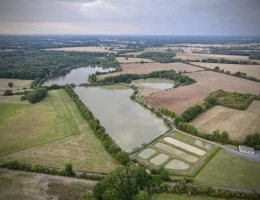
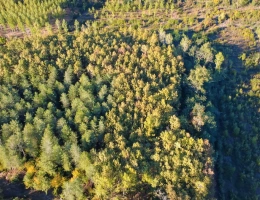
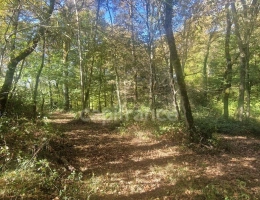
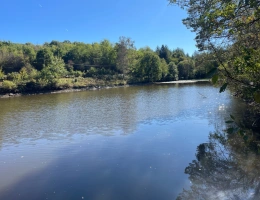
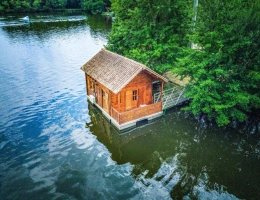
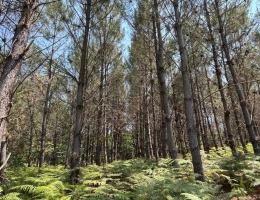
The market for a hunting property for sale in Lot-et-Garonne follows the lie of a department crossed by both the Garonne and the Lot. In the south-west, the Landes de Lot-et-Garonne, around Casteljaloux and Houeillès, belong to the great Landes de Gascogne forest: maritime pine, sandy soils and big game. In the north-east, the Fumélois and the Lémance valley, where the Bouriane of Quercy spills over into the department, form the other heavily wooded sector, with oak, chestnut and pine on more broken ground. In between, the Pays de Serres, the Néracais and the river valleys alternate orchards, arable land and more scattered woods. This page brings together the hunting properties and shoots for sale in the department, listed by private sellers, estate agents and notaires.
Below this introduction you will find the prices of woods and ponds recorded in the department, the game bag figures published by the French Biodiversity Agency (OFB), and then the points to examine before an offer, from the cull plan to fencing. If your project combines hunting and forestry, our article on the tax treatment of woods and forests will help you anticipate transfer duties and annual taxes.
A hunting estate is rarely valued with a single figure: its price adds up the value of the woodland, the ponds, the buildings and the shooting facilities. The statistics below give benchmarks for wooded land and ponds, based on sales actually recorded.
According to the ma-propriete.fr forest price observatory, built from sales recorded in the French DVF land registry database, the median price of a hectare of forest in Lot-et-Garonne was €5,036/ha in 2025*, across 95 sales, with an average of €5,504/ha. That puts the department above the Nouvelle-Aquitaine median (€3,995/ha) and above the national median (€4,936/ha). Compared with 2024, the median changed by +3.4%, a movement to interpret with care given the number of sales. Over the more robust 2020-2025 period, 531 sales give a median of €4,819/ha for a median plot size of 2.5 ha.
| Indicator | Lot-et-Garonne (47) | Nouvelle-Aquitaine | France |
|---|---|---|---|
| Median price 2025 | €5,036/ha* | €3,995/ha | €4,936/ha |
| Average price 2025 | €5,504/ha* | €4,688/ha | €6,214/ha |
| Number of sales 2025 | 95 | 1,450 | 6,329 |
| Change in median 2024 → 2025 | +3.4%* | +5.5% | +1.9% |
| Median price 2020-2025 | €4,819/ha | €3,684/ha | €4,778/ha |
| Number of sales 2020-2025 | 531 | 8,009 | 35,100 |
Nationally, the price per hectare rises with size: the large properties that appeal to hunters sell for more per hectare than medium-sized woods.
| Size of forest sold (France, 2020-2025) | Median price | Number of sales |
|---|---|---|
| 10 to 20 ha | €4,010/ha | 3,161 |
| 20 to 50 ha | €5,330/ha | 1,850 |
| 50 to 100 ha | €6,810/ha | 581 |
| Over 100 ha | €7,361/ha | 320 |
Ponds trade at a very different level: with too few sales in Lot-et-Garonne, the benchmark is the regional median of €18,535/ha for ponds sold without buildings between 2020 and 2025.
On the listings side, 18 hunting properties are offered on ma-propriete.fr across France as of 2 October 2026, 1 of them in Nouvelle-Aquitaine. Their median asking price is €888,000 for a median size of about 68 ha. These asking prices apply to complete properties, often with buildings, a pond or hunting rights: they cannot be compared directly with DVF medians per hectare.
* 30 to 99 sales: indicative value. Source: DVF (French tax authority), processed by ma-propriete.fr; forests of 1 ha or more, cadastral type woodland; ponds without buildings of at least 2,000 m²; July 2020 to December 2025; Moselle, Bas-Rhin and Haut-Rhin are not covered by DVF. Listings recorded on ma-propriete.fr on 2 October 2026.
The game bag records published by the French Biodiversity Agency (OFB) measure hunting pressure and, indirectly, the presence of big game. In Lot-et-Garonne, 346 red deer were taken in the 2024-2025 season, about 0.4% of the national total, alongside 8,048 roe deer and 7,691 wild boar.
| Species | 2021-2022 season | 2024-2025 season | Change |
|---|---|---|---|
| Red deer | 322 | 346 | +7% |
| Roe deer | 7,024 | 8,048 | +15% |
| Wild boar | 5,141 | 7,691 | +50% |
| Fallow deer | 68 | 55 | −19% |
Source: OFB, wild ungulates network, departmental big game bags (total culls, data published on data.gouv.fr).
In the south-west of the department, the Landes forest is first and foremost a production forest: maritime pine is planted, thinned and harvested on a regular cycle, so a hunting ground changes character with each clear-fell and replanting. Young plantations draw roe deer, older stands and damp hollows shelter wild boar, and red deer are part of the bag. As everywhere in France, red, fallow and roe deer here come under the cull plan (plan de chasse), which governs what each shoot may take.
Forest tracks and firebreaks make driven days and vehicle access easier, but the forest remains exposed to wildfire: the use of fire is regulated and, in the communes at risk, the surroundings of buildings must be kept clear of undergrowth. In autumn, the woodpigeon passage also brings some of the area’s pigeon hides (palombières) to life. The forest runs on without a break into the neighbouring department, and hunting properties in the Landes, on identical soils and stands, provide a useful benchmark.
In the north-east, in the Fumélois, wild boar and roe deer are the main quarry, and properties often combine woodland, meadows and stone buildings. Between the Lot and the Garonne, the Pays de Serres lines up flat-topped limestone ridges cut by steep little valleys, where hillside woods, hedges, cereals and orchards interlock. This is roe deer, hare and partridge country, where a coherent shoot is often put together by coming to terms with the neighbours or with the village hunting society. In the Garonne and Lot valleys, poplar plantations, gravel pits and riverbanks offer some wildfowling, and wild boar frequent the maize fields.
ACCAs, the communal hunting associations set up under the Verdeille Act, cover only a small part of Lot-et-Garonne: hunting rests mainly on village societies and private shoots. Before buying, find out who hunts the land today, under what arrangement, and what will become of that arrangement after the sale.
Cull plan allocations set a minimum and a maximum number of animals for each shoot: ask for those of recent seasons and how far they were met. Hunting enclosures, for their part, are subject to a separate regime.
Enclosures are precisely where the difficulty lies: the act of 2 February 2023 requires fences in natural or forest zones to be raised 30 cm off the ground, to stay below 1.20 m and to let wild animals move freely; mesh fences put up in the thirty years before the act have until 1 January 2027 to comply. For an enclosed shoot, the whole way the ground is run may change: our feature on the law against fencing off natural areas explains where things stand. Finally, ask the seller about wild boar damage around the property: boar culls have risen sharply in the department, and the species weighs on relations with farmers.
On ma-propriete.fr, hunting properties in Lot-et-Garonne are listed by their owners, by rural estate agents and by notaires; filter them by size and price, and let an alert tell you about each new listing. For a woodland-led project, see also our woods and pine forests for sale in Lot-et-Garonne; to compare with neighbouring departments, look at the shooting grounds for sale in Nouvelle-Aquitaine. Own a hunting wood? Post your listing.