



Looking for a poultry farm for sale in Lozère leads to a department where birds rarely take the leading role. Cattle and sheep dominate the livestock scene, and poultry usually appears as a secondary enterprise: one or two broiler farm buildings, chickens and guinea fowl kept outdoors, sometimes a batch of laying hens whose table eggs are sold at the gate, at market or to holiday accommodation. The offers gathered here come from farmers preparing a handover, from rural agencies and from notaries, describing the buildings, the range and the marketing channel. They add to the wider picture of poultry farms for sale.
Beyond the listings, you will find here what farmland is worth in Lozère, the areas where holdings come up, how to judge a building exposed to an upland climate, and the controls every incoming farmer has to satisfy. To prepare a setting-up project, our white paper « Créer une exploitation agricole » (in French) sets out the path from the agricultural qualification to the business forecast.
Land remains the largest item when buying a poultry farm. According to sales recorded by the French tax administration (DVF, vineyards excluded), the median price of agricultural land in Lozère (48) stood at €3,079/ha in 2025, with an average of €3,523/ha across 18 sales; 80% of transactions fall between €1,858 and €6,253/ha, against a national median of €5,307/ha. * Fewer than 30 recorded sales: indicative value.
The SAFER benchmark of land values (2025 figures) puts vacant land and pasture at €4,330/ha (-21.0% year on year, +14.9% over ten years), against a national average of €6,460/ha; land already let sells around 17% lower.
Altitude and access govern what the tool is worth here. You examine the insulation, the air tightness, the heating system and its winter cost, the ventilation, the strength of the roof under snow, the fencing of the ranges. Then come the access track and whether a lorry can use it in any season, how the buildings of a chicken farm sit within the yard, and the customer base built up through direct selling. Our land price observatory and our financial calculators help put a figure on each of those items.
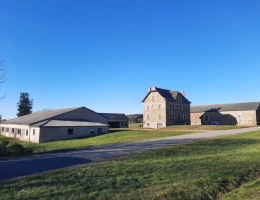
Poultry houses here tend to be short, well insulated and sited out of the wind, next to the cattle shed or in a converted farm building. Buyers look at the frame and its capacity to carry a snow load, the insulation of the walls, the heating system and what it consumes, ventilation and moisture control, the silos and feed line, the floor, the biosecurity entry room and the store. Mobile huts and range shelters, common on small outdoor units, are valued with the rest of the equipment. Whether a proper clean-out period can be kept between batches is worth checking even on modest flocks.
Almost no holding in the department lives on poultry alone: the unit sits inside a system where the herd and the forage area make most of the income. Overall value therefore depends as much on the land, the existing livestock buildings and the dwelling house as on the poultry house itself. Where a whole farm changes hands, ask for each component to be priced separately: a buyer who intends to keep only the poultry enterprise needs to know what is really being paid for the tool.
Handovers fall into four very different settings. The Aubrac and the Margeride, around Saint-Chély-d'Apcher, Marvejols and Langogne, offer extensive livestock farms where poultry stays incidental but buildings are plentiful. The causses, from Sauveterre to the Méjean, bring large, water-thrifty holdings set apart from the villages. The Cévennes side, towards Florac and Le Pont-de-Montvert, shelters small units strongly geared to direct selling. The Lot valley, around Mende and Chanac, concentrates the population, and with it the customers and part of the demand for land.
This remains one of the least populated departments in the country: local outlets are thin outside the season, and the turnover of farm-scale units leans heavily on summer visitors and country markets. A holding on a through road or close to a market town sells its output better than an isolated farm, and asking prices reflect that.
Even a modest flock falls under animal health rules: registration of the keeper, a flock register, a biosecurity plan suited to the site, fenced ranges and the ability to house birds indoors during an avian influenza alert. Above a given flock size the unit enters the classified installations nomenclature, under declaration, registration or authorisation as the case may be, and a change of operator must be brought to the prefecture's attention. Ask for the manure spreading plan too, and check storage capacity, which here has to be sized for a long winter.
A large share of the department lies within environmental designations and the listed Causses and Cévennes area, which governs outdoor works, extensions and the appearance of buildings: enquire at the town hall before planning any construction. Rented parcels follow the rural lease, which the owner has to agree to transfer, with the structures control, the French authorisation regime for farmland, and SAFER coming next. Snow cover and distance from services also justify checking the electricity supply and whether a standby generator is in place.
The holdings shown here are put on the market by private sellers, by rural estate agencies and by notaries. Filters on area, price and production isolate what interests you, from a small egg farm to a free-range poultry unit attached to a livestock farm, and an e-mail alert keeps you posted on new entries. Carry your search on with the poultry farms for sale in Occitanie.